Seu plano de estudos · Continuar · Revisar →
Drill: build 被 sentences
IntroduzidoSua posição salva fica neste navegador. Retomar não conclui a lição nem responde às perguntas.
Something happened to it
- Exam pieces: (passive: by)被 · I / me我(modifier / structural particle)的 · 偷走(completed / change)了 · bicycle自行车 → I / me我(modifier / structural particle)的bicycle自行车(passive: by)被偷走(completed / change)了。 — "My bike was stolen."
- Goal: build (passive: by)被 sentences from word pieces, and switch between (把: marks the object)把 and (passive: by)被.
The (passive: by)被 frame
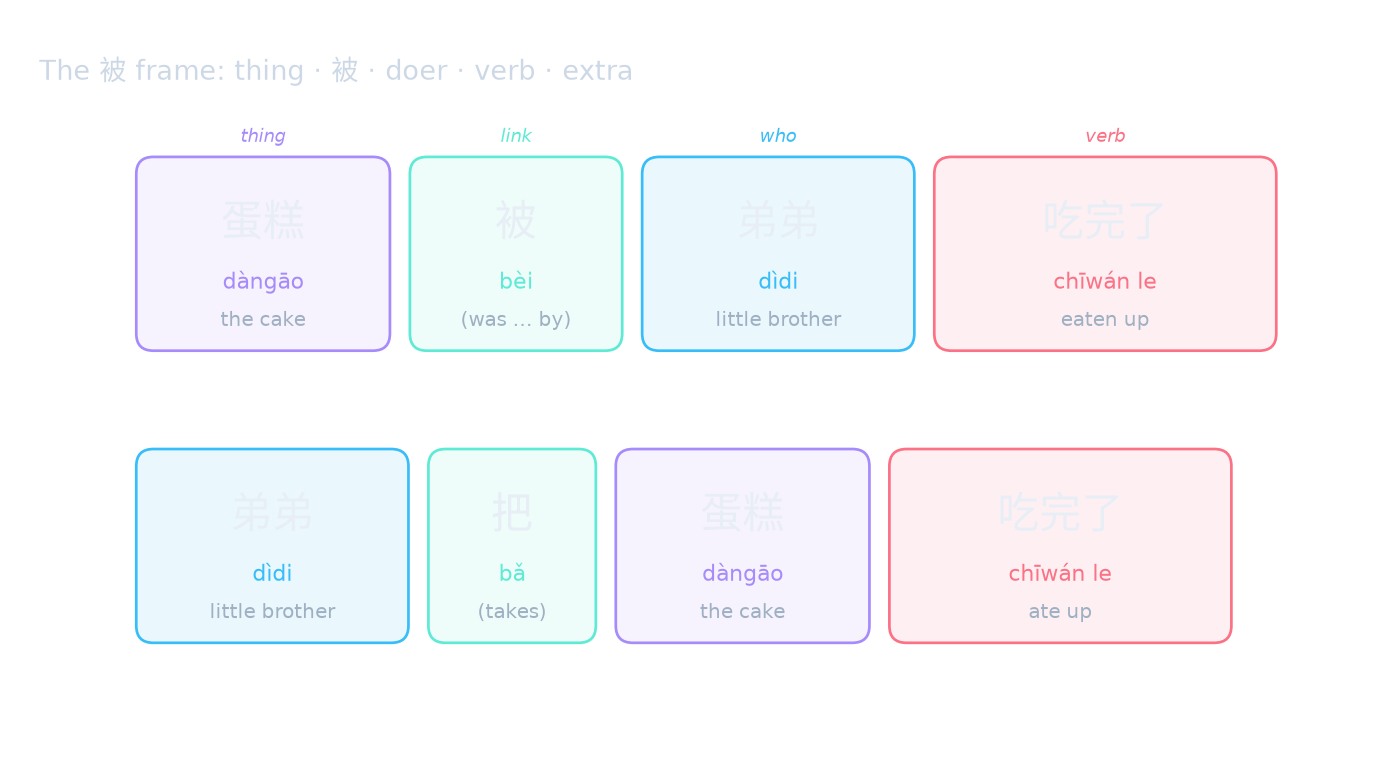
- Thing + (passive: by)被 + (doer) + verb + extra: the sentence starts with what was affected. The doer can be left out.
- cake蛋糕(passive: by)被younger brother弟弟to eat吃to finish完(completed / change)了。 — "The cake was eaten up by my little brother." window窗户(passive: by)被风吹to open; to drive开(completed / change)了。 — "The window was blown open by the wind."
the cake蛋糕(was … by)被little brother弟弟eat up吃完了。
Build: “My bike was stolen.”
Dificuldade 3/5 · Moedas 200 + pequeno bônus na primeira conclusão hoje
Thing + 被 + verb + result.
Build: “The window was blown open by the wind.”
Dificuldade 3/5 · Moedas 200 + pequeno bônus na primeira conclusão hoje
Thing + 被 + doer + verb + result.
Switch (把: marks the object)把 ↔ (passive: by)被
- younger brother弟弟(把: marks the object)把cake蛋糕to eat吃to finish完(completed / change)了。 (the doer first) ↔ cake蛋糕(passive: by)被younger brother弟弟to eat吃to finish完(completed / change)了。 (the thing first). Same verb and extra; swap the two people / things and (把: marks the object)把 ↔ (passive: by)被.
- (passive: by)被 often reports something unwanted: (passive: by)被to steal偷(completed / change)了, (passive: by)被to break打破(completed / change)了, (passive: by)被to criticize批评(completed / change)了.
Change to a 被 sentence. 小狗把我的鞋咬坏了。
Dificuldade 1/5 · Moedas 100 + pequeno bônus na primeira conclusão hoje
The thing (我的鞋) moves to the front; 把 becomes 被.
Change to a 把 sentence. 杯子被妹妹打破了。
Dificuldade 1/5 · Moedas 100 + pequeno bônus na primeira conclusão hoje
The doer (妹妹) goes first with 把.
Same traps as (把: marks the object)把
- not / haven't没 / already已经 / again又 go before (passive: by)被: ✓ I / me我(modifier / structural particle)的mobile phone手机not / haven't没(passive: by)被to take away拿走 ✗ I / me我(modifier / structural particle)的mobile phone手机(passive: by)被not / haven't没to take away拿走.
- The verb needs an extra: ✗ bicycle自行车(passive: by)被to steal偷 → ✓ bicycle自行车(passive: by)被to steal偷(completed / change)了 / (passive: by)被to steal偷to walk走(completed / change)了.
Which sentence is correct?
Dificuldade 1/5 · Moedas 100 + pequeno bônus na primeira conclusão hoje
没 goes before 被.
Build: “He was criticised by the teacher again.”
Dificuldade 3/5 · Moedas 200 + pequeno bônus na primeira conclusão hoje
又 before 被.
Recap
- Thing + (not / haven't没 / already已经) + (passive: by)被 + (doer) + verb + result / (completed / change)了.
- (把: marks the object)把: doer first. (passive: by)被: thing first. The rest stays the same.
Build: “The tickets have already been sold out.”
Dificuldade 3/5 · Moedas 200 + pequeno bônus na primeira conclusão hoje
已经 + 被 + verb + result.
Build: “That book was borrowed by a classmate.”
Dificuldade 3/5 · Moedas 200 + pequeno bônus na primeira conclusão hoje
Thing + 被 + doer + verb + result.
Tell a friend about a bad morning. Say two things that happened to your things with 被, then say one of them again with 把.
Your answer need not copy the model. A partner or teacher must hear the spoken response to comment on pronunciation.