Argumentos verbais: suposições, causas alternativas e direção da evidência
Introduzido| English | Significado |
|---|---|
| alternative cause/ɔːlˈtɜːnətɪv kɔːz/ | causa alternativa |
| negation/nɪˈɡeɪʃn/ | negação |
After a change is not yet because of it
- Fictional argument: “After the town installed brighter streetlights, reported burglaries fell from 100 to 70. Therefore the lights helped reduce actual burglaries.” The timing is relevant, but it leaves a gap between the records and the causal conclusion.
- This lesson uses invented examples and numbers. Practise identifying the exact conclusion, asking what connects it to the evidence, and judging how additional information changes that connection.
Separate observation from conclusion
- Observation: the recorded count fell by 30 out of 100, or 30%. Conclusion: the lights contributed to a fall in actual burglaries. A reported count and an actual incident count are different quantities.
- The observation alone does not establish what would have happened without the lights. That missing comparison matters to a causal claim, even when the before-and-after arithmetic is correct.
Keep the target conclusion precise
- “The lights contributed to the fall” allows other influences. “The lights alone caused the entire fall” is stronger. Evidence of another cause may weaken the original support without proving that the lights had no effect.
- Strengthening makes the inference better supported; weakening makes it less well supported. Neither task normally requires a proof that the conclusion is certainly true or certainly false. Judge the stated claim rather than a stronger one you invented.
Which conclusion permits both streetlights and increased patrols to contribute to the same decline?
Dificuldade 1/5 · Moedas 100 + pequeno bônus na primeira conclusão hoje
Contributed allows multiple influences. Alone, entirely and no other factor are stronger claims excluding other contributions.
Look for another possible explanation
- An alternative cause 其他原因 is a different factor that could help explain the observed change. If police patrols also doubled and began covering previously unpatrolled streets, the fall need not be attributed only to the lights.
- That information raises a competing explanation; it does not by itself measure the patrols' effect. Unchanged patrol numbers would rule out that particular increase, not every possible change in policing or every other cause.
Hypothetical argument: after brighter streetlights were installed, reported burglaries fell from 100 to 70; therefore the lights contributed to a fall in actual burglaries. Which new fact most weakens that inference among these choices?
Dificuldade 1/5 · Moedas 100 + pequeno bônus na primeira conclusão hoje
The patrol change supplies a plausible competing explanation for the decline. It weakens attribution to the lights from the before-and-after count, but does not prove patrols caused the entire change or that lights had no effect.
Ask what the records measure
- Imagine one record per incident before the change: 100 actual burglaries produce 100 records. Afterwards, 70 actual burglaries all recorded would produce 70 records. So would 100 actual burglaries with only 70 recorded.
- Both invented accounts fit the same recorded fall. The second shows why reporting completeness matters; it does not establish that under-recording actually occurred. Even a genuine fall in incidents still needs evidence about what caused it.

A fall from 100 recorded burglaries to 70 proves that actual burglaries fell, even with no information about recording coverage.
Dificuldade 1/5 · Moedas 100 + pequeno bônus na primeira conclusão hoje
The same records can arise from fewer actual incidents or from lower recording coverage. The observation alone does not distinguish those possibilities.
Hypothetical argument: after brighter streetlights were installed, reported burglaries fell from 100 to 70; therefore the lights contributed to a fall in actual burglaries. Give two hypothetical accounts producing the same 70 records, and explain what the count alone does not establish.
Uma possível explicação. Compare o raciocínio e o escopo com sua redação; este modelo local não prediz nota no GRE.
Use comparisons with relevant similarities
- Suppose comparable towns had similar prior burglary trends and used the same recording definitions. If towns without new lights showed no decline while the newly lit town did, with patrol patterns and other major measured changes alike, that would strengthen the lighting explanation.
- A comparison does not become reliable just because a town is nearby. Differences in policing, reporting, population or prior trends may matter. Even a useful comparison supports an inference rather than guaranteeing that every alternative has been eliminated.
Hypothetical argument: after brighter streetlights were installed, reported burglaries fell from 100 to 70; therefore the lights contributed to a fall in actual burglaries. Which fact most strengthens the inference among these choices?
Dificuldade 1/5 · Moedas 100 + pequeno bônus na primeira conclusão hoje
A relevant comparison supports the lighting explanation by addressing important differences. It does not guarantee that every possible confounder is absent. The other facts supply no stated burglary-effect link.
Which feature most directly makes a comparison town useful for evaluating the lighting explanation?
Dificuldade 1/5 · Moedas 100 + pequeno bônus na primeira conclusão hoje
Relevant prior trends, incident definitions, recording coverage and other changes help assess comparability. Location or appearance alone does not establish it.
Connect each new fact to the gap
- Ask what the new information changes: the actual-crime evidence, the comparison, or a competing explanation. A statement only saying that residents like the lights supplies no evidence about burglary changes by itself.
- Do not invent a long chain to make every topic-related fact decisive. Costs or paint colours may matter to other questions, but a causal claim about burglary needs a stated or reasonably supported link to those outcomes.
Como o novo fato afeta esta inferência?
Objetivo hipotético: novas luzes contribuíram para uma redução real de furtos, inferida de 100 a 70 registros. Classifique como cada fato declarado afeta essa inferência baseada em registros; fortalecimento não é prova e enfraquecimento não é desmentida.
Information related to the topic always strengthens or weakens the argument.
Dificuldade 1/5 · Moedas 100 + pequeno bônus na primeira conclusão hoje
Topic relevance alone does not establish evidential direction. The information must bear on the stated inference, its evidence, comparison or an alternative explanation.
Make a necessary condition concrete
- Fictional workshop rule: registration and attendance at a safety briefing are both listed requirements. Lin is a student. Someone concludes, without further evidence, “Lin meets both listed requirements.” Being a student alone does not establish that conclusion.
- Lin is registered is necessary for this particular conclusion: if Lin is not registered, Lin cannot meet both requirements. But registration alone does not establish that Lin attended the briefing. Keep the target to these two listed requirements.
Fictional workshop: registration and attendance at a safety briefing are both listed requirements. Lin is a student. The target conclusion is that Lin meets both listed requirements. Which condition is necessary for that target conclusion?
Dificuldade 1/5 · Moedas 100 + pequeno bônus na primeira conclusão hoje
Lin cannot meet both registration and briefing requirements without being registered. This is necessary for the target but does not alone establish briefing attendance; the question does not assert that Lin actually registered.
Necessary and sufficient answer different questions
- A necessary condition must hold for the target conclusion to hold; a sufficient condition is enough to establish it, given the stated premises. For Lin to meet both listed requirements, registration is necessary but not sufficient. Registration and briefing attendance together are both necessary and sufficient.
- “Every student has completed both requirements” would be sufficient because Lin is a student. It is not necessary: Lin could have completed both while another student has not. A stronger assumption can make an argument work without being required.

Fictional workshop: registration and attendance at a safety briefing are both listed requirements. Lin is a student. The target conclusion is that Lin meets both listed requirements. Select all correct statements.
Dificuldade 2/5 · Moedas 140 + pequeno bônus na primeira conclusão hoje
Registration is required but does not settle attendance. Registration and attendance together establish exactly the two listed requirements. A universal claim about every student is stronger than needed.
Fictional workshop: registration and attendance at a safety briefing are both listed requirements. Lin is a student. The target conclusion is that Lin meets both listed requirements. Explain why registration is necessary but not sufficient, and why a claim about every student is stronger than needed.
Uma possível explicação. Compare o raciocínio e o escopo com sua redação; este modelo local não prediz nota no GRE.
Negate exactly what the statement says
- A negation 否定 says that a statement is not the case. “The reporting method did not change” becomes “The reporting method changed.” It does not automatically become “the change caused the entire recorded fall.”
- A new form layout or database label could change while counting the same incidents in the same way. Such a harmless change is enough to defeat the blanket no-change statement, but does not by itself damage the burglary comparison.
To test whether an assumption is necessary, imagine its ____.
Dificuldade 1/5 · Moedas 100 + pequeno bônus na primeira conclusão hoje
Use its exact negation: make the candidate statement false without adding a stronger causal, numerical or universal claim. Then test whether the stated reasoning depends on it.
What is the exact negation of “The reporting method did not change”?
Dificuldade 1/5 · Moedas 100 + pequeno bônus na primeira conclusão hoje
Negation denies no change. It does not by itself add under-recording, a crime effect or an explanation of the entire fall.
Find the error in the preserved sketch
- The original sketch below adds a causal effect when it says it is negating “the reporting method did not change.” That is stronger than the exact negation. It therefore does not establish the blanket no-change statement as a necessary assumption.
- Evidence that under-recording explains the fall would weaken the inference from records to actual crime. It would not logically prove that the lights had no effect: another source of evidence could still support that claim. Keep a broken inference distinct from a disproved conclusion.
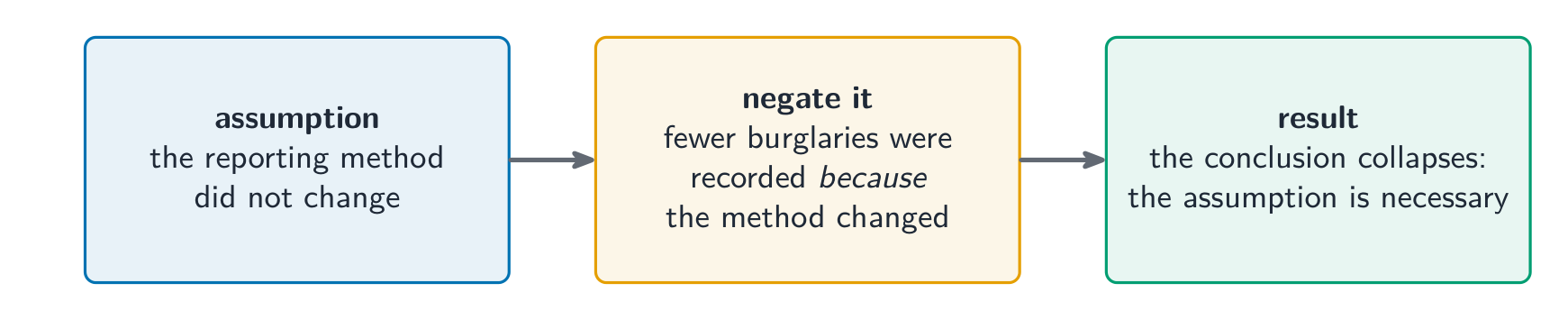
The preserved sketch labels “fewer burglaries were recorded because the method changed” as the negation of “the reporting method did not change.” Repair the negation and explain the limit on the sketch’s conclusion.
Uma possível explicação. Compare o raciocínio e o escopo com sua redação; este modelo local não prediz nota no GRE.
Apply the test to the exact target
- For the workshop conclusion, negate “Lin is registered” to “Lin is not registered.” The conclusion that Lin meets both listed requirements then fails. This shows why registration is required; it does not supply evidence that Lin actually registered.
- Negate “Every student completed both requirements”: at least one student did not complete both. That student could be Kai, while Lin completed both. The target conclusion can survive, so the universal statement is not necessary for it.
Preserve and, some and all
- Negating “Lin registered and attended the briefing” means at least one part fails: Lin did not register, did not attend, or both. Requiring both parts to fail would be too strong.
- Negating “all students attended” means at least one did not, not “none attended.” Negating “some students attended” means none did, with the same group of students understood throughout.
Necessário, suficiente, ambos ou nenhum?
Alvo do workshop: Lin, uma estudante, atende a ambos os requisitos listados — inscrição e presença na orientação. Kai é outra estudante. Classifique cada afirmação adicional em relação a esse alvo exato.
What is the exact negation of “Lin registered and attended the briefing”?
Dificuldade 1/5 · Moedas 100 + pequeno bônus na primeira conclusão hoje
The conjunction is false if either part fails, including when both fail. Saying both failed is only one of those possibilities.
Ask a question that could resolve a gap
- To evaluate the lighting argument, ask whether the before-and-after counts used the same incident definitions and comparable recording coverage. An answer showing systematic omissions would weaken the record-based inference; comparable coverage would remove that particular concern.
- No single check has to settle the whole causal question. You may still need information about patrols, comparison trends or other changes. “What would help evaluate this?” differs from “What assumption is strictly required?”
Transfer to a different rule
- Fictional library rule: active membership and no overdue loans are both listed conditions for borrowing. Patel has active membership. The conclusion “Patel meets both listed conditions” still requires Patel has no overdue loans.
- “No library member has overdue loans” would be sufficient for that conclusion, given Patel's membership, but it is stronger than needed. Another member could have an overdue loan without changing Patel's status. Check the named person and the actual conditions.
Fictional library: active membership and no overdue loans are both listed conditions for borrowing. Patel has active membership. The target conclusion is that Patel meets both listed conditions. Which remaining condition is necessary for the target conclusion?
Dificuldade 1/5 · Moedas 100 + pequeno bônus na primeira conclusão hoje
Patel’s own overdue-loan status is required. The absence of overdue loans for every member would be sufficient given Patel’s membership, but that universal statement is not necessary.
Fictional library: active membership and no overdue loans are both listed conditions for borrowing. Patel has active membership. The target conclusion is that Patel meets both listed conditions. State the necessary missing condition, negate it exactly, and give a counterexample to the claim that every member must have no overdue loans.
Uma possível explicação. Compare o raciocínio e o escopo com sua redação; este modelo local não prediz nota no GRE.
Recap
- Separate records, actual outcomes and causes. Judge whether new information strengthens or weakens the stated inference; a contributing-cause claim does not require every other influence to be absent.
- For a necessary-condition test, hold the target and premises fixed and use the exact negation. A counterexample with the conclusion true and the candidate false shows that the candidate is not necessary.
- alternative cause: A different factor that could help explain an observed result.
- negation: A statement that denies another statement.