Researching society
Introduzido| English | Significado |
|---|---|
| sample/ˈsæmpl/ | Amostra |
| research question/rɪˈsɜːtʃ ˈkwestʃn/ | Questão de pesquisa |
| quantitative/ˈkwɒntɪteɪtɪv/ | Quantitativo |
| qualitative/ˈkwɒlɪteɪtɪv/ | Qualitativo |
| convenience sample/kənˈviːnɪəns ˈsæmpl/ | A sample of whoever is easiest to reach, prone to bias. |
2.4 million replies and the wrong answer, 1936
- Before the 1936 US presidential election the magazine Literary Digest posted about 10 million ballots and received some 2.4 million back. It predicted that Alf Landon would win easily. Franklin Roosevelt won 46 of 48 states.
- The names came largely from telephone directories and car registrations — at the time, wealthier people — and those who chose to reply differed too. A huge sample 样本 that is not representative still gives the wrong answer.
Why was the 1936 Literary Digest poll wrong?
Dificuldade 1/5 · Moedas 100 + pequeno bônus na primeira conclusão hoje
Size cannot fix bias.
Start with a research question
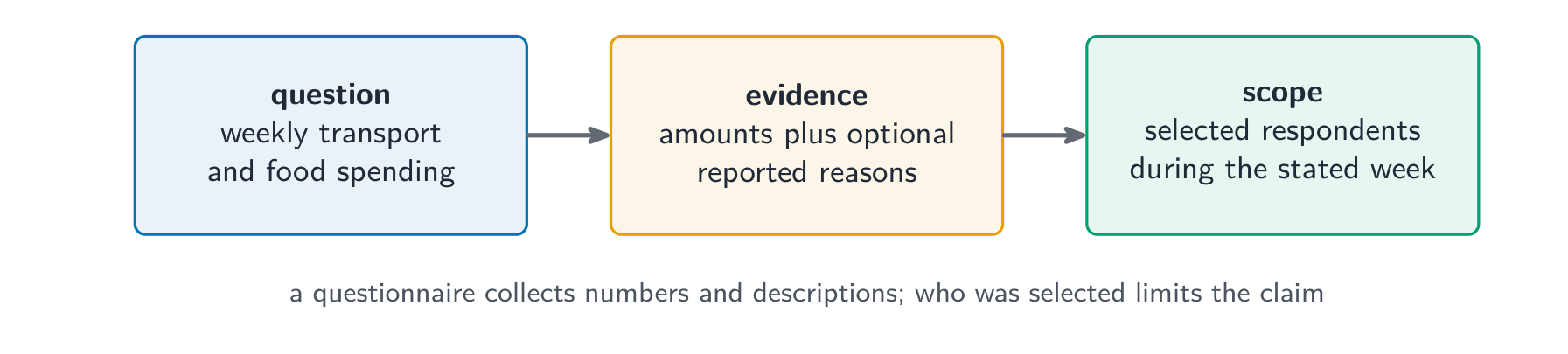
- A research question 研究问题 is clear and bounded: "How many hours do first-year students at this college sleep on weeknights?" is better than "How do students sleep?"
- The question decides the method.
Which research question is best bounded?
Dificuldade 1/5 · Moedas 100 + pequeno bônus na primeira conclusão hoje
Clear population, measure and time.
Quantitative and qualitative
- Quantitative 定量 research collects numbers: surveys with fixed answers, counts, measurements. It shows how many and how much.
- Qualitative 定性 research collects words and meanings: interviews, observation, open questions. It shows why and how people experience something.
Match each method to its type.
Dificuldade 2/5 · Moedas 140 + pequeno bônus na primeira conclusão hoje
Numbers versus meanings.
Sampling
- A random sample gives everyone in the population an equal chance of being chosen. A stratified sample keeps the right proportions of groups.
- A convenience sample 方便样本 uses whoever is easy to reach — your friends, one class. It is quick but may not represent the population.
Asking only your own friends is which kind of sample?
Dificuldade 1/5 · Moedas 100 + pequeno bônus na primeira conclusão hoje
Easy to reach, may not represent.
In a random sample everyone in the population has an equal chance of being chosen.
Dificuldade 1/5 · Moedas 100 + pequeno bônus na primeira conclusão hoje
That is the definition.
Worked example: choose a method
Question: "Why do some first-year international students stop attending lectures?"
- Type: "why" needs reasons and experiences → qualitative.
- Method: semi-structured interviews with about 12 students.
- Sample: pick students from several courses and countries, not only your friends; explain the limit that 12 cannot represent everyone.
A question beginning "why" usually suits qualitative methods.
Dificuldade 1/5 · Moedas 100 + pequeno bônus na primeira conclusão hoje
It asks for reasons.
Mixed methods
- Many studies combine both: a survey shows how many students miss lectures; interviews explain why.
- Each method checks the other's weaknesses.
A bigger sample does not fix a biased one. The Literary Digest had 2.4 million replies and was wrong; a smaller random sample can be more accurate.
A larger sample always removes bias.
Dificuldade 1/5 · Moedas 100 + pequeno bônus na primeira conclusão hoje
The Literary Digest example.
Write a bounded research question first. Use quantitative methods for how many, qualitative for why and how, and choose a sample that represents the population — not just a convenient one.
Write a bounded research question about canteen food at your college and choose a method and sample for it.
Question, method, sample.