Poverty, inequality and redistribution
Introduzido| English | Significado |
|---|---|
| absolute poverty/ˈæbsəluːt ˈpɒvəti/ | pobreza absoluta |
| relative poverty/ˈrelətɪv ˈpɒvəti/ | pobreza relativa |
The end of extreme poverty in China?
- In February 2021 China's government announced that extreme rural poverty had been eliminated. About 99 million people had been lifted above the official line since 2012. Yet large gaps between the incomes of rich and poor remained.
- Economists use two different measures of poverty.
Absolute poverty
- Absolute poverty 绝对贫困 means not having enough income for basic needs: food, clean water, shelter, clothing.
- The World Bank's line in 2022 was 2.15 US dollars a day.
Relative poverty
- Relative poverty 相对贫困 means having much less than most people in your society, often below 60% of the median income.
- A country can end absolute poverty but still have many people in relative poverty.
Match each case to the type of poverty.
Dificuldade 2/5 · Moedas 140 + pequeno bônus na primeira conclusão hoje
Basic needs or comparison with others?
A country can end absolute poverty and still have relative poverty.
Dificuldade 1/5 · Moedas 100 + pequeno bônus na primeira conclusão hoje
Gaps can remain.
Worked example: a progressive tax
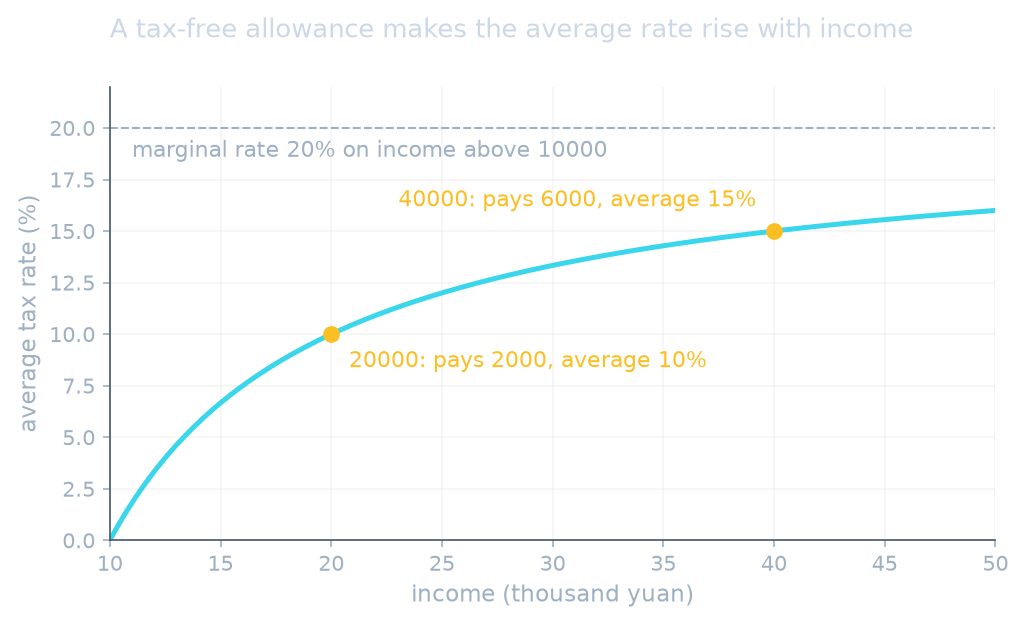
The first 10 000 yuan of income is tax-free; the rest is taxed at 20%.
- Income 20 000: tax $0.2 \times 10\,000 = 2000$, average rate $\dfrac{2000}{20\,000} = 10\%$.
- Income 40 000: tax $0.2 \times 30\,000 = 6000$, average rate $\dfrac{6000}{40\,000} = 15\%$.
- Progressive: the average rate rises with income, so richer people pay a larger share.
An allowance makes a flat rate progressive
The first 10000 yuan is untaxed and the rest pays 20%. Income of 20000 pays 2000 (average 10%); income of 40000 pays 6000 (average 15%). The average rate rises with income, so the tax is progressive.
With a 10 000-yuan allowance and 20% above it, how much tax is paid on 60 000 yuan?
Dificuldade 2/5 · Moedas 140 + pequeno bônus na primeira conclusão hoje
0.2 × 50 000.
What is the average tax rate on 60 000 yuan, in per cent?
Dificuldade 2/5 · Moedas 140 + pequeno bônus na primeira conclusão hoje
10 000 ÷ 60 000 × 100.
Redistribution
- Governments redistribute income through progressive taxes and through benefits, pensions and free services.
- A minimum wage and free education also raise the incomes of poorer families.
Which help redistribute income to poorer people?
Dificuldade 2/5 · Moedas 140 + pequeno bônus na primeira conclusão hoje
A top-rate cut helps the rich most.
Costs of redistribution
- High taxes may reduce the reward for working or investing.
- Benefits cost money and must be designed so that taking a job still pays.
A progressive tax is not the same as a single high rate. Here everyone pays 20% on income above 10 000, yet the average rate rises with income because of the tax-free allowance.
A tax with one rate of 20% above an allowance cannot be progressive.
Dificuldade 1/5 · Moedas 100 + pequeno bônus na primeira conclusão hoje
The allowance makes the average rate rise.
Absolute poverty means lacking basic needs; relative poverty means falling far below most people. Progressive taxes, benefits and free services redistribute income, but high taxes can weaken incentives to work.
China announced the end of extreme rural poverty in 2021. Explain why relative poverty may still be a problem, and one policy to reduce it.
Poverty.