Unemployment: measurement and causes
Introduzido| English | Significado |
|---|---|
| labour force/ˈleɪbə fɔːs/ | força de trabalho |
| structural unemployment/ˈstrʌktʃərəl ʌnemˈplɔɪmənt/ | desemprego estrutural |
Graduates without jobs, 2023
- In June 2023 China's official unemployment rate for 16- to 24-year-olds in cities reached 21.3%, a record. A record number of graduates, over 11 million, were looking for work, while the economy's recovery after the pandemic was slow.
- To understand unemployment, first count who is in the labour force.
Who counts
- The labour force 劳动力 is everyone of working age who has a job or is actively looking for one.
- People not working and not looking — students, carers, early retirees — are economically inactive, not unemployed.
A full-time university student who is not looking for work is
Dificuldade 1/5 · Moedas 100 + pequeno bônus na primeira conclusão hoje
Not in the labour force.
The unemployment rate
- Unemployment rate $= \dfrac{\text{unemployed}}{\text{labour force}} \times 100$.
- The labour force is employed plus unemployed; the inactive are left out.
1800 people are employed and 200 unemployed. What is the labour force?
Dificuldade 2/5 · Moedas 140 + pequeno bônus na primeira conclusão hoje
1800 + 200.
Worked example: a town of 1200
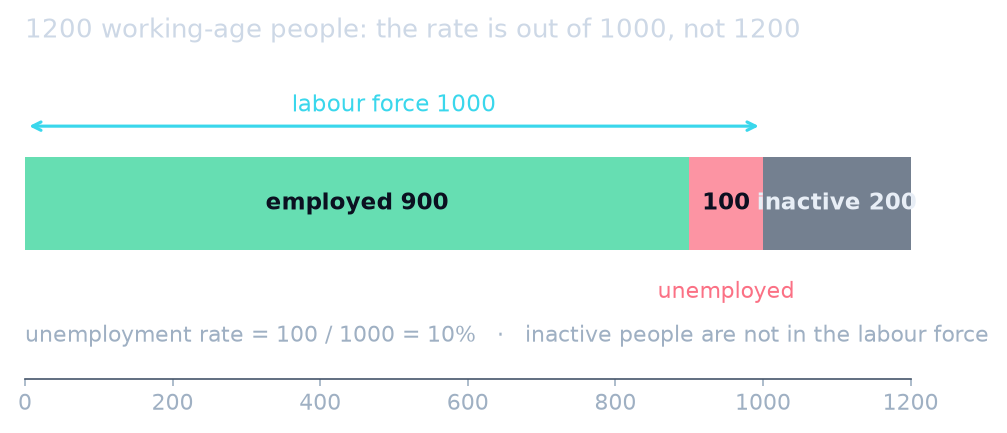
Of 1200 working-age people, 900 have jobs, 100 are looking for work, and 200 are neither working nor looking.
- Labour force: $900 + 100 = 1000$.
- Unemployment rate: $\dfrac{100}{1000} \times 100 = 10\%$ — not $\dfrac{100}{1200}$.
- Participation: $\dfrac{1000}{1200} \approx 83\%$ of working-age people are in the labour force.
Which denominator belongs in the rate?
Use the lesson’s 900 employed, 100 unemployed and 200 inactive people. Compare the labour force with the whole eligible model group.
Using those figures, what is the unemployment rate, in per cent?
Dificuldade 2/5 · Moedas 140 + pequeno bônus na primeira conclusão hoje
200 ÷ 2000 × 100.
Causes of unemployment
- Structural unemployment 结构性失业: industries decline and workers' skills no longer match the jobs available, as when coal mines close.
- Cyclical: demand falls in a recession. Frictional: people between jobs. Seasonal: work only at certain times of year.
Match each case to its type of unemployment.
Dificuldade 2/5 · Moedas 140 + pequeno bônus na primeira conclusão hoje
Cause of the job loss.
Costs of unemployment
- Lost output and income, lower tax revenue and higher benefit spending.
- For people: lost skills, stress and poverty; long spells make finding work harder.
Which are costs of unemployment?
Dificuldade 2/5 · Moedas 140 + pequeno bônus na primeira conclusão hoje
Benefit spending rises.
Students are not unemployed. If they are not looking for work, they are inactive and are left out of the labour force. Dividing by all 1200 people gives a wrong rate of 8.3%.
The unemployment rate divides the unemployed by the whole working-age population.
Dificuldade 1/5 · Moedas 100 + pequeno bônus na primeira conclusão hoje
Divide by the labour force.
Labour force = employed + unemployed. Unemployment rate = unemployed ÷ labour force × 100. Causes are structural, cyclical, frictional and seasonal. Unemployment wastes output and harms people.
Explain two possible causes of high youth unemployment in China in 2023, and one cost to the economy.
Unemployment.