Increasing a wage floor
Introduzido| English | Significado |
|---|---|
| wage bill/weɪdʒ bɪl/ | despesa com salários |
| labour mobility/ˈleɪbə məʊˈbɪlɪti/ | mobilidade da mão de obra |
Germany's 12-euro wage, 2022
- In October 2022 Germany raised its minimum wage from 10.45 to 12 euros an hour, a rise of about 15% in one step. Around six million workers got a pay rise. Economists watched closely to see whether jobs would be lost.
- Raising a wage floor that is already binding has bigger effects.
A higher floor
- When a minimum wage rises further above the market wage, firms want fewer hours and more people want to work.
- The gap — excess supply of labour — grows.
A binding minimum wage is raised further. What happens to excess supply of labour?
Dificuldade 1/5 · Moedas 100 + pequeno bônus na primeira conclusão hoje
Fewer demanded, more supplied.
The wage bill
- The wage bill 工资总额 is the wage multiplied by the hours worked.
- A higher wage on fewer hours can raise or lower the total paid to workers.
What is the wage bill when 50 hours are worked at 30 yuan?
Dificuldade 2/5 · Moedas 140 + pequeno bônus na primeira conclusão hoje
30 × 50.
Worked example: 24 to 28 yuan
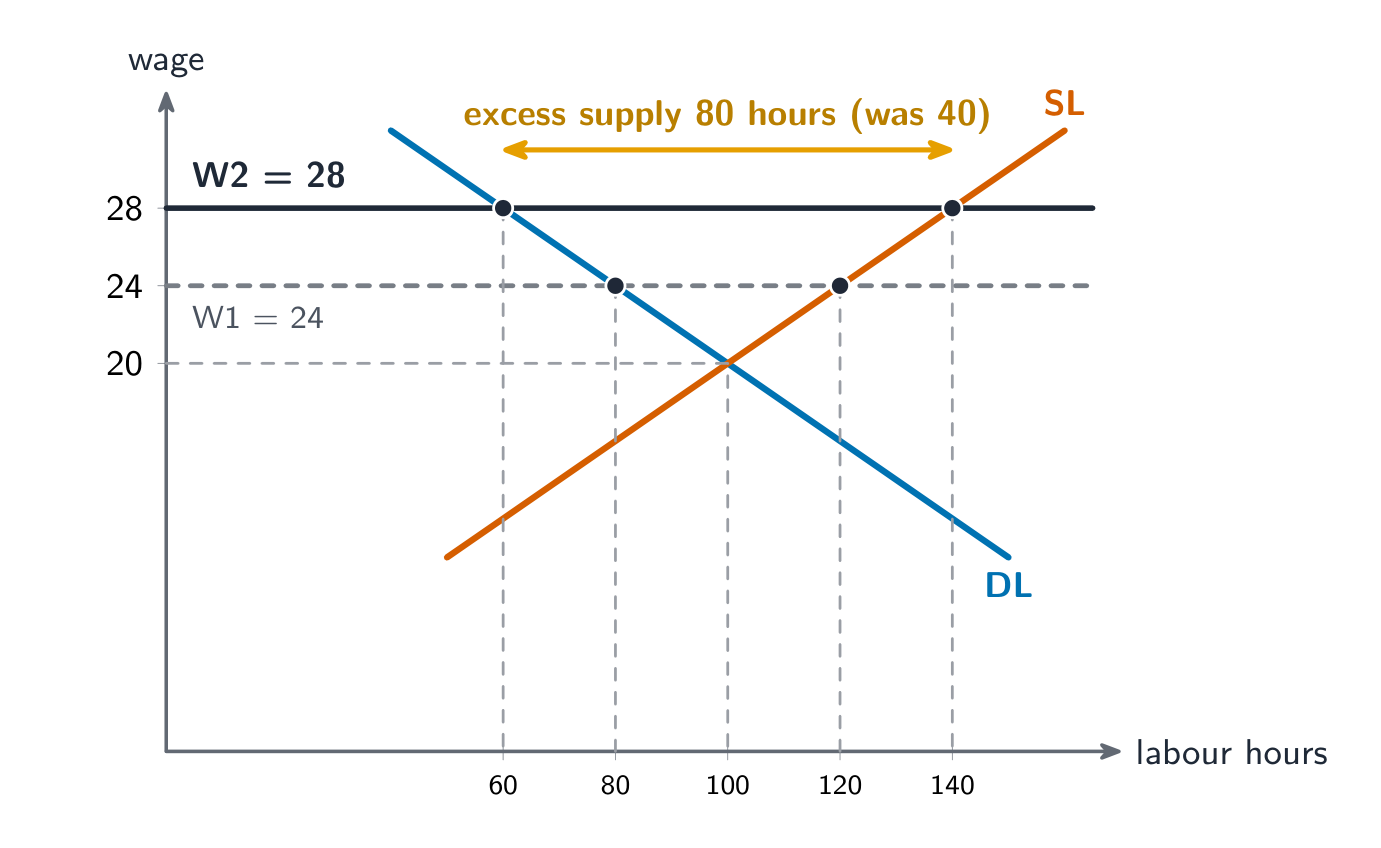
The market wage is 20 yuan with 100 hours. At a floor of 24 yuan, 80 hours are demanded and 120 supplied. The floor rises to 28 yuan.
- At 28: 60 hours demanded, 140 supplied; excess supply $140 - 60 = 80$ hours, up from 40.
- Wage bill: $24 \times 80 = 1920$ before; $28 \times 60 = 1680$ after.
- Result: higher pay per hour, but fewer hours, and a smaller total paid to workers.
Raising the minimum wage
Equilibrium is W 20 with 100 hours. A floor of 24 gives 80 hours demanded and 120 supplied, excess supply 40; at 28 it is 60 against 140. Hours worked fall, so the wage bill falls from 1,920 to 1,680 yuan.
At a floor of 30 yuan, 50 hours are demanded and 150 supplied. What is the excess supply?
Dificuldade 2/5 · Moedas 140 + pequeno bônus na primeira conclusão hoje
150 − 50.
Labour mobility
- Labour mobility 劳动力流动性 is how easily workers can move between jobs (occupational) or places (geographical).
- Workers who lose hours may find work elsewhere if mobility is high, which softens the job loss.
Match each example to its type of mobility.
Dificuldade 2/5 · Moedas 140 + pequeno bônus na primeira conclusão hoje
Changing job or changing place.
Who gains, who loses
- Workers who keep their hours gain. Workers who lose hours, and firms facing higher costs, lose.
- Effects depend on how elastic labour demand is: inelastic demand means small job losses.
If labour demand is inelastic, a higher minimum wage causes only a small fall in hours.
Dificuldade 1/5 · Moedas 100 + pequeno bônus na primeira conclusão hoje
Firms respond weakly to the wage.
A higher minimum wage does not always raise the total paid to workers. Here the wage bill falls from 1920 to 1680 yuan because hours fall faster than the wage rises.
A higher minimum wage always increases the wage bill.
Dificuldade 1/5 · Moedas 100 + pequeno bônus na primeira conclusão hoje
Hours may fall faster than the wage rises.
Raising a binding wage floor widens the gap between hours supplied and demanded. The wage bill may rise or fall, depending on how much hours fall. High labour mobility and inelastic labour demand reduce the harm.
Germany raised its minimum wage by about 15% in 2022. Evaluate the likely effects on low-paid workers.
Raising a floor.