Economies and diseconomies of scale
Introduzido| English | Significado |
|---|---|
| economies of scale/ɪˈkɒnəmiz ɒv skeɪl/ | economias de escala |
| diseconomies of scale/ˌdɪsɪˈkɒnəmiz ɒv skeɪl/ | deseconomias de escala |
Bigger ships, cheaper boxes
- In 2013 Maersk launched ships that each carry about 18 000 containers. A ship twice as big does not need twice the crew or twice the fuel. The cost of moving each container fell, which is one reason goods from Asia are cheap in Europe.
- Larger scale can lower the cost of each unit.
Economies of scale
- Economies of scale 规模经济 are falls in average cost as a firm grows larger.
- Average cost $=$ total cost $\div$ output.
A firm makes 400 units for a total cost of 2800 yuan. What is the average cost?
Dificuldade 2/5 · Moedas 140 + pequeno bônus na primeira conclusão hoje
2800 ÷ 400.
Diseconomies of scale
- Diseconomies of scale 规模不经济 are rises in average cost when a firm becomes too large.
- Causes: slow communication, poor coordination, and workers who feel unimportant.
Which are causes of diseconomies of scale?
Dificuldade 2/5 · Moedas 140 + pequeno bônus na primeira conclusão hoje
Bulk buying is an economy.
Worked example: three scales
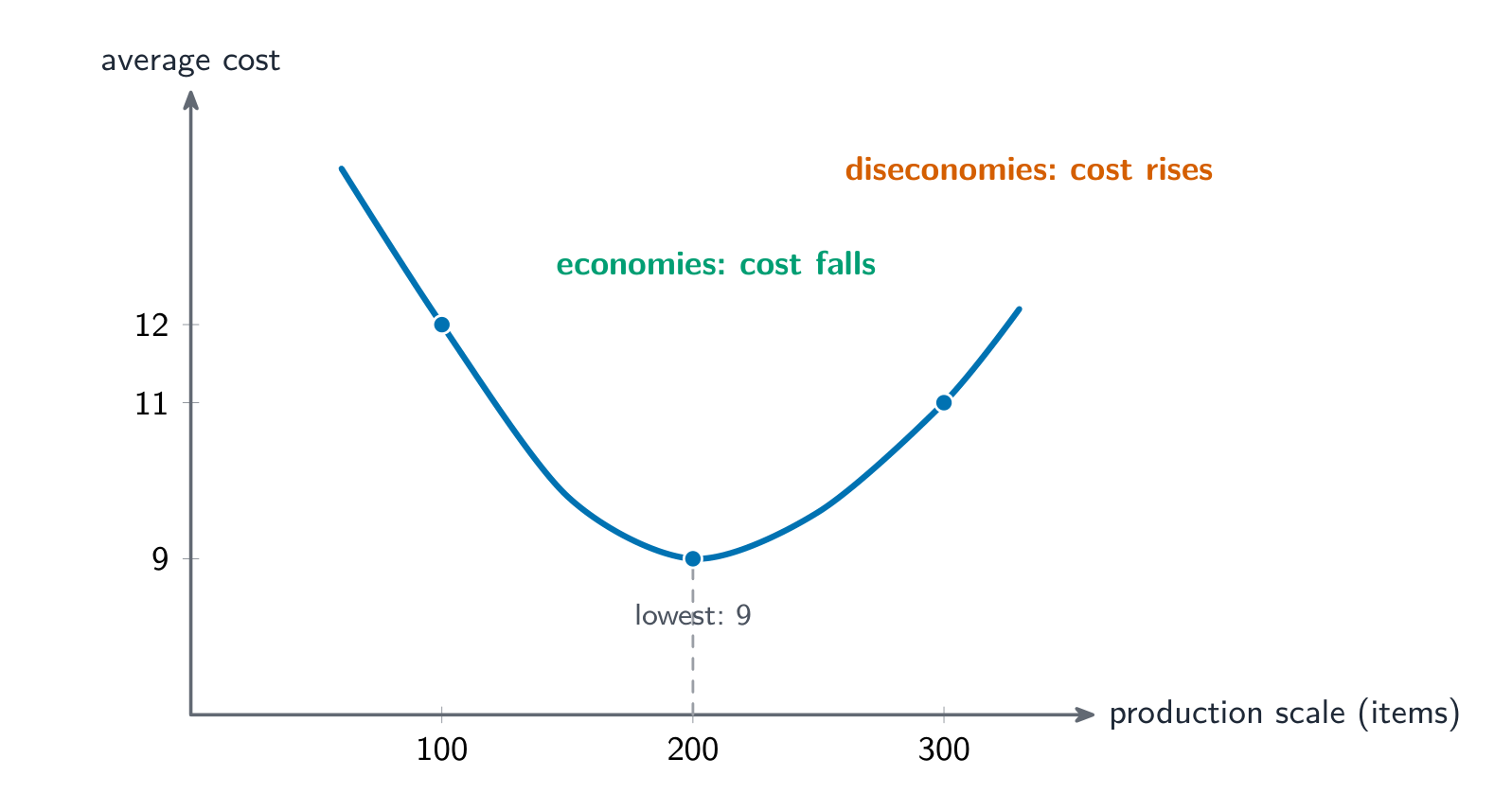
A firm could make 100 items for 1200 yuan, 200 for 1800 yuan, or 300 for 3300 yuan.
- Average costs: $\dfrac{1200}{100} = 12$, $\dfrac{1800}{200} = 9$, $\dfrac{3300}{300} = 11$ yuan.
- 100 → 200: economies of scale — average cost falls from 12 to 9.
- 200 → 300: diseconomies — average cost rises to 11. The lowest-cost scale of the three is 200.
Total cost rises while average cost falls
100 items cost 1200 (average 12); 200 cost 1800 (average 9); at 300 delays push total cost to 3300 (average 11). Average cost falls with economies of scale, then rises with diseconomies: 200 is the lowest-cost scale of the three.
100 units cost 1000 yuan; 200 cost 1600; 300 cost 2700. Which scale has the lowest average cost?
Dificuldade 1/5 · Moedas 100 + pequeno bônus na primeira conclusão hoje
10, 8, 9.
Sources of economies
- Buying in bulk, using large specialized machines, borrowing more cheaply, and spreading advertising over more sales.
- Large firms can also afford research that small firms cannot.
Large firms can often borrow money at lower interest rates.
Dificuldade 1/5 · Moedas 100 + pequeno bônus na primeira conclusão hoje
A financial economy of scale.
Why does a larger container ship lower the cost of each container?
Dificuldade 1/5 · Moedas 100 + pequeno bônus na primeira conclusão hoje
Technical economy of scale.
Why big firms can struggle
- Many layers of managers slow decisions. Messages get lost between departments.
- Firms split into smaller units or use better systems to avoid this.
Total cost rising does not mean diseconomies. From 100 to 200 items, total cost rose from 1200 to 1800, but average cost fell. Always divide by output.
If total cost rises, the firm has diseconomies of scale.
Dificuldade 1/5 · Moedas 100 + pequeno bônus na primeira conclusão hoje
Look at average cost.
Economies of scale lower average cost as a firm grows; diseconomies raise it when the firm grows too large. Compare average costs, not total costs, to find the cheapest scale.
A firm doubles in size. Explain one economy and one diseconomy of scale it may face, and how each affects average cost.
Scale.