Choosing an environmental intervention
Introduzido| English | Significado |
|---|---|
| regulation/ˌreɡjʊˈleɪʃn/ | regulamentação |
| pollution permit/pəˈluːʃn ˈpɜːmɪt/ | permissão de poluição |
China's carbon market, 2021
- In July 2021 China opened a national carbon market. Over 2000 power companies received permits for their carbon dioxide and can buy or sell them. It became the world's largest carbon market by the amount of emissions covered.
- Governments can choose among several tools to cut pollution.
Regulation
- Regulation 监管规定 means laws and rules: emission limits, bans, or required equipment such as filters.
- It is clear and quick, but it makes every firm cut by the same amount, even when some can cut far more cheaply.
Which is an example of regulation?
Dificuldade 1/5 · Moedas 100 + pequeno bônus na primeira conclusão hoje
A legal rule.
Pollution permits
- A pollution permit 排污许可证 allows a firm to emit one unit of pollution. The government sets the total number — the cap.
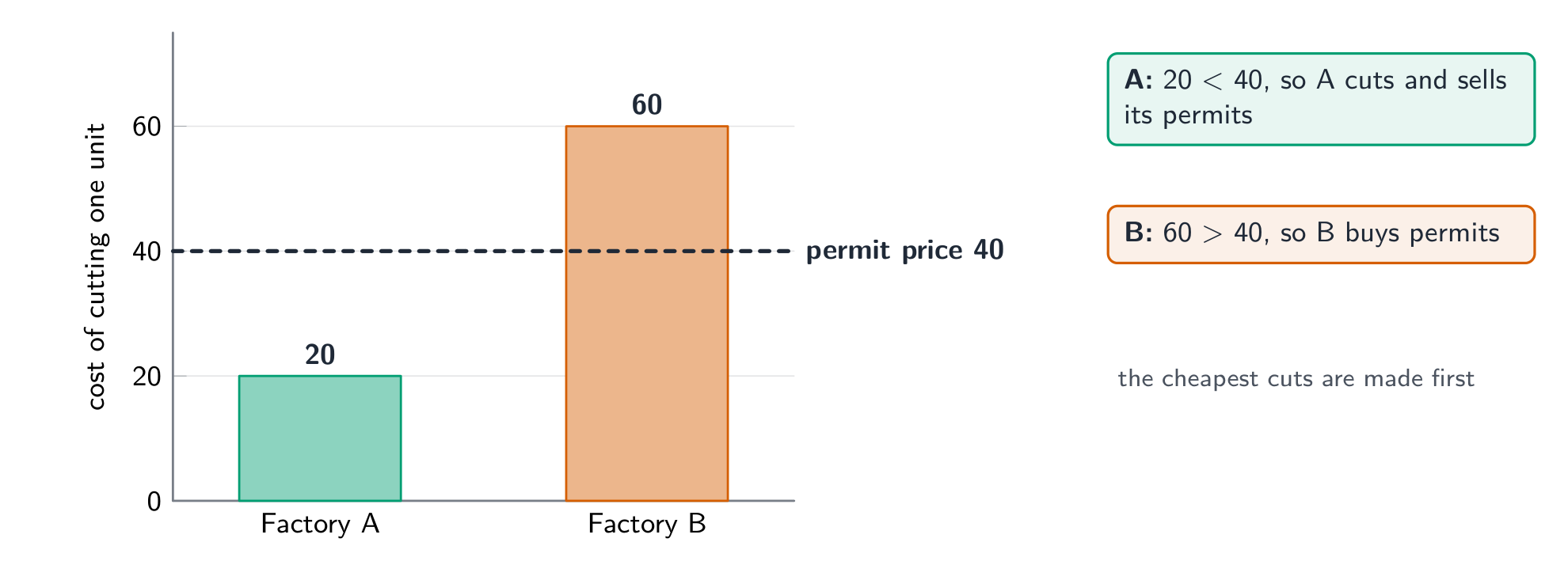
- Firms that cut cheaply sell spare permits to firms that find cutting expensive.
Which firm buys permits?
Dificuldade 1/5 · Moedas 100 + pequeno bônus na primeira conclusão hoje
Buying is cheaper than cutting for it.
Worked example: two firms, one cap
Firms A and B each emit 10 units. The cap requires 10 units cut in total. A can cut one unit for 20 yuan, B for 60. Permits trade at 40 yuan.
- Regulation (each cuts 5): $5 \times 20 + 5 \times 60 = 400$ yuan.
- Permits: A cuts all 10 for $10 \times 20 = 200$ yuan and sells its spare permits to B, which prefers paying 40 to cutting at 60.
- Result: the same 10 units cut for 200 yuan instead of 400.
Who should cut the discharge?
A can cut a unit for 20 yuan and B for 60, with permits at 40. If each cuts 5 units the cost is 400; if A cuts all 10 and sells its spare permits to B, the same cap is met for 200.
Firm C cuts pollution at 30 yuan a unit and firm D at 70 yuan. Each must cut 4 units under regulation. What is the total cost?
Dificuldade 2/5 · Moedas 140 + pequeno bônus na primeira conclusão hoje
4 × 30 + 4 × 70.
With permits, C makes all 8 cuts instead. What is the total cost?
Dificuldade 2/5 · Moedas 140 + pequeno bônus na primeira conclusão hoje
8 × 30.
Taxes
- An emissions tax charges firms for each unit of pollution. Firms cut where cutting is cheaper than the tax.
- The government raises revenue, but it cannot be sure how much pollution will fall.
Choosing a tool
- Regulation: certain and simple, but costly. Permits: certain total, cheap cutting, but complex to run.
- Taxes: cheap cutting and revenue, but uncertain results. Choose by the harm, the firms and the cost of checking.
Match each tool to a strength.
Dificuldade 2/5 · Moedas 140 + pequeno bônus na primeira conclusão hoje
Each tool's main advantage.
Permits do not let pollution grow without limit. The cap fixes the total. Trading only changes which firm does the cutting — and the cheapest cutter does most of it.
Trading permits increases total pollution.
Dificuldade 1/5 · Moedas 100 + pequeno bônus na primeira conclusão hoje
The cap fixes the total.
Regulation, taxes and permits all cut pollution. Permits fix the total and let firms trade, so cuts happen where they are cheapest. A good answer weighs certainty, cost to firms, revenue and how easy the tool is to enforce.
Evaluate whether a permit system is better than regulation for cutting carbon from China's power stations.
Choosing a tool.