Demand: a movement or a shift?
Introduzido| English | Significado |
|---|---|
| quantity demanded/ˈkwɒntɪti dɪˈmændɪd/ | quantidade demandada |
| complement/ˈkɒmplɪmənt/ | complemento |
| substitute/ˈsʌbstɪtjuːt/ | Goods or services that can be used in place of each other. |
The 2020 flour rush
- In spring 2020, lockdowns kept millions of people at home. In Britain, sales of flour roughly doubled, and many shops ran out — though the price of flour had barely changed. People's circumstances changed, not the price.
- Economists separate a movement along the demand curve from a shift of the whole curve.
What demand means
- Demand is the amount buyers are willing and able to buy at each price. Wanting something without the money is not demand.
- Quantity demanded 需求量 is the amount at one particular price.
Movement along the curve
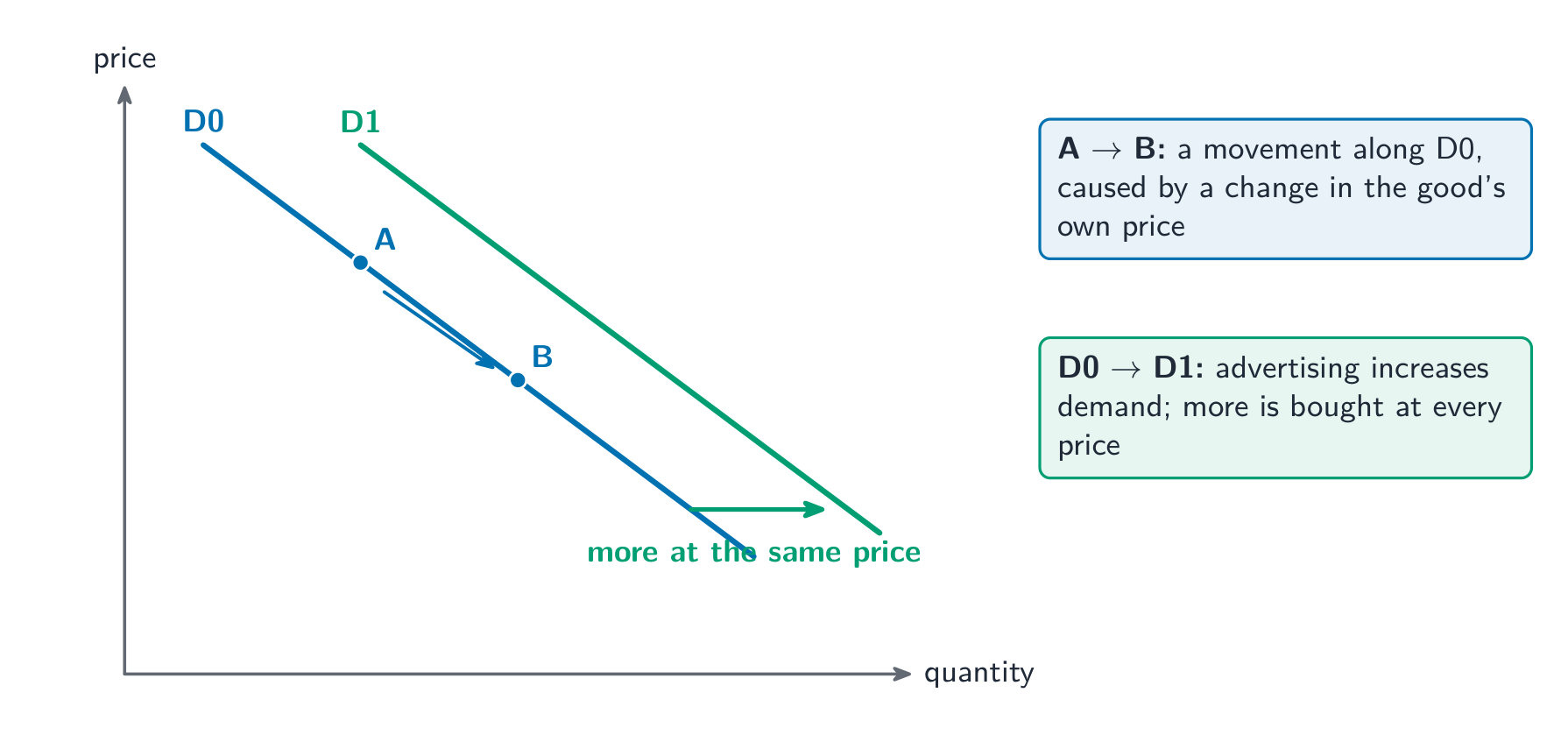
- A change in the good's own price moves buyers along the demand curve: a lower price, a larger quantity demanded.
- Concert tickets at 100, 80 and 60 yuan: 30, 40 and 50 tickets demanded.
The price of rice falls. What happens on the rice demand diagram?
Dificuldade 1/5 · Moedas 100 + pequeno bônus na primeira conclusão hoje
Own-price change.
Worked example: an advertising campaign
Before a campaign, demand for tickets is 30, 40 and 50 at 100, 80 and 60 yuan. After it, demand is 45, 55 and 65 at the same prices.
- At 80 yuan: quantity demanded rises from 40 to 55, with no change in price.
- Every price: 15 more tickets are demanded.
- Conclusion: the whole demand curve has shifted right — an increase in demand.
More demanded at the same price
At 80 yuan the old schedule shows 40 tickets; after the advertising campaign it shows 55 at the same price. The whole demand curve has shifted right: an increase in demand, not a movement along it. The 60 and 100 yuan rows are illustrative.
At 80 yuan, 40 tickets are demanded before a campaign and 55 after. By how many tickets did demand increase at that price?
Dificuldade 2/5 · Moedas 140 + pequeno bônus na primeira conclusão hoje
55 − 40.
What shifts demand?
- Income, tastes and fashion, advertising, population, and the prices of related goods.
- A complement 互补品 is used together with the good (printers and ink). A fall in a complement's price increases demand for the good.
Which shift the demand curve for bicycles to the right?
Dificuldade 2/5 · Moedas 140 + pequeno bônus na primeira conclusão hoje
Own price causes a movement, not a shift.
Printers and ink cartridges are complements.
Dificuldade 1/5 · Moedas 100 + pequeno bônus na primeira conclusão hoje
They are used together.
Substitutes
- A substitute can replace the good (tea and coffee). If coffee becomes dearer, demand for tea increases.
- Each shift has a reason that is not the good's own price.
The price of coffee rises sharply. What happens to demand for tea?
Dificuldade 1/5 · Moedas 100 + pequeno bônus na primeira conclusão hoje
Tea is a substitute.
A fall in a good's price does not "increase demand". It increases the quantity demanded — a movement along the curve. "Increase in demand" means the whole curve shifts right, for a non-price reason.
A fall in a good's own price causes an increase in demand.
Dificuldade 1/5 · Moedas 100 + pequeno bônus na primeira conclusão hoje
It increases quantity demanded.
Own-price change → movement along the demand curve. Change in income, tastes, advertising, population or related goods' prices → shift of the curve. Complements move together; substitutes move apart.
Explain, using a demand diagram, why flour sales doubled in Britain in 2020 even though its price hardly changed.
Shifts in demand.