Binomial expansion and valid approximations
Introduzido| English | Significado |
|---|---|
| binomial coefficient/baɪˈnəʊmɪəl ˌkəʊɪˈfɪʃənt/ | coeficiente binomial |
A letter to Leibniz, June 1676
- On 13 June 1676, Isaac Newton sent a long letter to Gottfried Leibniz through the Royal Society's secretary. In it he showed how to expand $(1 + x)^n$ when $n$ is a fraction or negative — an expansion that never ends. With it he could calculate square roots and areas to many decimal places by adding just a few terms.
- P2 expands $(a + b)^n$ for positive integers $n$ exactly; P4 expands $(1 + x)^n$ for any rational $n$ as a series that is valid only for small $x$.
Positive integer powers
- $(a + b)^n = \sum_{r=0}^{n} \dbinom{n}{r}a^{n-r}b^r$, where the binomial coefficient 二项式系数 is $\dbinom{n}{r} = \dfrac{n!}{r!(n - r)!}$.
- $(2 + x)^4 = 16 + 32x + 24x^2 + 8x^3 + x^4$.
Find the coefficient of $x^3$ in $(2 + x)^5$.
Dificuldade 2/5 · Moedas 140 + pequeno bônus na primeira conclusão hoje
$\binom{5}{3} \times 2^2 = 10 \times 4$.
Evaluate $\dbinom{8}{3}$.
Dificuldade 2/5 · Moedas 140 + pequeno bônus na primeira conclusão hoje
$\dfrac{8 \times 7 \times 6}{3!}$.
Any rational power
- $(1 + x)^n = 1 + nx + \dfrac{n(n - 1)}{2!}x^2 + \dfrac{n(n - 1)(n - 2)}{3!}x^3 + \dots$
- For $n$ not a positive integer, this never stops, and it is valid only for $|x| < 1$.
Binomial expansion and valid approximations
For positive integer n, (a+b)^n is a finite binomial expansion
Compare the model with the worked case and explain one change.
Expand $(1 + x)^{-1}$ up to $x^3$.
Dificuldade 1/5 · Moedas 100 + pequeno bônus na primeira conclusão hoje
Coefficients $-1$, $\tfrac{(-1)(-2)}{2} = 1$, $\tfrac{(-1)(-2)(-3)}{6} = -1$.
Worked example: expansion and validity
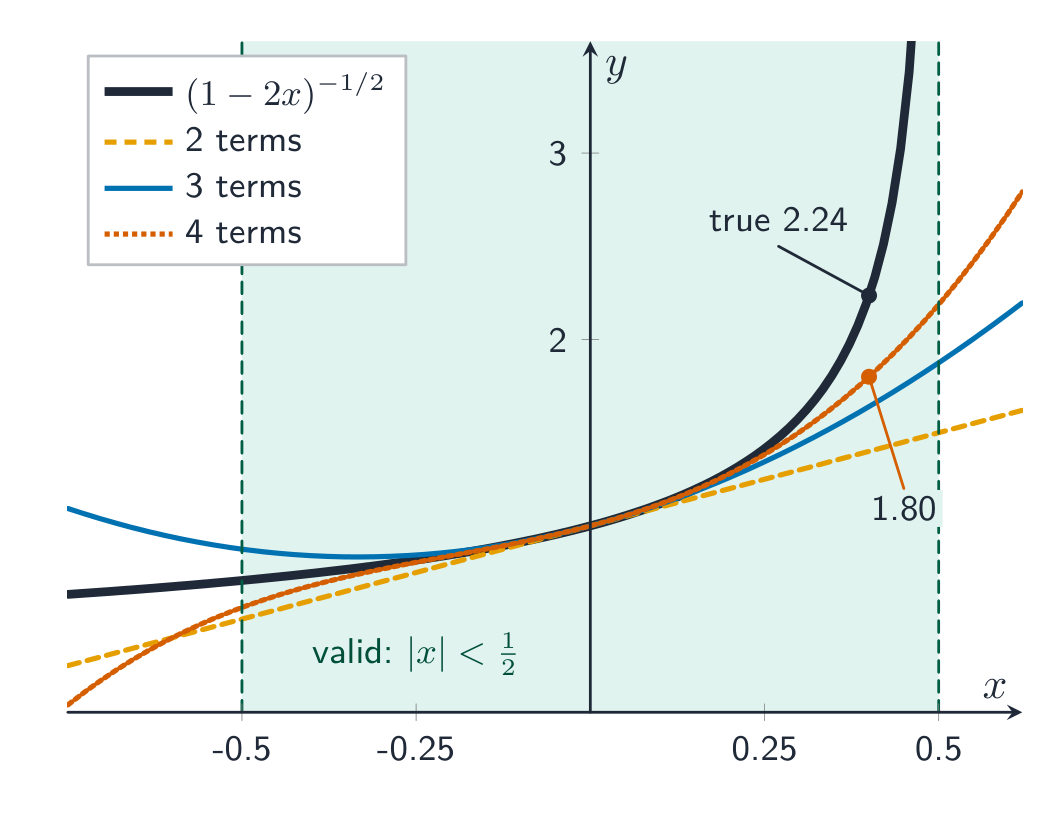
Expand $(1 - 2x)^{-\frac{1}{2}}$ up to $x^3$, state the validity, and estimate $\dfrac{1}{\sqrt{0.98}}$.
- Terms: with $n = -\tfrac{1}{2}$ and "$x$" $= -2x$: $1 + x + \tfrac{3}{2}x^2 + \tfrac{5}{2}x^3 + \dots$
- Validity: $|-2x| < 1$, so $|x| < \tfrac{1}{2}$.
- Estimate: $1 - 2x = 0.98$ gives $x = 0.01$: $1 + 0.01 + 0.00015 + 0.0000025 = 1.0101525$; a calculator gives $1.0101525\ldots$ ✓.
For which $x$ is the expansion of $(1 + 3x)^{\frac{1}{3}}$ valid?
Dificuldade 1/5 · Moedas 100 + pequeno bônus na primeira conclusão hoje
$|3x| < 1$.
Taking out a factor
- To expand $(4 + x)^{\frac{1}{2}}$, write $4^{\frac{1}{2}}\left(1 + \tfrac{x}{4}\right)^{\frac{1}{2}} = 2\left(1 + \tfrac{x}{8} - \tfrac{x^2}{128} + \dots\right)$.
- Valid for $\left|\tfrac{x}{4}\right| < 1$, so $|x| < 4$.
In the expansion of $(9 + x)^{\frac{1}{2}}$, find the coefficient of $x$ as a decimal to 4 d.p.
Dificuldade 2/5 · Moedas 140 + pequeno bônus na primeira conclusão hoje
$3\left(1 + \tfrac{x}{9}\right)^{\frac{1}{2}} = 3 + \tfrac{3}{18}x + \dots$, so $\tfrac{1}{6}$.
Choosing a good $x$
- An approximation is accurate only when $x$ is small: each extra term is smaller.
- In the example, $x = 0.4$ is still valid ($|x| < \tfrac{1}{2}$), but four terms give $1 + 0.4 + 0.24 + 0.16 = 1.80$ against the true $\tfrac{1}{\sqrt{0.2}} = 2.24$: close to the edge, the series converges slowly.
Exam-style question
Question (6 marks): (a) Find the binomial expansion of $\dfrac{1}{(2 - x)^2}$, in ascending powers of $x$, up to the term in $x^3$, and state the values of $x$ for which it is valid. (b) Hence find the expansion of $\dfrac{1 + x}{(2 - x)^2}$ up to $x^3$.
- Take out the 2 (M1): $(2 - x)^{-2} = 2^{-2}\left(1 - \tfrac{x}{2}\right)^{-2} = \tfrac{1}{4}\left(1 - \tfrac{x}{2}\right)^{-2}$.
- Expand with $n = -2$ and "$x$" $= -\tfrac{x}{2}$ (M1): $1 + 2\left(\tfrac{x}{2}\right) + 3\left(\tfrac{x}{2}\right)^2 + 4\left(\tfrac{x}{2}\right)^3 = 1 + x + \tfrac{3}{4}x^2 + \tfrac{1}{2}x^3$.
- Multiply by $\tfrac{1}{4}$ (A1): $\tfrac{1}{4} + \tfrac{1}{4}x + \tfrac{3}{16}x^2 + \tfrac{1}{8}x^3$. Valid for $\left|\tfrac{x}{2}\right| < 1$, so $|x| < 2$ (B1).
- (b) Multiply by $(1 + x)$ and collect terms up to $x^3$ (M1): $\tfrac{1}{4} + \tfrac{1}{2}x + \tfrac{7}{16}x^2 + \tfrac{5}{16}x^3$ (A1).
Where marks are lost: writing $2^{-2} = -4$ or forgetting it altogether; squaring $-\tfrac{x}{2}$ without the bracket; giving $|x| < 1$ instead of $|x| < 2$: the condition is on the whole term $\tfrac{x}{2}$.
Using $\dfrac{1}{(2 - x)^2} = \tfrac{1}{4} + \tfrac{1}{4}x + \tfrac{3}{16}x^2 + \dots$, find the coefficient of $x^2$ in the expansion of $\dfrac{1 - x}{(2 - x)^2}$, as a decimal.
Dificuldade 2/5 · Moedas 140 + pequeno bônus na primeira conclusão hoje
$\tfrac{3}{16} - \tfrac{1}{4} = -\tfrac{1}{16} = -0.0625$.
Find the validity from the whole bracket term. For $(1 - 2x)^{-\frac{1}{2}}$, the condition is $|2x| < 1$, giving $|x| < \tfrac{1}{2}$ — not $|x| < 1$. For $(4 + x)^{\frac{1}{2}}$, take out the 4 first.
The expansion of $(2 + x)^{-2}$ is valid for $|x| < 1$.
Dificuldade 1/5 · Moedas 100 + pequeno bônus na primeira conclusão hoje
Take out $2^{-2}$: $(1 + \tfrac{x}{2})^{-2}$ is valid for $|x| < 2$.
For positive integer $n$, $(a + b)^n$ has $n + 1$ terms with coefficients $\binom{n}{r}$. For other rational $n$, $(1 + x)^n = 1 + nx + \tfrac{n(n - 1)}{2!}x^2 + \dots$ is infinite and valid for $|x| < 1$. Take out a factor to get the form $(1 + \dots)$, and state the validity.
Expand $\sqrt{1 + 4x}$ up to $x^2$, and use $x = 0.01$ to estimate $\sqrt{104}$ to 4 decimal places.
Expansion used for approximation.