Seu plano de estudos · Continuar · Revisar →
Register: friendly, neutral and formal
IntroduzidoSua posição salva fica neste navegador. Retomar não conclui a lição nem responde às perguntas.
Nesta aula
| English | Significado |
|---|---|
| register/ˈredʒɪstə/ | |
| neutral/ˈnjuːtrəl/ | Neither acidic nor alkaline when describing a solution, or having no net electric charge when describing a particle or object. |
| formal/ˈfɔːml/ | |
| postpone/pəʊstˈpəʊn/ | |
| contraction/kənˈtrækʃn/ | |
| phrasal verb/ˈfreɪzl vɜːb/ |
Same message, three voices
- "Send me the file." · "Could you send me the file, please?" · "I would be grateful if you could send me the file."
- All three ask for the same thing. Which one is right depends on who you are writing to. Choosing the right register is part of every BEC writing and speaking mark.
"Send me the file" and "I would be grateful if you could send me the file" ask for the same thing.
Dificuldade 1/5 · Moedas 100 + pequeno bônus na primeira conclusão hoje
The content is the same; only the register changes.
Three registers for business
| Friendly | Neutral | Formal | |
|---|---|---|---|
| Use it with | colleagues you know well | most colleagues, regular customers | new customers, suppliers, complaints, senior managers you don't know |
| Greeting | Hi Tom, | Dear Tom, · Hello Ms Li, | Dear Ms Li, · Dear Sir or Madam, |
| Asking | Can you…? | Could you…, please? | I would be grateful if you could… |
| Ending | Thanks, Amy | Best regards, | Yours sincerely, · Yours faithfully, |
- Most BEC tasks need neutral or formal English. Friendly English fits Part 1 notes to colleagues.
Match each reader with the best register.
Dificuldade 2/5 · Moedas 140 + pequeno bônus na primeira conclusão hoje
The reader decides the register.
Which ending matches "Dear Sir or Madam"?
Dificuldade 1/5 · Moedas 100 + pequeno bônus na primeira conclusão hoje
Faithfully after Sir or Madam; sincerely after a name.
What makes English more formal?
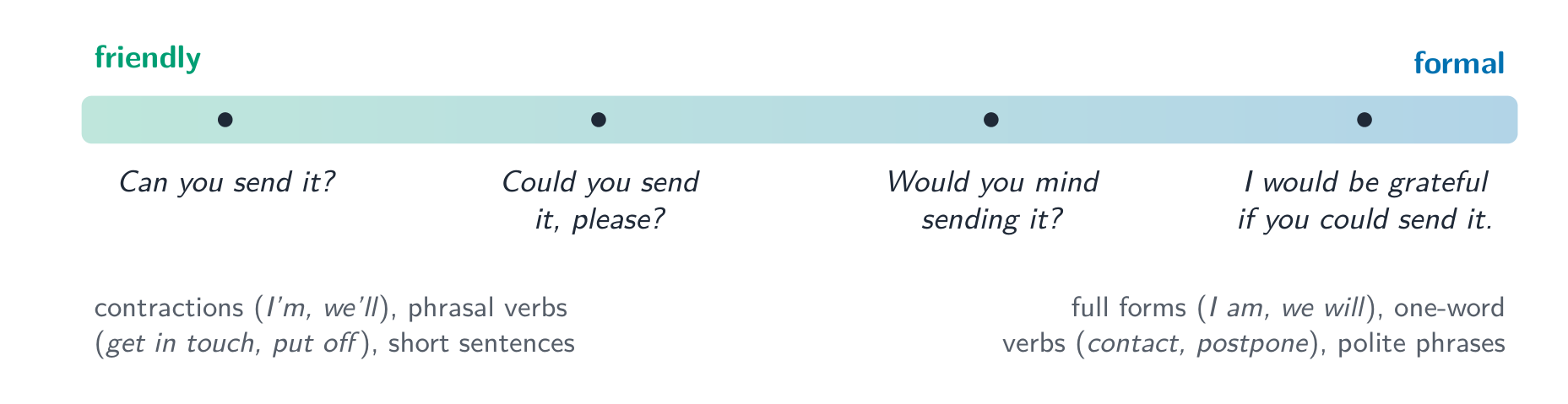
- Formal English uses full forms (I am, not I'm), longer polite phrases (I would be grateful if…) and one-word verbs (receive, contact, postpone).
- Friendly English uses contractions, phrasal verbs (get, get in touch, put off) and shorter sentences.
Order these requests from most friendly to most formal.
Dificuldade 3/5 · Moedas 200 + pequeno bônus na primeira conclusão hoje
Longer, more indirect phrases sound more formal.
Word pairs: friendly and formal
- get → receive · get in touch → contact · put off → postpone · find out → discover
- ask for → request · help → assist · buy → purchase · need → require
- Sorry about… → We apologise for… · Thanks for… → Thank you for…
- Don't overdo it. A short email to a colleague full of require and purchase sounds cold. Match the reader.
Friendly, neutral or formal?
Recognise the register of common business phrases
Match each friendly verb with its formal partner.
Dificuldade 2/5 · Moedas 140 + pequeno bônus na primeira conclusão hoje
Formal English often uses one-word verbs instead of phrasal verbs.
Make it formal: "We need your answer by Monday." → "We ___ your reply by Monday."
Dificuldade 1/5 · Moedas 100 + pequeno bônus na primeira conclusão hoje
Require is the formal partner of need.
One request, two readers
| To a colleague (friendly) | To a new supplier (formal) |
|---|---|
| Hi Jack, | Dear Mr Wong, |
| Can you send me the price list by Friday? We need it for the meeting. | I would be grateful if you could send us your current price list by Friday, as we require it for a meeting. |
| Thanks, Amy | Yours sincerely, Amy Lin |
- The content is the same; the register changes the greeting, the request, the verbs and the ending.
Register mistakes examiners notice
- Mixing registers: Dear Sir or Madam, … Cheers, Amy. Keep the whole text in one register.
- Too casual for a customer: Hey!, gonna, ASAP, emoji. Never in an exam answer.
- Wrong ending pair: Dear Ms Li … Yours faithfully. After a name, use Yours sincerely.
What is wrong with this letter: "Dear Sir or Madam, … I'm gonna send it ASAP. Cheers, Amy"?
Dificuldade 1/5 · Moedas 100 + pequeno bônus na primeira conclusão hoje
Keep the whole text in one register.
Choosing a register in five seconds
- Ask: who is the reader, and do I know them? Colleague you know → friendly. Outside or unknown → neutral to formal.
- Check the signals: greeting, contractions, request phrase, verbs, ending. All five should match.
- When in doubt, choose neutral: polite, clear and never wrong.
You are not sure how formal to be. What is the safest choice?
Dificuldade 1/5 · Moedas 100 + pequeno bônus na primeira conclusão hoje
Neutral English is polite and clear and is never wrong.
Rewrite this note to a colleague as a formal email to a new customer: "Hi! Sorry we're late with your stuff. It'll get to you on Tuesday. Thanks for waiting! Jo"
Check the five signals one by one; all five should be formal.
O que deu errado? Somente a equipe do site vê isso.