Molten binary compounds: metal at the cathode, non-metal at the anode
Introduzido| English | Significado |
|---|---|
| binary ionic compound/ˈbaɪnəri aɪˈɒnɪk ˈkɒmpaʊnd/ | composto iônico binário |
| molten electrolyte/ˈməʊltn ɪˈlektrəlaɪt/ | eletrólito fundido |
Lead and bromine from a white powder
- Heat white lead bromide powder until it melts and pass a current through it. Silvery beads of lead collect at one electrode; brown bromine vapour rises from the other.
- This is a binary ionic compound 二元离子化合物 — made of just two elements — and the rule for its products is simple.
Which are binary ionic compounds?
Dificuldade 2/5 · Moedas 140 + pequeno bônus na primeira conclusão hoje
CuSO₄ contains three elements.
Why it must be molten
- A molten electrolyte 熔融电解质 has free ions and no water.
- So the only ions that can react are the metal ions and the non-metal ions of the compound itself.
Why do no other products form in a molten binary compound?
Dificuldade 1/5 · Moedas 100 + pequeno bônus na primeira conclusão hoje
Only the compound's own ions are present.
The rule
- The metal forms at the cathode (negative).
- The non-metal forms at the anode (positive).
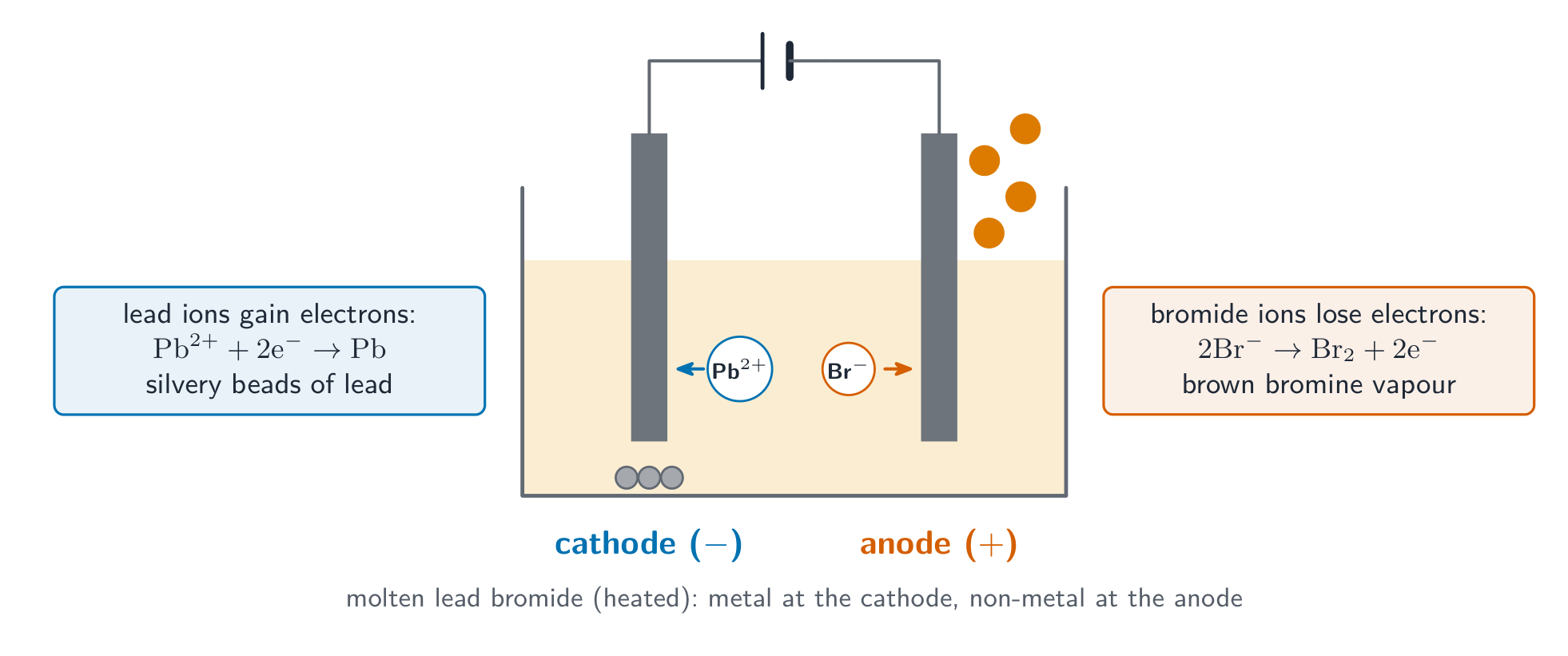
Worked example: lead bromide
Predict the products of electrolysing molten PbBr₂.
- Ions: Pb²⁺ and Br⁻.
- Cathode: Pb²⁺ is attracted and forms lead metal (a silvery liquid at the bottom).
- Anode: Br⁻ is attracted and forms bromine (brown gas).
Molten lead bromide splits at the electrodes
Pb²⁺ ions drift to the negative cathode and form lead; Br⁻ ions drift to the positive anode and form bromine. The metal always forms at the cathode of a molten binary compound.
What forms at the anode when molten zinc bromide is electrolysed?
Dificuldade 1/5 · Moedas 100 + pequeno bônus na primeira conclusão hoje
The non-metal forms at the anode.
In molten lead bromide, lead forms at the ____.
Dificuldade 1/5 · Moedas 100 + pequeno bônus na primeira conclusão hoje
Pb²⁺ is attracted to the negative electrode.
More examples
- Molten sodium chloride → sodium (cathode) + chlorine (anode).
- Molten zinc iodide → zinc (cathode) + iodine (anode).
Molten sodium chloride is electrolysed. What forms at each electrode?
Dificuldade 2/5 · Moedas 140 + pequeno bônus na primeira conclusão hoje
Metal at the cathode.
This rule is for molten compounds only. If sodium chloride is dissolved in water, hydrogen forms at the cathode, not sodium, because water provides H⁺ ions. Always check whether the electrolyte is molten or aqueous.
Electrolysis of sodium chloride solution gives sodium at the cathode.
Dificuldade 1/5 · Moedas 100 + pequeno bônus na primeira conclusão hoje
Hydrogen forms in solution.
When a molten binary ionic compound is electrolysed, the metal forms at the cathode and the non-metal at the anode. There is no water, so no other ions compete.
Predict and explain the products of electrolysing molten potassium iodide.
Metal at cathode, non-metal at anode.