Higher Tier, Chemistry-only: determine acid concentration from RP2 data
Introduzido| English | Significado |
|---|---|
| known concentration/nəʊn ˌkɒnsənˈtreɪʃn/ | concentração conhecida |
| standard solution/ˈstændəd səˈluːʃn/ | A solution whose concentration is known exactly. |
Checking battery acid
- Car batteries contain sulfuric acid, which must be about 4–5 mol/dm³ to work well. Technicians and manufacturers check the concentration by titration.
- The trick: use an alkali of known concentration 已知浓度 — a standard solution 标准溶液 — and the equation ratio.
- This lesson is Higher Tier.
The steps
- 1. Moles of the standard solution $= c \times V$.
- 2. Use the balanced equation to find moles of the acid.
- 3. Acid concentration $= \dfrac{\text{moles}}{\text{titre in dm}^3}$.
How many moles are in 25.0 cm³ of 0.200 mol/dm³ NaOH?
Dificuldade 2/5 · Moedas 140 + pequeno bônus na primeira conclusão hoje
$0.200 \times 0.0250 = 0.00500$ mol.
The 2 : 1 ratio
- $\text{H}_2\text{SO}_4 + 2\text{NaOH} \rightarrow \text{Na}_2\text{SO}_4 + 2\text{H}_2\text{O}$.
- Each sulfuric acid molecule reacts with two NaOH, so moles of acid = moles of NaOH ÷ 2.
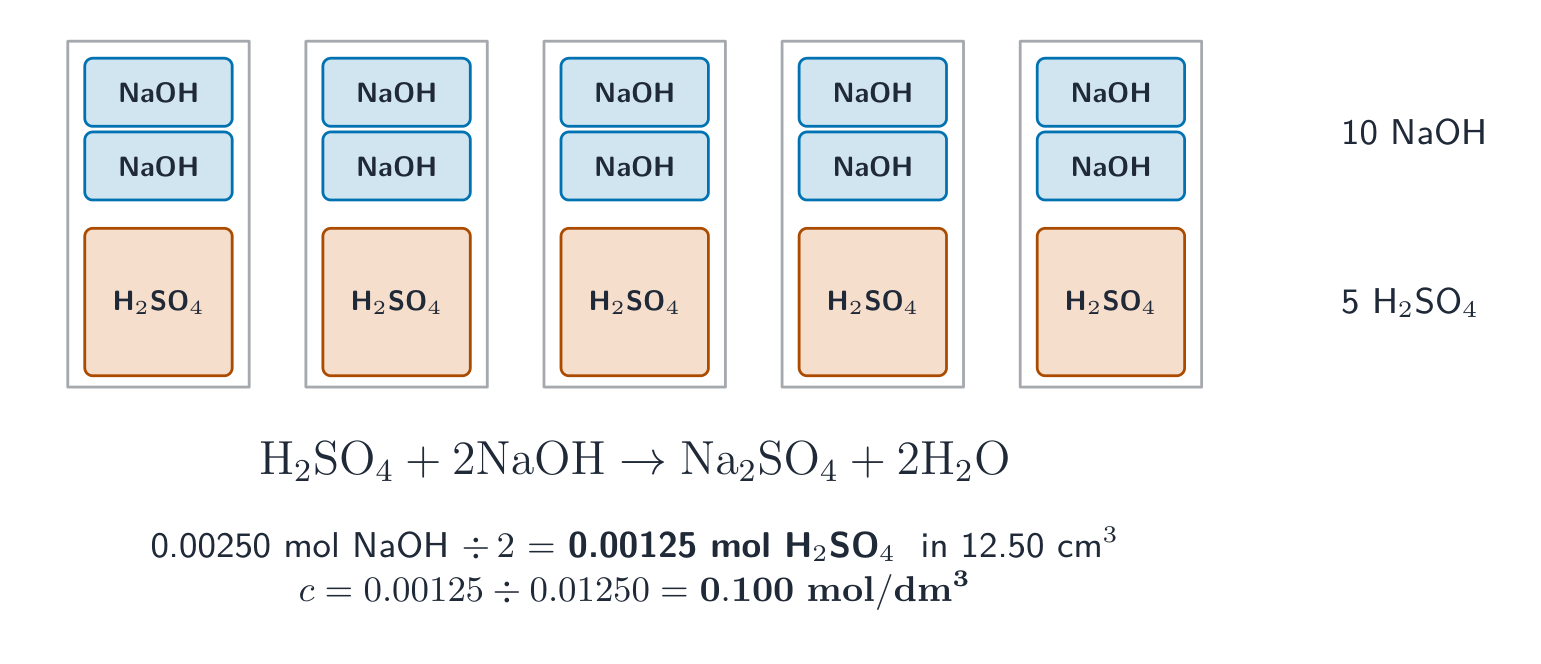
0.00500 mol of NaOH reacts with sulfuric acid. How many moles of H₂SO₄ is that?
Dificuldade 2/5 · Moedas 140 + pequeno bônus na primeira conclusão hoje
Halve it.
Worked example: sulfuric acid
25.0 cm³ of 0.100 mol/dm³ NaOH is neutralised by a titre of 12.50 cm³ of sulfuric acid.
- Moles of NaOH $= 0.100 \times 0.0250 = 0.00250$ mol.
- Moles of H₂SO₄ $= \dfrac{0.00250}{2} = 0.00125$ mol.
- Concentration $= \dfrac{0.00125}{0.01250} = 0.100 \, \dfrac{\text{mol}}{\text{dm}^3}$.
From the acid titre to the acid concentration
$n(\mathrm{H_2SO_4})=\tfrac12\,n(\mathrm{NaOH}),\quad c=n/V$
25.0 cm³ of 0.100 mol/dm³ NaOH holds 0.00250 mol; the acid amount is half that, 0.00125 mol, in a 12.50 cm³ titre, so the acid is 0.100 mol/dm³.
25.0 cm³ of 0.200 mol/dm³ NaOH needs 20.0 cm³ of H₂SO₄. What is the acid concentration?
Dificuldade 2/5 · Moedas 140 + pequeno bônus na primeira conclusão hoje
0.00250 mol ÷ 0.0200 dm³ = 0.125.
25.0 cm³ of 0.100 mol/dm³ NaOH needs 20.0 cm³ of HCl. What is the HCl concentration?
Dificuldade 2/5 · Moedas 140 + pequeno bônus na primeira conclusão hoje
Ratio 1 : 1; 0.00250 ÷ 0.0200 = 0.125.
Converting to g/dm³
- Multiply by $M_r$: $0.100 \times 98 = 9.8 \, \dfrac{\text{g}}{\text{dm}^3}$ of sulfuric acid.
- Reports often give both units.
Convert 0.125 mol/dm³ H₂SO₄ ($M_r$ 98) to g/dm³. Give your answer to 3 significant figures.
Dificuldade 2/5 · Moedas 140 + pequeno bônus na primeira conclusão hoje
$0.125 \times 98 = 12.25$ ≈ 12.3.
Halving goes the right way. Students often double the NaOH moles to get the acid moles. Sulfuric acid needs two NaOH each, so it has half as many moles. Check with the equation every time.
To get the moles of H₂SO₄, double the moles of NaOH.
Dificuldade 1/5 · Moedas 100 + pequeno bônus na primeira conclusão hoje
Halve them.
Use the standard solution's $c \times V$ to find its moles, apply the equation ratio (halve for sulfuric acid with NaOH), and divide by the titre in dm³ to find the acid's concentration. Multiply by $M_r$ for g/dm³.
25.0 cm³ of 0.150 mol/dm³ KOH is neutralised by 15.0 cm³ of H₂SO₄ ($2\text{KOH} + \text{H}_2\text{SO}_4 \rightarrow \text{K}_2\text{SO}_4 + 2\text{H}_2\text{O}$). Calculate the acid concentration.
c × V, ratio, ÷ V.