Higher Tier: find which reactant limits the product
Introduzido| English | Significado |
|---|---|
| limiting reactant/ˈlɪmɪtɪŋ rɪˈæktənt/ | reactivo limitante |
| excess reactant/ekˈses rɪˈæktənt/ | reactivo em excesso |
Not enough bread
- You have 10 slices of bread and 8 slices of cheese. Each sandwich needs 2 bread and 1 cheese. You can make only 5 sandwiches — bread runs out, and 3 cheese slices are left.
- Reactions work the same way. The reactant that runs out first stops the reaction.
- This lesson is Higher Tier.
Limiting and excess
- The limiting reactant 限量反应物 is used up completely. It decides how much product forms.
- The excess reactant 过量反应物 is left over when the reaction stops.
Match each term to its meaning.
Dificuldade 2/5 · Moedas 140 + pequeno bônus na primeira conclusão hoje
The first one to run out limits.
How to find it
- 1. Convert both reactants to moles.
- 2. Use the equation ratio to work out how much of the other reactant each one needs.
- 3. The one that cannot be fully matched is the limiting reactant.
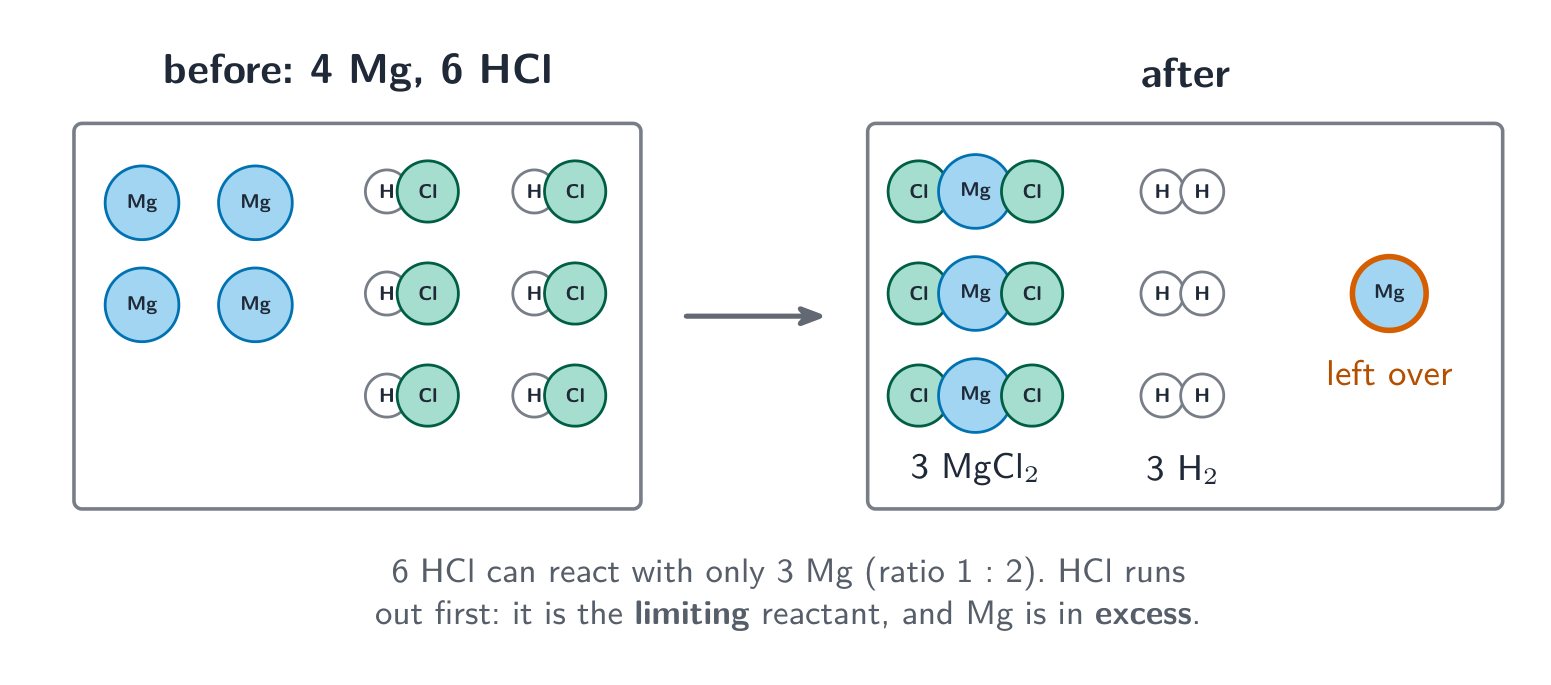
Worked example: magnesium and acid
4.8 g of Mg ($A_r$ 24) is added to 0.30 mol of HCl. $\text{Mg} + 2\text{HCl} \rightarrow \text{MgCl}_2 + \text{H}_2$
- Moles of Mg $= \dfrac{4.8}{24} = 0.20$ mol. This needs $0.40$ mol HCl — but there is only 0.30.
- HCl limits. It reacts with $\dfrac{0.30}{2} = 0.15$ mol Mg and makes 0.15 mol H₂.
- Mg left over $= 0.20 - 0.15 = 0.05$ mol $= 0.05 \times 24 = 1.2$ g.
Which reactant runs out first?
$\mathrm{Mg + 2HCl \rightarrow MgCl_2 + H_2}$
4.8 g of magnesium is 0.20 mol, but 0.30 mol HCl can react with only 0.15 mol of it. HCl limits, 0.15 mol of H₂ forms and 1.2 g of magnesium is left over.
In $\text{Mg} + 2\text{HCl} \rightarrow \text{MgCl}_2 + \text{H}_2$, how many moles of HCl react with 0.25 mol of Mg?
Dificuldade 2/5 · Moedas 140 + pequeno bônus na primeira conclusão hoje
Ratio 1 : 2.
0.10 mol Mg is added to 0.30 mol HCl. Which is limiting?
Dificuldade 1/5 · Moedas 100 + pequeno bônus na primeira conclusão hoje
0.10 mol Mg needs 0.20 mol HCl; 0.30 is available.
0.10 mol Mg is added to 0.30 mol HCl. How many moles of H₂ form?
Dificuldade 2/5 · Moedas 140 + pequeno bônus na primeira conclusão hoje
Mg limits; ratio 1 : 1 with H₂.
3.6 g Mg ($A_r$ 24) is added to 0.20 mol HCl. What mass of Mg is left over?
Dificuldade 2/5 · Moedas 140 + pequeno bônus na primeira conclusão hoje
0.15 mol Mg; HCl reacts with 0.10 mol; 0.05 mol × 24 = 1.2 g.
Why use an excess on purpose?
- Chemists often add one cheap reactant in excess so that the expensive one reacts completely.
- In the lab, adding excess solid metal to acid makes sure all the acid reacts; the leftover metal is filtered off.
Why might a chemist use an excess of a cheap reactant?
Dificuldade 1/5 · Moedas 100 + pequeno bônus na primeira conclusão hoje
The costly one becomes limiting.
The reactant with fewer grams is not always the limiting one. Compare moles, and use the equation ratio. Here Mg had more moles (0.20) than half the HCl (0.15), so the acid, not the magnesium, ran out.
The limiting reactant is used up first and sets the amount of product; the other reactant is in excess. Find it by converting to moles and comparing with the ratio in the balanced equation.
In $2\text{H}_2 + \text{O}_2 \rightarrow 2\text{H}_2\text{O}$, 0.60 mol H₂ is mixed with 0.40 mol O₂. Find the limiting reactant and the moles of water made.
Compare with the ratio.