An open vessel: explain mass entering or escaping as gas
Introduzido| English | Significado |
|---|---|
| open system/ˈəʊpən ˈsɪstəm/ | sistema aberto |
| thermal decomposition/ˈθɜːml ˌdiːkɒmpəˈzɪʃn/ | decomposição térmica |
Making lime
- To make lime for cement, limestone (calcium carbonate) is heated in a kiln to about 900 °C. Tonnes of it go in; a much lighter solid comes out.
- Yet when magnesium ribbon is heated in air, the solid gets heavier.
- Both happen in an open system 开放系统 — gas can cross the boundary.
A gas leaves: mass falls
- Thermal decomposition 热分解 breaks a substance down using heat. $\text{CaCO}_3 \rightarrow \text{CaO} + \text{CO}_2$.
- The carbon dioxide escapes, so the solid left behind is lighter.
Breaking down a compound by heating it is called thermal ____.
Dificuldade 1/5 · Moedas 100 + pequeno bônus na primeira conclusão hoje
Heat splits CaCO₃ into CaO and CO₂.
A gas joins: mass rises
- $2\text{Mg} + \text{O}_2 \rightarrow 2\text{MgO}$. Oxygen from the air becomes part of the solid.
- The magnesium oxide weighs more than the magnesium, because it now contains oxygen atoms too.
Does the mass of the solid increase or decrease when heated in an open container?
Dificuldade 2/5 · Moedas 140 + pequeno bônus na primeira conclusão hoje
Carbonates lose CO₂; metals gain oxygen.
1.2 g of magnesium burns to make 2.0 g of magnesium oxide. What mass of oxygen reacted?
Dificuldade 2/5 · Moedas 140 + pequeno bônus na primeira conclusão hoje
$2.0 - 1.2 = 0.8$ g.
Why does magnesium get heavier when it burns?
Dificuldade 1/5 · Moedas 100 + pequeno bônus na primeira conclusão hoje
The oxide contains oxygen too.
Worked example: heating limestone
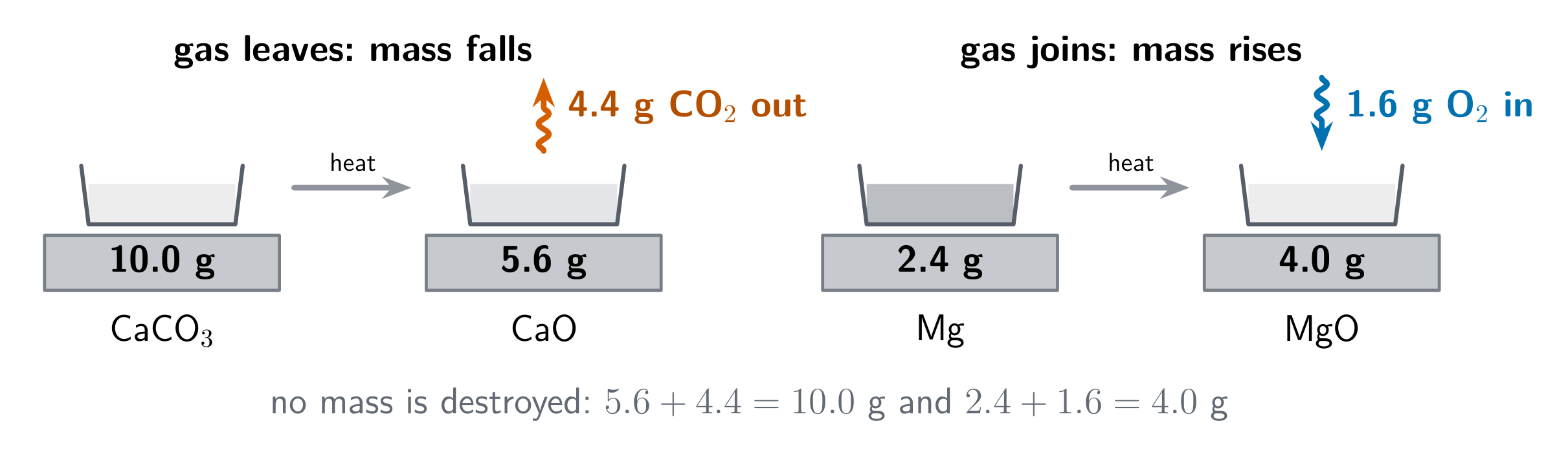
10.0 g of calcium carbonate is heated strongly. 5.6 g of calcium oxide is left.
- Mass lost $= 10.0 - 5.6 = 4.4$ g.
- Explanation: 4.4 g of carbon dioxide escaped.
- Check: $5.6 + 4.4 = 10.0$ g — no mass was destroyed.
Mass lost is the gas that escaped
10.0 g of calcium carbonate leaves 5.6 g of calcium oxide. The missing 4.4 g left as carbon dioxide: 5.6 + 4.4 = 10.0 g, so no mass was destroyed.
25.0 g of calcium carbonate leaves 14.0 g of calcium oxide when heated. What mass of carbon dioxide escaped?
Dificuldade 2/5 · Moedas 140 + pequeno bônus na primeira conclusão hoje
$25.0 - 14.0 = 11.0$ g.
In the lab
- Acid + carbonate in an open flask on a balance: the reading falls as CO₂ fizzes out.
- A cotton-wool plug lets the gas out but stops acid spray, so the mass loss is all gas.
A mass change does not mean the law failed. It means a gas crossed the boundary of the system you weighed. Say which gas, and whether it left or joined.
A fall in mass in an open beaker shows that atoms were destroyed.
Dificuldade 1/5 · Moedas 100 + pequeno bônus na primeira conclusão hoje
A gas left the system.
In an open system, mass can appear to change. It falls when a gaseous product escapes (carbonates, acid reactions) and rises when a gas from the air reacts (metals burning in oxygen). Counting the gas always balances the masses.
Marble chips and acid are in an open flask on a balance. Explain why the reading falls, and how you would show mass is conserved.
Close the boundary.