Proton number identifies the element; electrons determine net charge
Introduzido| English | Significado |
|---|---|
| protons/ˈprəʊtɒnz/ | Positively charged subatomic particles found in atomic nuclei. |
| electrons/ɪˈlektrɒnz/ | Negatively charged subatomic particles found outside atomic nuclei. |
| ion/ˈaɪɒn/ | íon |
| neutrons/ˈnjuːtrɒnz/ | Electrically neutral subatomic particles found in most atomic nuclei. |
| atomic number/əˈtɒmɪk ˈnʌmbə/ | número atômico |
One number identifies an element
- Every atom with 6 protons is carbon — in diamond, in your body or in a star. An atom with 7 protons is nitrogen.
- Change the number of protons and you have a different element. Change the number of electrons and you have an ion 离子 of the same element.
- Three particles make every atom.
Protons, neutrons and electrons
- Protons (charge +1) and neutrons (charge 0) are in the nucleus.
- Electrons (charge −1) are outside the nucleus, in shells.
- The atomic number 原子序数 is the number of protons. It defines the element and its place in the periodic table.
Match each particle to its relative charge.
Dificuldade 2/5 · Moedas 140 + pequeno bônus na primeira conclusão hoje
Protons and electrons have opposite charges.
What decides which element an atom is?
Dificuldade 1/5 · Moedas 100 + pequeno bônus na primeira conclusão hoje
The atomic number is the proton number.
Why atoms are neutral
- In an atom, the number of electrons equals the number of protons, so the charges cancel.
- An aluminium atom has 13 protons (+13) and 13 electrons (−13): total charge 0.
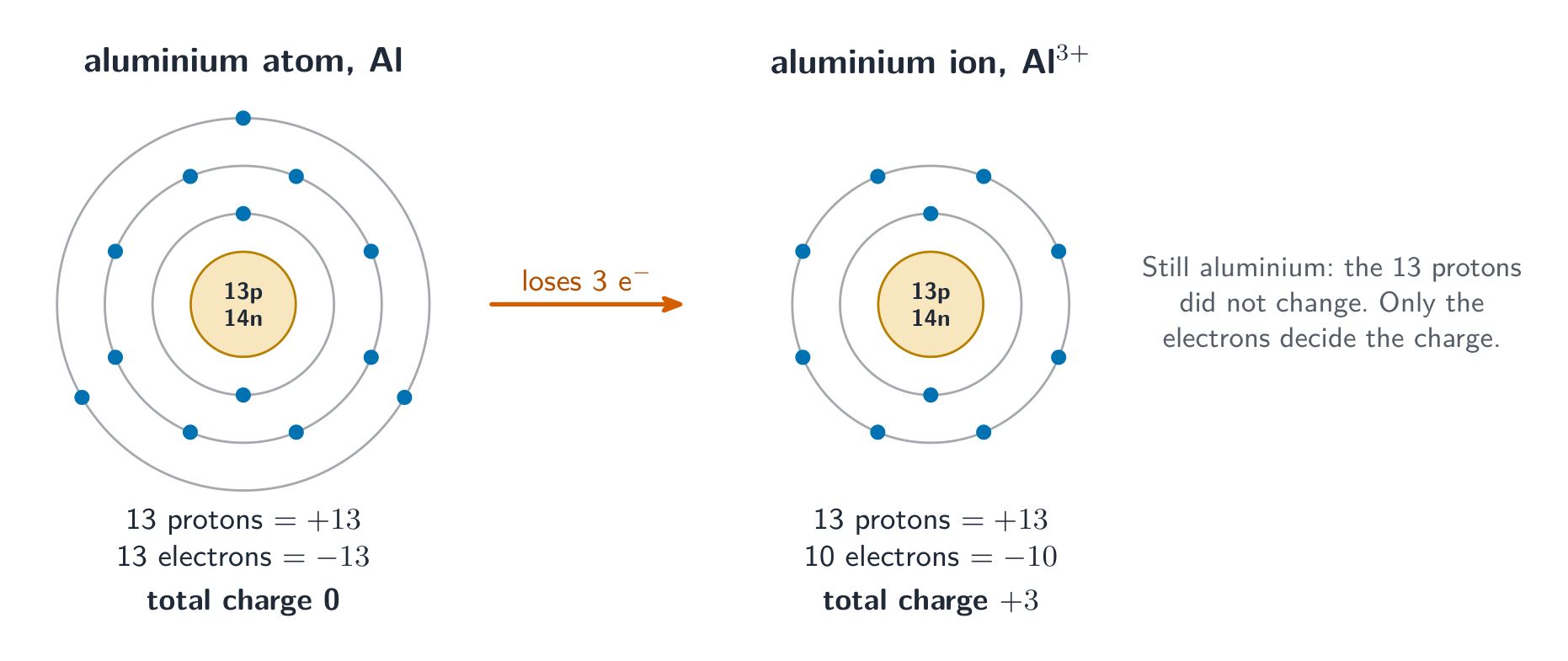
Worked example: identifying a particle
A particle has 13 protons, 14 neutrons and 10 electrons.
- Element: 13 protons, so aluminium.
- Charge $= \text{protons} - \text{electrons} = 13 - 10 = +3$: it is the ion Al³⁺.
- Neutrons do not change the charge or the element; they change only the mass.
Element, isotope and charge are different
Proton number identifies the element; neutron changes distinguish isotopes and electron changes distinguish ions.
A particle has 16 protons and 18 electrons. What is its charge?
Dificuldade 2/5 · Moedas 140 + pequeno bônus na primeira conclusão hoje
$16 - 18 = -2$: the sulfide ion S²⁻.
Forming ions
- Metal atoms lose electrons and become positive ions: Na (11 electrons) → Na⁺ (10 electrons).
- Non-metal atoms gain electrons and become negative ions: Cl (17 electrons) → Cl⁻ (18 electrons).
How many electrons are in a Mg²⁺ ion? (Magnesium has atomic number 12.)
Dificuldade 2/5 · Moedas 140 + pequeno bônus na primeira conclusão hoje
$12 - 2 = 10$.
Which type of ion do metals usually form?
Dificuldade 1/5 · Moedas 100 + pequeno bônus na primeira conclusão hoje
Metal atoms lose their outer electrons.
A positive ion has lost electrons, not gained protons. The number of protons never changes in a chemical reaction — if it did, the element would change. Na⁺ still has 11 protons.
Na⁺ has one more proton than a sodium atom.
Dificuldade 1/5 · Moedas 100 + pequeno bônus na primeira conclusão hoje
It has one fewer electron; the proton number is unchanged.
The atomic number is the number of protons and identifies the element. Atoms are neutral because electrons equal protons. Losing electrons gives a positive ion; gaining them gives a negative ion. Charge = protons − electrons.
Explain why a sodium atom is neutral but a sodium ion has a charge of +1.
Charge = protons − electrons.