Amounts, equations and limiting reagents
Introduzido| English | Significado |
|---|---|
| mole/məʊl/ | mol |
| relative formula mass/ˈrelətɪv ˈfɔːmjʊlə mæs/ | The sum of the relative atomic masses of the atoms in a formula, written Mr. |
| Avogadro constant/ˌævəˈɡædrəʊ ˈkɒnstənt/ | The number of particles in one mole of a substance, 6.02 × 10²³. |
| limiting reagent/ˈlɪmɪtɪŋ rɪˈeɪdʒənt/ | reactivo limitante |
| concentration/ˌkɒnsənˈtreɪʃn/ | The amount of a substance per unit volume of a mixture or solution. |
| titration/taɪˈtreɪʃn/ | A method of finding an unknown concentration by measuring the volume needed to react with a solution of known concentration. |
| atom economy/ˈætəm ɪˈkɒnəmi/ | The mass of the desired product as a percentage of the total mass of all products. |
| percentage yield/pəˈsentɪdʒ jiːld/ | Actual product yield divided by the theoretical maximum yield, multiplied by one hundred. |
72 litres in 30 milliseconds
- A car airbag holds about 130 g of sodium azide. In a crash, a spark sets off $2\text{NaN}_3 \rightarrow 2\text{Na} + 3\text{N}_2$, and the bag fills with nitrogen in about 30 ms.
- Engineers must know exactly how much gas a given mass makes. That calculation uses the mole 摩尔: 130 g of $\text{NaN}_3$ makes about 72 litres of nitrogen.
The mole
- The relative formula mass 相对式量 $M_r$ is the sum of the relative atomic masses: $\text{NaN}_3 = 23 + 3 \times 14 = 65$.
- One mole contains $6.02 \times 10^{23}$ particles (the Avogadro constant 阿伏加德罗常数) and has a mass equal to $M_r$ in grams. So $n = \dfrac{m}{M}$: 130 g of $\text{NaN}_3$ is $\dfrac{130}{65} = 2.0$ mol.
What is the relative formula mass of calcium carbonate, $\text{CaCO}_3$? (Ca = 40, C = 12, O = 16)
Dificuldade 2/5 · Moedas 140 + pequeno bônus na primeira conclusão hoje
$40 + 12 + 3 \times 16 = 100$.
How many moles are in 9.0 g of water? ($M_r = 18$)
Dificuldade 2/5 · Moedas 140 + pequeno bônus na primeira conclusão hoje
$n = \dfrac{9.0}{18} = 0.50$ mol.
Equations give mole ratios
- A balanced equation gives the ratio of moles, not of masses. In $\text{Mg} + 2\text{HCl} \rightarrow \text{MgCl}_2 + \text{H}_2$, 1 mol of Mg reacts with 2 mol of HCl and gives 1 mol of $\text{H}_2$.
- At room temperature and pressure, one mole of any gas fills $24\ \text{dm}^3$. So 2.0 mol of $\text{NaN}_3$ gives 3.0 mol of $\text{N}_2$, which is $3.0 \times 24 = 72\ \text{dm}^3$.
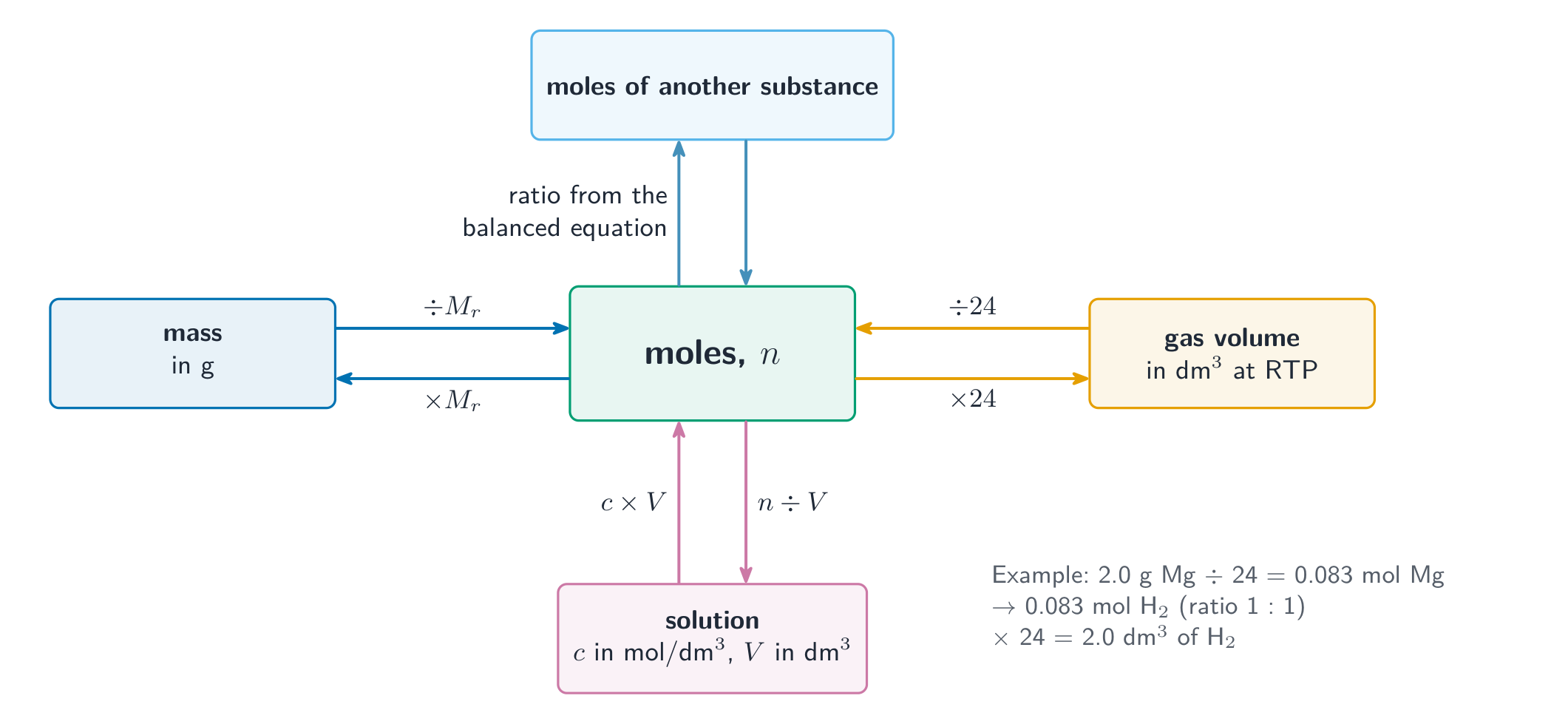
50 g of $\text{CaCO}_3$ is heated: $\text{CaCO}_3 \rightarrow \text{CaO} + \text{CO}_2$. What volume of $\text{CO}_2$ forms at room conditions, in dm³?
Dificuldade 2/5 · Moedas 140 + pequeno bônus na primeira conclusão hoje
$\dfrac{50}{100} = 0.50$ mol $\text{CaCO}_3$ gives 0.50 mol $\text{CO}_2$, and $0.50 \times 24 = 12\ \text{dm}^3$.
Worked example: the limiting reagent
2.0 g of magnesium is added to $50\ \text{cm}^3$ of $2.0\ \dfrac{\text{mol}}{\text{dm}^3}$ hydrochloric acid. Which reactant runs out, and what volume of hydrogen forms?
- Moles: Mg: $\dfrac{2.0}{24} = 0.0833$ mol. HCl: $c \times V = 2.0 \times \dfrac{50}{1000} = 0.100$ mol.
- Compare with the ratio: 0.0833 mol Mg needs $2 \times 0.0833 = 0.167$ mol HCl, but only 0.100 mol is there. HCl is the limiting reagent 限量试剂; Mg is in excess.
- Product from the limiting reagent: 0.100 mol HCl gives $\dfrac{0.100}{2} = 0.050$ mol $\text{H}_2$, which is $0.050 \times 24 = 1.2\ \text{dm}^3$.
Moles set the reaction endpoint
$n_A/a\quad\text{compared with}\quad n_B/b$
Convert mass into moles, compare amounts divided by equation coefficients, and track what is used, formed and left. Changing starting amounts can change the limiting reactant.
0.20 mol of $\text{H}_2$ is mixed with 0.20 mol of $\text{O}_2$: $2\text{H}_2 + \text{O}_2 \rightarrow 2\text{H}_2\text{O}$. Which is the limiting reagent?
Dificuldade 1/5 · Moedas 100 + pequeno bônus na primeira conclusão hoje
The ratio is 2 : 1. 0.20 mol $\text{H}_2$ uses 0.10 mol $\text{O}_2$, so oxygen is left over and hydrogen runs out.
Concentration
- Concentration 浓度 is the amount dissolved per volume: $c = \dfrac{n}{V}$, in $\dfrac{\text{mol}}{\text{dm}^3}$. Change $\text{cm}^3$ to $\text{dm}^3$ by dividing by 1000.
- In a titration 滴定, the volume of a solution of known concentration that just reacts gives the moles, and the equation gives the unknown concentration.
0.25 mol of sodium hydroxide is dissolved to make $500\ \text{cm}^3$ of solution. What is the concentration, in mol/dm³?
Dificuldade 2/5 · Moedas 140 + pequeno bônus na primeira conclusão hoje
$c = \dfrac{0.25}{0.500} = 0.50\ \dfrac{\text{mol}}{\text{dm}^3}$.
Yield and atom economy
- Percentage yield 产率 $= \dfrac{\text{actual mass}}{\text{theoretical mass}} \times 100\,\%$. It is below 100 % because of losses, side reactions and reversible reactions.
- Atom economy 原子经济性 $= \dfrac{M_r \text{ of the useful product}}{\text{total } M_r \text{ of all products}} \times 100\,\%$. A process with high atom economy wastes fewer atoms.
A reaction should make 8.0 g of product but makes 6.0 g. What is the percentage yield?
Dificuldade 2/5 · Moedas 140 + pequeno bônus na primeira conclusão hoje
$\dfrac{6.0}{8.0} \times 100 = 75\,\%$.
Equations compare moles, not grams. In $\text{Mg} + 2\text{HCl}$, 1 g of magnesium does not react with 2 g of acid. Change every mass into moles first, use the ratio, then change back to mass or volume.
In $\text{Mg} + 2\text{HCl} \rightarrow \text{MgCl}_2 + \text{H}_2$, 24 g of magnesium reacts with 48 g of HCl.
Dificuldade 1/5 · Moedas 100 + pequeno bônus na primeira conclusão hoje
1 mol Mg (24 g) reacts with 2 mol HCl, which is $2 \times 36.5 = 73$ g, not 48 g.
Amount in moles is $n = \dfrac{m}{M}$, $n = cV$ for solutions, and volume ÷ 24 for gases at room conditions. A balanced equation gives the mole ratio. Find the limiting reagent by comparing what you have with what the ratio needs, and calculate products from it.
Iron is made by $\text{Fe}_2\text{O}_3 + 3\text{CO} \rightarrow 2\text{Fe} + 3\text{CO}_2$. What mass of iron can be made from 320 kg of iron(III) oxide? (Fe = 56, O = 16)
Mass → moles → ratio → mass.