A Guerra Fria
Introduzido| English | Significado |
|---|---|
| Non-Aligned Movement/nɒn əˈlaɪnd ˈmuːvmənt/ | Movimento dos Países Não-Alinhados |
| Cold War/kəʊld wɔː/ | Guerra Fria |
| superpowers/ˈsuːpəpaʊəz/ | superpotências |
Twenty-nine nations at Bandung, April 1955
- In April 1955, leaders from 29 Asian and African countries met in Bandung, Indonesia. Most had only recently won independence. India's Nehru, Egypt's Nasser, Indonesia's Sukarno and China's Zhou Enlai attended. Sukarno called it "the first intercontinental conference of coloured peoples in the history of mankind". The meeting led to the Non-Aligned Movement 不结盟运动, founded in Belgrade in 1961.
- After 1945, the Cold War 冷战 divided the world between two superpowers, while many new states refused to choose a side.
How many countries met at Bandung in 1955?
Dificuldade 2/5 · Moedas 140 + pequeno bônus na primeira conclusão hoje
Asian and African states.
Two superpowers, two systems
- The US promoted capitalism and liberal democracy; the Soviet Union promoted communism and a one-party state.
- Both became superpowers 超级大国 — states with global military and economic reach.
Match each superpower to its system.
Dificuldade 2/5 · Moedas 140 + pequeno bônus na primeira conclusão hoje
Two systems and a third way.
A struggle everywhere
- The rivalry reached Europe (the Berlin crises), Asia (Korea, Vietnam), Africa (Angola) and Latin America (Cuba).
- It also covered science and culture: the space race, sport and propaganda.
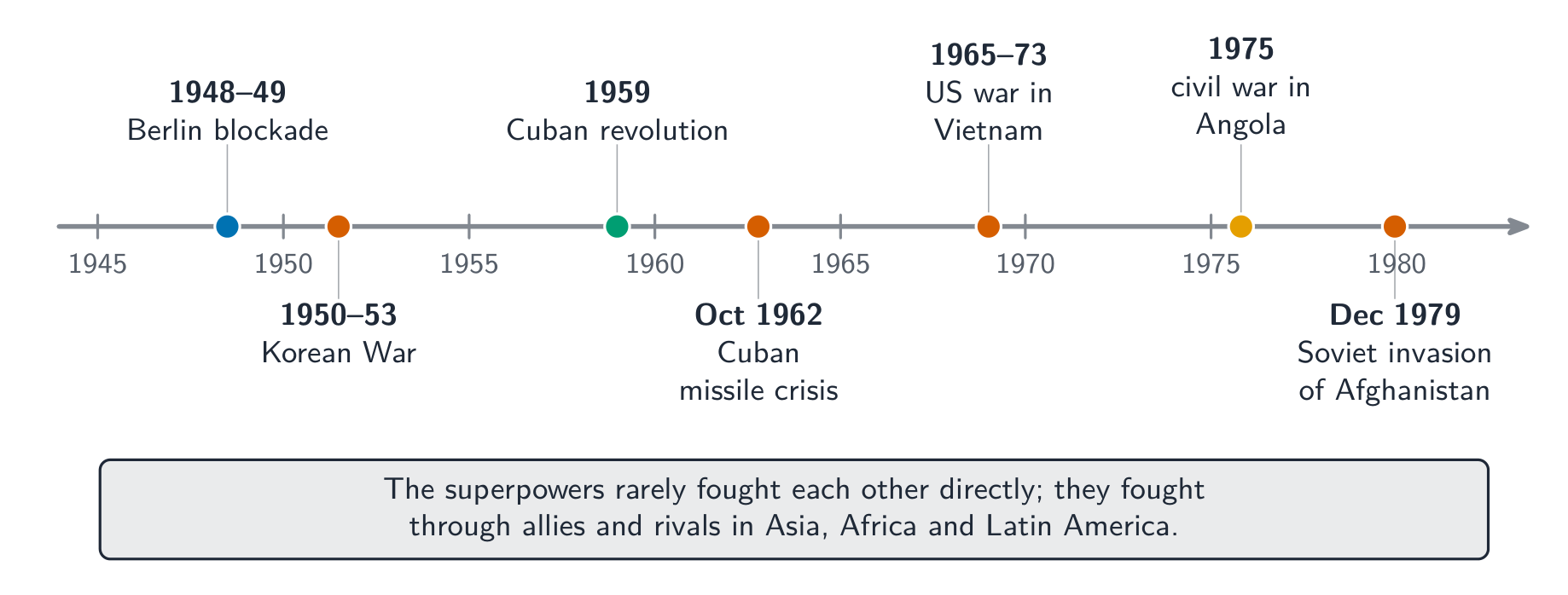
Watch a rivalry take a shape
The Cold War is a competition that never becomes a direct war, so what it built instead is the content.
Where did the Cold War rivalry reach?
Dificuldade 2/5 · Moedas 140 + pequeno bônus na primeira conclusão hoje
It was everywhere.
Worked example: Indian non-alignment
- Position: Nehru refused to join either bloc, arguing that India needed peace and aid from everyone.
- Practice: India took aid from both — US food aid and Soviet help to build the Bhilai steel plant (1959).
- Effect: non-alignment let a poor new state keep its independence and gain from both sides.
How did India benefit from non-alignment?
Dificuldade 1/5 · Moedas 100 + pequeno bônus na primeira conclusão hoje
US food aid and the Bhilai steel plant.
Ideological conflict had content
- The argument was about real choices: private or state ownership, multiparty elections or one party.
- Each side presented itself as the model for newly independent states.
Causes and effects
- Causes: different ideologies and wartime mistrust; Soviet control of Eastern Europe; the atomic bomb.
- Effects: arms races, alliances, proxy wars — and the Non-Aligned Movement.
Put these in order.
Dificuldade 3/5 · Moedas 200 + pequeno bônus na primeira conclusão hoje
1955, 1959, 1961, 1962.
Not every country was on one side. Many states, led by India, Egypt, Indonesia and Yugoslavia, chose non-alignment.
Every country joined one of the two blocs.
Dificuldade 1/5 · Moedas 100 + pequeno bônus na primeira conclusão hoje
Many chose non-alignment.
After 1945, the US and Soviet Union competed with rival systems in every region and in science and culture. Many new states, meeting at Bandung in 1955, refused to choose, forming the Non-Aligned Movement and gaining aid from both sides.
Explain why many new states chose non-alignment.
Causation.