Industry Spreads, and Shares Shift
Introduzido| English | Significado |
|---|---|
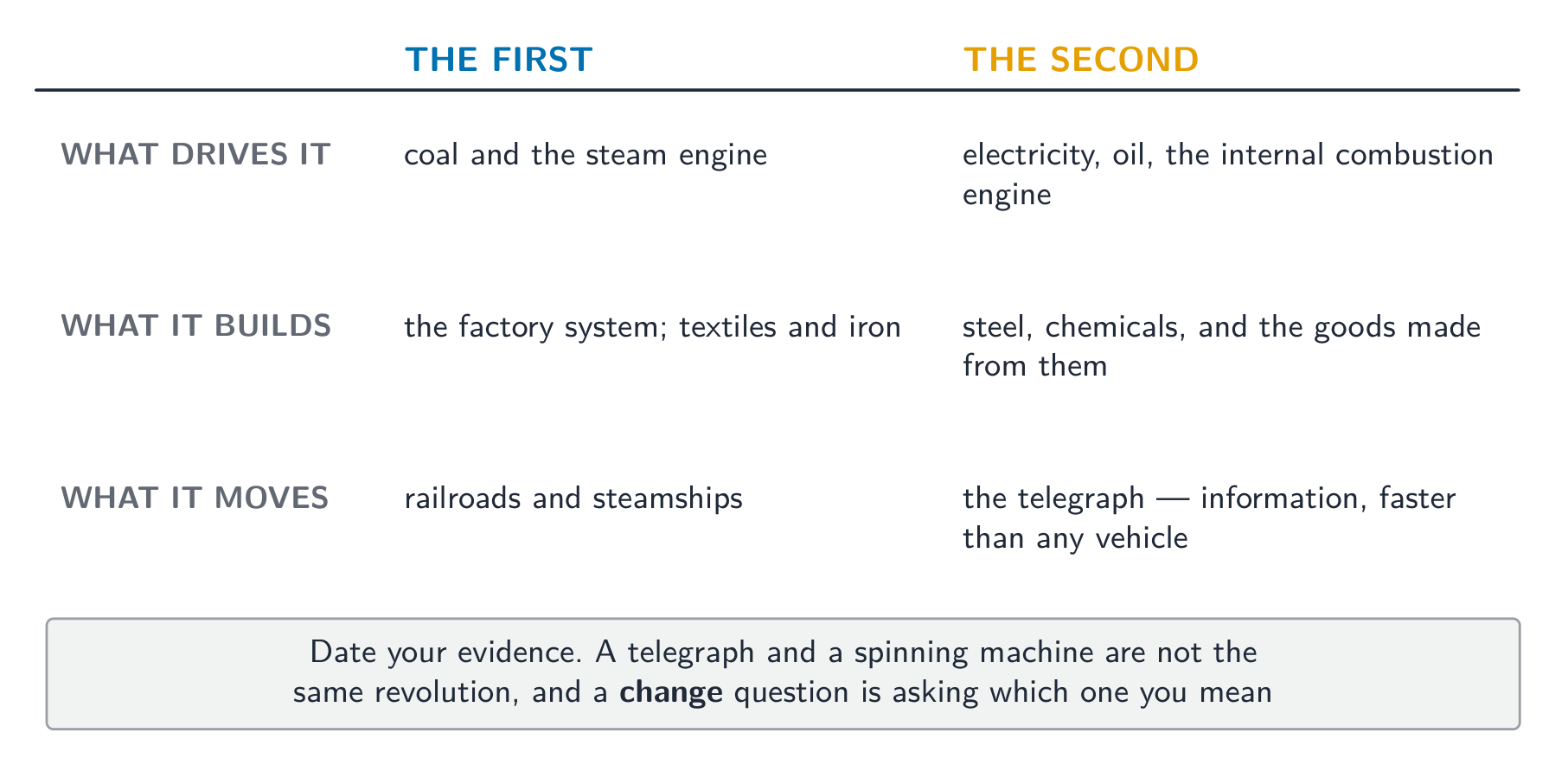
| second industrial revolution/ˈsekənd ɪnˈdʌstrɪəl ˌrevəˈluːʃn/ | The later industrial wave of steel, chemicals, electricity, and oil. |
A railway across Asia, May 1891
- On 31 May 1891, the future Tsar Nicholas II laid the first stone of the Trans-Siberian Railway in Vladivostok. The Russian finance minister Sergei Witte used state money and foreign loans to build it. When it was finished in 1916, it ran about 9300 km from Moscow to the Pacific — the longest railway in the world. Industry was spreading far beyond Britain.
- After 1750, industrialisation spread from northwestern Europe to the US, Russia and Japan, and the world's shares of manufacturing shifted.
The Trans-Siberian Railway was begun in 1891 and finished in 1916. How many years did it take?
Dificuldade 2/5 · Moedas 140 + pequeno bônus na primeira conclusão hoje
1916 − 1891.
From northwestern Europe outward
- Industry began in Britain, then spread to Belgium, France, Germany and the United States in the 19th century.
- Russia and Japan industrialised late, from the 1880s and 1890s, with strong state support.
Which countries industrialised late with strong state support?
Dificuldade 2/5 · Moedas 140 + pequeno bônus na primeira conclusão hoje
From the 1880s and 1890s.
Shares of manufacturing moved
- In 1750, China and India together made over half of the world's manufactured goods.
- By 1900, Britain, Germany and the US made most of them; India's and China's shares fell sharply.
Where industry spread, what lost share, or the mechanism?
Sort each item in the spread of industry.
Worked example: India's falling textile share
- Known: by one estimate (Paul Bairoch), India made about 25% of the world's manufactured goods in 1750 and about 2% in 1900.
- Mechanism: India's hand-weavers did not all stop working, but British machine-made cloth was far cheaper, and British rule kept tariffs low, so Indian output grew far more slowly than world output.
- Result: a falling share means others grew much faster — not always that output itself vanished.
India's share fell from about 25% to about 2%. By how many percentage points?
Dificuldade 2/5 · Moedas 140 + pequeno bônus na primeira conclusão hoje
25 − 2.
Other industries that lost share
- Textile production in Egypt declined after Muhammad Ali's mills closed.
- Shipbuilding in India and Southeast Asia declined as steel steamships from Britain replaced wooden ships.
Match each to its category.
Dificuldade 2/5 · Moedas 140 + pequeno bônus na primeira conclusão hoje
Three categories.
The second industrial revolution
- In the second industrial revolution 第二次工业革命, after about 1870, new industries — steel, chemicals, electricity and oil — grew, led by Germany and the United States.
- The US produced about a third of the world's manufactured goods by 1913.
Which industries led the second industrial revolution?
Dificuldade 1/5 · Moedas 100 + pequeno bônus na primeira conclusão hoje
After about 1870.
A falling share is not the same as falling output. India's share fell because world production rose much faster, as well as because some local crafts were destroyed.
A falling share of world manufacturing always means output fell.
Dificuldade 1/5 · Moedas 100 + pequeno bônus na primeira conclusão hoje
Others may grow faster.
Industry spread from Britain to Europe, the US, Russia (such as the Trans-Siberian Railway) and Japan. Shares of world manufacturing moved from China and India — about 25% to 2% for India by one estimate — to Europe and the US, as textiles and shipbuilding in Asia and Egypt lost ground.
Explain why India's share of world manufacturing fell between 1750 and 1900.
Causation.