Sampling Distribution of x-bar
Introduzido| English | Significado |
|---|---|
| sample mean/ˈsæmpl miːn/ | média amostral |
| standard error/ˈstændəd ˈerə/ | erro padrão |
The distribution of x-bar
- A sample mean 样本均值 $\bar{x}$ estimates the true population mean $\mu$.
- Its sampling distribution is centered at $\mu$: $\mu_{\bar{x}} = \mu$ (so $\bar{x}$ is unbiased).
- Sample means can differ; the spread shrinks with sample size.
- This is the workhorse statistic for inference about means.
The standard deviation
- The standard deviation of $\bar{x}$ is:
-
$$\sigma_{\bar{x}} = \frac{\sigma}{\sqrt{n}}$$
- When σ is estimated by s, the estimated standard error is $s/\sqrt{n}$. This formula assumes independent random observations; without replacement, the 10% condition makes it a good approximation.
- Quadruple $n$ and the spread only halves (because of the square root).
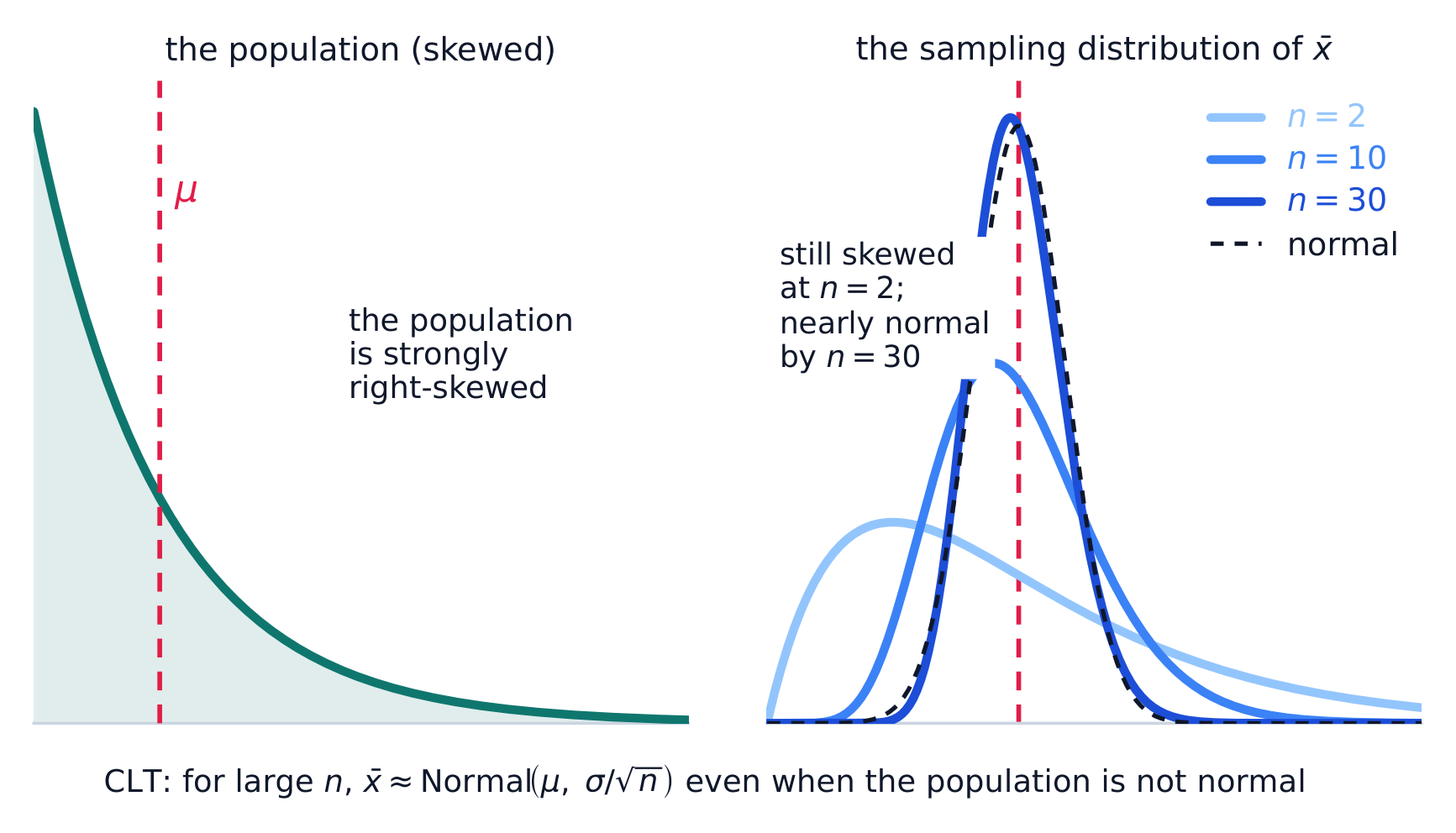
Sample means from a skewed population become approximately normal as n grows
Normality via the CLT
- Is $\bar{x}$ normal? Two ways to justify it:
- If the population is normal, $\bar{x}$ is exactly normal for any $n$.
- Otherwise, the Central Limit Theorem gives approximate normality for a sufficiently large independent random sample; $n \ge 30$ is a guideline, and severe skew may need more.
- Always state which justification your problem relies on.
Conditions and probabilities
- Check the 10% condition ($n \le 0.10N$) when sampling without replacement.
- With normality justified, standardize: $z = \dfrac{\bar{x} - \mu}{\sigma/\sqrt{n}}$.
- Then find probabilities for $\bar{x}$ from the standard normal.
- This answers "how likely is a sample mean this far from $\mu$?"
Use $\sigma/\sqrt{n}$, not $\sigma$, for the spread of $\bar{x}$ — the sample mean varies far less than individual data values. A frequent error is dividing by $n$ instead of $\sqrt{n}$. And justify normality explicitly: either a normal population or the CLT with a large $n$ — don't assume $\bar{x}$ is normal for a small sample from a skewed population.
Take $n = 25$ independent random observations from a normal population with mean $\mu = 100$ and SD $\sigma = 20$.
- Center: $\mu_{\bar{x}} = 100$. SD: $\sigma_{\bar{x}} = \dfrac{20}{\sqrt{25}} = \dfrac{20}{5} = 4$.
- $P(\bar{x} > 108)$: $z = \dfrac{108 - 100}{4} = 2$ → $1-\Phi(2) \approx 0.0228$, or $2.28\%$.
- So a sample mean above $108$ is fairly unlikely.
Individual spread and sample-mean spread
$\mathrm{SD}(\bar X)=\sigma/\sqrt n$
Changing n changes the standard error, not the population standard deviation. Normal probabilities require an explicit distribution model.
The sample mean $\bar{x}$ has $\mu_{\bar{x}} = \mu$ and $\sigma_{\bar{x}} = \frac{\sigma}{\sqrt{n}}$. Justify a normal model either by a normal population or by the Central Limit Theorem ($n\ge 30$); check the 10% condition when sampling without replacement, then find probabilities via $z = \frac{\bar{x}-\mu}{\sigma/\sqrt{n}}$.
Write from the data: find the standard deviation
- The population standard deviation is 12.
- An independent random sample has size 16.
For independent random observations with population SD 12 and sample size 16, what is the standard deviation of the sample mean?
The standard deviation of x-bar is sigma over square root of n.
For independent random observations with population SD 12 and sample size 16, what is the standard deviation of the sample mean?
Dificuldade 1/5 · Moedas 100 + pequeno bônus na primeira conclusão hoje
12 divided by 4 is 3.
Population σ = 20, n = 25. Find the SD of x-bar, σ/√n.
Dificuldade 2/5 · Moedas 140 + pequeno bônus na primeira conclusão hoje
20/√25 = 20/5 = 4.
With μ=100 and SD of x-bar = 4, find the z-score of x-bar = 108.
Dificuldade 2/5 · Moedas 140 + pequeno bônus na primeira conclusão hoje
z = (108 − 100)/4 = 2.
The standard deviation of the sample mean is...
Dificuldade 1/5 · Moedas 100 + pequeno bônus na primeira conclusão hoje
Divide σ by √n — not by n.
If the population is already normal, x-bar is normal for any sample size n.
Dificuldade 1/5 · Moedas 100 + pequeno bônus na primeira conclusão hoje
A normal population gives an exactly normal x-bar at any n.
To make the sampling distribution of x-bar have half the spread, you should...
Dificuldade 1/5 · Moedas 100 + pequeno bônus na primeira conclusão hoje
Spread ∝ 1/√n, so 4× n halves the SD.