Summary Statistics for a Quantitative Variable
Introduzido| English | Significado |
|---|---|
| mean/miːn/ | média |
| median/ˈmiːdiːən/ | mediana |
| Range/reɪndʒ/ | Amplitude |
| Standard deviation/ˈstændəd ˌdiːvɪˈeɪʃn/ | Desvio padrão |
| resistant/rɪˈzɪstənt/ | resistente |
Numbers that summarize the data
- A graph shows the shape; summary statistics boil a distribution down to a few key numbers.
- Two jobs: measure the center (a typical value) and the spread (how variable).
- Which numbers you use depends on the shape — especially whether there are outliers.
- These summaries are the backbone of every later inference.
Measures of center
- The mean 均值 $\bar{x}$ is the arithmetic average: add all values, divide by how many.
- The median 中位数 is the middle value when the data are sorted (average the two middle if even).
- For a symmetric distribution they're close; for a skewed one they differ.
- The mean gets pulled toward a long tail; the median is less sensitive to extreme values, but can change if ranks change.
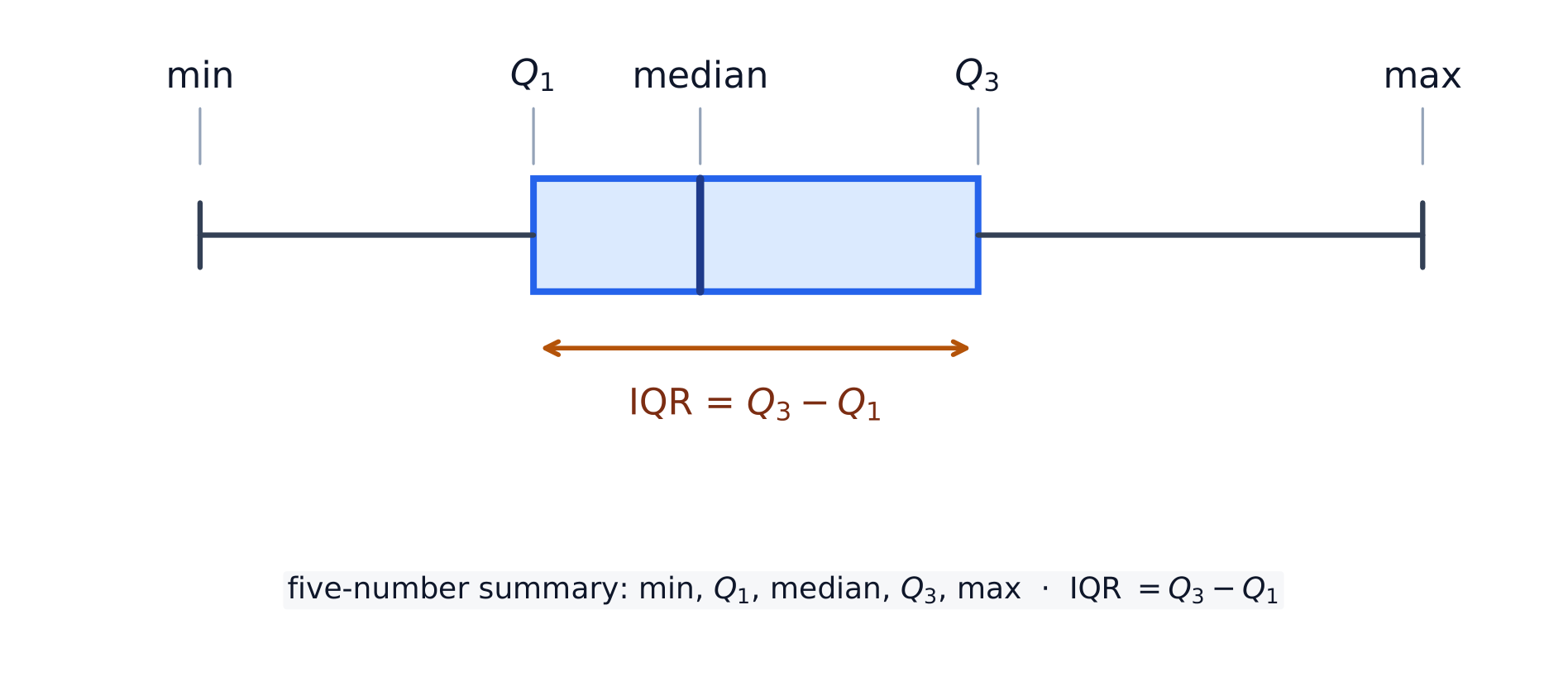
The five-number summary and the IQR on a box plot
Center and spread of data
The mean and median mark the center; the range, IQR, and standard deviation measure the spread.
Find the median of $4, 5, 6, 7, 100$.
Dificuldade 2/5 · Moedas 140 + pequeno bônus na primeira conclusão hoje
The middle value of the sorted data is $6$.
In $4,5,6,7,100$, the mean ($24.4$) is dragged upward by the value $100$.
Dificuldade 1/5 · Moedas 100 + pequeno bônus na primeira conclusão hoje
The mean is sensitive to extreme values.
Measures of spread
- Range 极差 = maximum − minimum (simple, but sensitive to extremes).
- IQR (interquartile range) $=Q_3-Q_1$ — the spread of the middle $50\%$.
- Standard deviation 标准差 $s_x$ — the typical distance of values from the mean.
- Bigger spread numbers mean more variability.
For a data set with $Q_1=5$ e $Q_3=7$, find the IQR.
Dificuldade 2/5 · Moedas 140 + pequeno bônus na primeira conclusão hoje
$\text{IQR}=Q_3-Q_1=7-5=2$.
Resistant vs. sensitive
- Median and IQR are resistant 稳健 — outliers barely move them.
- Mean and standard deviation are sensitive — one extreme value can shift them a lot.
- So for skewed data or data with outliers, report the median and IQR.
- Outlier rule: a value is an outlier if it's below $Q_1-1.5\times\text{IQR}$ or above $Q_3+1.5\times\text{IQR}$.
Which measures are resistant to outliers?
Dificuldade 2/5 · Moedas 140 + pequeno bônus na primeira conclusão hoje
Median and IQR resist outliers; mean and SD do not.
By the $1.5\times\text{IQR}$ rule, a high outlier is any value above...
Dificuldade 1/5 · Moedas 100 + pequeno bônus na primeira conclusão hoje
Measure from the quartile: $Q_3+1.5\,\text{IQR}$.
For strongly skewed data, the best center/spread summary is...
Dificuldade 1/5 · Moedas 100 + pequeno bônus na primeira conclusão hoje
Resistant measures suit skewed data.
Match the summary to the shape: for skewed data or outliers, use the resistant median and IQR — the mean and standard deviation get dragged by extremes. And the $1.5\times\text{IQR}$ rule measures from the quartiles ($Q_1,Q_3$), not the mean: flag values below $Q_1-1.5\,\text{IQR}$ or above $Q_3+1.5\,\text{IQR}$.
Data: $4, 5, 6, 7, 100$.
- Mean $=\tfrac{4+5+6+7+100}{5}=24.4$ (dragged up by $100$). Median $=6$ (unaffected).
- The median ($6$) better represents the typical value here.
- Including the median in each half when finding quartiles gives $Q_1=5$, $Q_3=7$, $\text{IQR}=2$: $100>7+1.5(2)=10$, so $100$ is an outlier.
Summarize center with the mean $\bar{x}$ or median, and spread with the range, IQR $=Q_3-Q_1$, or standard deviation $s_x$. The median and IQR are resistant to outliers; the mean and SD are not — so prefer them for skewed data. Flag outliers with the $1.5\times\text{IQR}$ rule.
Write from the data: find the mean
- The values are 4, 4, 4 and 8.
- Find the total, divide by the number of values, and compare with the median.
For the values 4, 4, 4 and 8, find the mean and compare it with the median. Show your calculation.
The mean is the total divided by the number of values.
What is the mean of 4, 4, 4 and 8?
Dificuldade 1/5 · Moedas 100 + pequeno bônus na primeira conclusão hoje
The total is 4+4+4+8=20, so the mean is 20/4=5. The median is 4 and the maximum is 8.