Vector-Valued Functions · Funções Vetoriais
| English | Português |
|---|---|
| vector-valued function/ˈvektə ˈvæljuːd ˈfʌŋkʃn/ | função vetorial |
| vector/ˈvektə/ | vetor |
| parameter/pəˈræmɪtə/ | parâmetro |
A function that outputs an arrow
- Ordinary functions output a number; parametric ones output a pair of coordinates.
- A vector-valued function packages that pair into a single vector.
- Think of it as an arrow from the origin whose tip moves as time passes.
- It is the natural language for describing position, velocity, and motion in the plane.
Uma função que sai com uma seta
- Funções comuns saem com um número; funções paramétricas saem com um par de coordenadas.
- Uma função vetorial empacota esse par em um único vetor.
- Pense nisso como uma seta partindo da origem cuja ponta se move conforme o tempo passa.
- É a linguagem natural para descrever posição, velocidade e movimento no plano.
What it outputs
- A vector-valued function 向量值函数 $\vec{r}(t)$ returns a vector 向量 for each input $t$.
- Usually that vector is a position: $\vec{r}(t) = \langle x(t), y(t)\rangle$.
- The parameter 参数 $t$ (often time) drives the arrow to a new spot.
- So one input gives one arrow, pointing from the origin to the current location.
O que ela devolve
- Uma função vetorial 向量值函数 $\vec{r}(t)$ retorna um vetor 向量 para cada entrada $t$.
- Geralmente esse vetor é uma posição: $\vec{r}(t) = \langle x(t), y(t)\rangle$.
- O parâmetro 参数 $t$ (geralmente tempo) faz a seta ir para um novo lugar.
- Então uma entrada dá uma seta, apontando da origem para a localização atual.
A vector-valued function $\vec{r}(t)$ outputs, for each $t$, a… · Uma função vetorial $\vec{r}(t)$ gera, para cada $t$, um…
A vector-valued function returns a vector for each input — often the position $\langle x(t), y(t)\rangle$. · Uma função vetorial retorna um vetor para cada entrada — frequentemente a posição $\langle x(t), y(t)\rangle$.
The tip traces the path
- Hold the tail at the origin and let $t$ increase.
- The arrow's tip moves, and the trail it leaves is the curve.
- That curve is exactly the parametric path from earlier lessons.
- So a vector-valued function and a parametric function are two views of one idea.
A ponta traça o caminho
- Segure a cauda na origem e deixe $t$ aumentar.
- A ponta da seta se move, e a trilha que deixa é a curva.
- Essa curva é exatamente o caminho paramétrico das lições anteriores.
- Então uma função vetorial e uma função paramétrica são duas visões de uma mesma ideia.
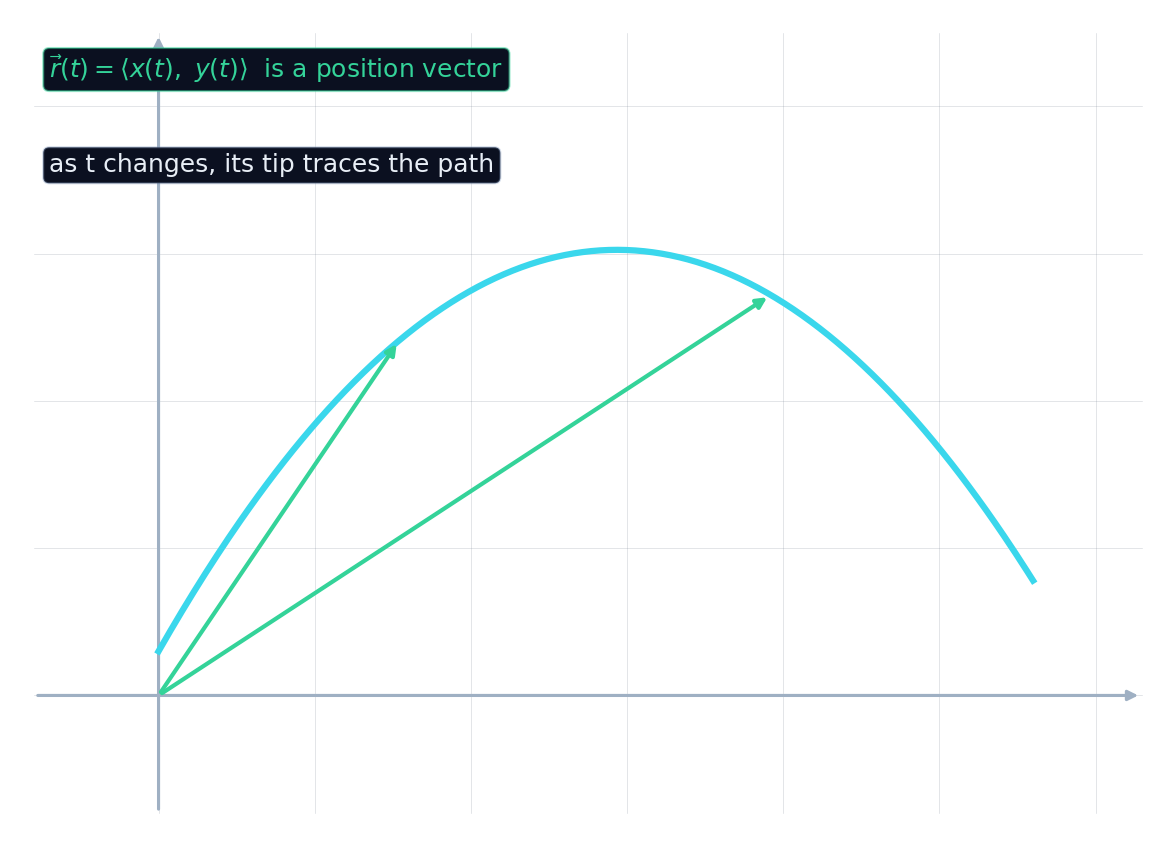
A vector-valued function $\vec{r}(t) = \langle x(t), y(t)\rangle$ is closely related to a parametric function. · Uma função vetorial $\vec{r}(t) = \langle x(t), y(t)\rangle$ está intimamente relacionada a uma função paramétrica.
They are two views of the same idea: the components $x(t), y(t)$ are exactly the parametric equations. · São duas visões da mesma ideia: os componentes $x(t), y(t)$ são exatamente as equações paramétricas.
As the parameter $t$ changes, the ____ of the position vector traces the curve. · À medida que o parâmetro $t$ muda, a ____ do vetor posição traça a curva.
The vector starts at the origin; its arrow tip · ponta marks the current point on the path. · O vetor começa na origem; sua ponta marca o ponto atual no trajeto.
For · A favor $\vec{r}(t) = \langle 2t,\ t^2\rangle$, what is the $y$-component at $t = 3$? · Para $\vec{r}(t) = \langle 2t,\ t^2\rangle$, qual é o componente $y$ em $t = 3$?
The · A $y$-component is $t^2 = 3^2 = 9$; the $x$-component is $2t = 6$, so $\vec{r}(3) = \langle 6, 9\rangle$. · O componente $y$ é $t^2 = 3^2 = 9$; o componente $x$ é $2t = 6$, logo $\vec{r}(3) = \langle 6, 9\rangle$.
Select all · todos true statements about vector-valued functions. · Selecione todas as afirmações verdadeiras sobre funções vetoriais.
They output a vector, not a single number. The other three are correct. · Elas retornam um vetor, não um único número. As outras três estão corretas.
Evaluating and combining
- Evaluate $\vec{r}(t)$ by plugging $t$ into each component.
- $\vec{r}(3) = \langle 2\cdot 3,\ 3^2\rangle = \langle 6, 9\rangle$ for $\vec{r}(t) = \langle 2t, t^2\rangle$.
- The rate of change of $\vec{r}(t)$ is the velocity vector — components $\langle x'(t), y'(t)\rangle$.
- Add two vector-valued functions by adding their components.
Avaliando e combinando
- Avalie $\vec{r}(t)$ substituindo $t$ em cada componente.
- $\vec{r}(3) = \langle 2\cdot 3,\ 3^2\rangle = \langle 6, 9\rangle$ para $\vec{r}(t) = \langle 2t, t^2\rangle$.
- A taxa de variação de $\vec{r}(t)$ é o vetor velocidade — componentes $\langle x'(t), y'(t)\rangle$.
- Some duas funções vetoriais somando seus componentes.
Vector-valued functions · Funções vetoriais
A vector-valued function outputs a vector; add the component vectors to get the resultant. · Uma função vetorial retorna um vetor; some os vetores componentes para obter o resultante.
Why the vector view helps
- Writing motion as one vector keeps position, velocity, and direction together.
- It generalises cleanly to three dimensions, where you add a $z(t)$ component.
- Physics and computer graphics describe moving objects exactly this way.
- The single-arrow picture makes combined motions easy to reason about.
Por que a visão vetorial ajuda
- Escrever o movimento como um único vetor mantém posição, velocidade e direção juntos.
- Generaliza-se limpidamente para três dimensões, onde você adiciona um componente $z(t)$.
- Física e gráficos por computador descrevem objetos em movimento exatamente dessa forma.
- A imagem de uma única seta torna fácil raciocinar sobre movimentos combinados.
A vector-valued function outputs a vector, not a number. Do not treat $\vec{r}(t) = \langle x(t), y(t)\rangle$ as a single value — it always carries two components (a direction and a size), and both change with $t$.
Uma função vetorial devolve um vetor, não um número. Não trate $\vec{r}(t) = \langle x(t), y(t)\rangle$ como um valor único — ele sempre carrega dois componentes (uma direção e um tamanho), e ambos mudam com $t$.
A particle moves as $\vec{r}(t) = \langle t,\ t^2\rangle$.
- At $t = 0$: $\vec{r} = \langle 0, 0\rangle$ — it starts at the origin.
- At $t = 2$: $\vec{r} = \langle 2, 4\rangle$ — up and to the right.
- Its tip traces the parabola $y = x^2$ as $t$ increases.
Uma partícula se move conforme $\vec{r}(t) = \langle t,\ t^2\rangle$.
- Em $t = 0$: $\vec{r} = \langle 0, 0\rangle$ — começa na origem.
- Em $t = 2$: $\vec{r} = \langle 2, 4\rangle$ — para cima e para a direita.
- Sua ponta traça a parábola $y = x^2$ enquanto $t$ aumenta.
A vector-valued function $\vec{r}(t)$ outputs a vector for each parameter value — usually the position $\langle x(t), y(t)\rangle$. Its tip traces a path as $t$ changes, so it is the vector view of a parametric function. Evaluate it component by component.
Uma função vetorial $\vec{r}(t)$ produz um vetor para cada valor do parâmetro — geralmente a posição $\langle x(t), y(t)\rangle$. Sua ponta traça um caminho conforme $t$ muda, portanto é a visão vetorial de uma função paramétrica. Avalie-a componente por componente.