Parametric Circles and Lines · Círculos e Linhas Paramétricos
| English | Português |
|---|---|
| parameter/pəˈræmɪtə/ | parâmetro |
| parametric equations/ˌpærəˈmetrɪk ɪˈkweɪʒnz/ | equações paramétricas |
| unit circle/ˈjuːnɪt ˈsɜːkl/ | círculo unitário |
Drawing circles the easy way
- A circle is impossible to write as a single $y = f(x)$ — it fails the vertical-line test.
- But with a parameter, it becomes beautifully simple: an angle sweeping around.
- Lines, too, get a clean parametric form built from a starting point and a direction.
- These two shapes are the workhorses of parametric geometry.
Desenhando círculos facilmente
- Um círculo é impossível escrever como uma única $y = f(x)$ — ele falha no teste da linha vertical.
- Mas com um parâmetro, torna-se magnificamente simples: um ângulo varrendo ao redor.
- Linhas, também, ganham uma forma paramétrica limpa construída a partir de um ponto inicial e uma direção.
- Estas duas formas são as ferramentas básicas da geometria paramétrica.
A line, parametrically
- Start at a point $(x_0, y_0)$ and move a fixed step each unit of $t$.
- The parametric equations 参数方程 are $x = x_0 + at$ and $y = y_0 + bt$.
- Here $(a, b)$ is the direction, and $t$ is the parameter 参数 that carries you along.
- As $t$ runs over all reals, the point traces the full straight line.
Uma linha, parametricamente
- Comece em um ponto $(x_0, y_0)$ e mova-se um passo fixo por unidade de $t$.
- As equações paramétricas 参数方程 são $x = x_0 + at$ e $y = y_0 + bt$.
- Aqui $(a, b)$ é a direção, e $t$ é o parâmetro 参数 que te transporta ao longo.
- À medida que $t$ percorre todos os reais, o ponto traça a linha reta inteira.
A line through a point in a fixed direction can be written parametrically as… · Uma linha através de um ponto em uma direção fixa pode ser escrita parametricamente como…
Starting at $(x_0, y_0)$ and moving by $(a, b)$ each unit of $t$ traces a straight line. · Começando em $(x_0, y_0)$ e movendo-se por $(a, b)$ a cada unidade de $t$ traça uma linha reta.
A circle, parametrically
- A point on the unit circle 单位圆 at angle $t$ is $(\cos t, \sin t)$.
- Scale by the radius $r$: $x = r\cos t$ and $y = r\sin t$ trace a circle of radius $r$.
- As $t$ sweeps from $0$ to $2\pi$, the point travels once around, counter-clockwise.
- Shift by $(h, k)$ to centre the circle anywhere.
Um círculo, parametricamente
- Um ponto na circunferência unitária 单位圆 no ângulo $t$ é $(\cos t, \sin t)$.
- Escalone pelo raio $r$: $x = r\cos t$ e $y = r\sin t$ traçam um círculo de raio $r$.
- À medida que $t$ varre de $0$ a $2\pi$, o ponto viaja uma volta completa, sentido anti-horário.
- Desloque por $(h, k)$ para centralizar o círculo em qualquer lugar.
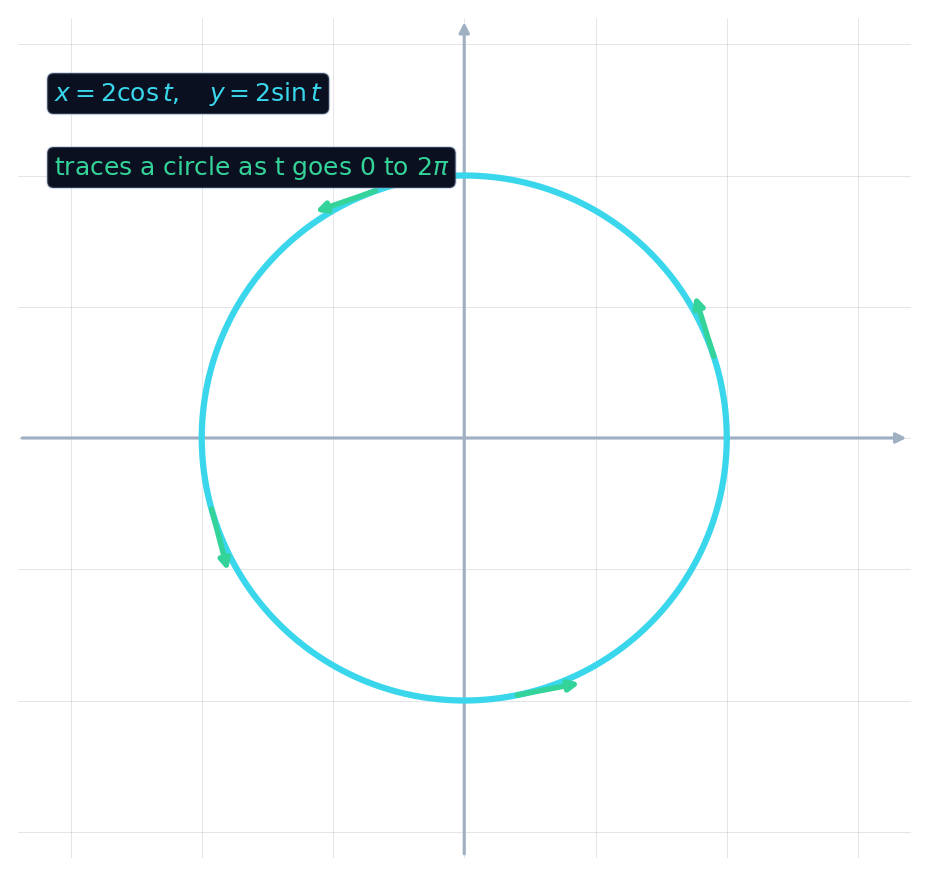
Sweep the angle to trace a circle · Varia o ângulo para traçar um círculo
As the parameter (an angle) sweeps from 0 to 2 pi, the point (cos t, sin t) travels once around the circle. · À medida que o parâmetro (um ângulo) varre de 0 a 2 pi, o ponto (cos t, sin t) viaja uma vez ao redor do círculo.
Which parametric equations trace a circle of radius $r$ centred at the origin? · Quais equações paramétricas traçam um círculo de raio $r$ centrado na origem?
From the unit circle scaled by $r$: $x = r\cos t$ and · e $y = r\sin t$ trace the circle as $t$ goes $0$ to · até $2\pi$. · Do círculo unitário escalado por $r$: $x = r\cos t$ e $y = r\sin t$ traçam o círculo à medida que $t$ vai de $0$ a $2\pi$.
The parametrization $x = \cos t,\ y = \sin t$ comes directly from the ____. · A parametrização $x = \cos t,\ y = \sin t$ vem diretamente da ____.
A point on the unit circle at angle $t$ is $(\cos t, \sin t)$ — the natural parametrization of a circle. · Um ponto no círculo unitário no ângulo $t$ é $(\cos t, \sin t)$ — a parametrização natural de um círculo.
Select all · todos true statements. · Selecione todas as afirmações verdadeiras.
A circle can be parametrized (that is the whole point). The other three are correct. · Um círculo pode ser parametrizado (que é todo o ponto). As outras três estão corretas.
Direction and speed
- The parametrization sets not just the shape but the way it is drawn.
- $x = \cos t, y = \sin t$ goes counter-clockwise; $x = \cos t, y = -\sin t$ goes clockwise.
- Replacing $t$ with $2t$ traces the same circle twice as fast.
- So the same circle has many parametrizations, each with its own motion.
Direção e velocidade
- A parametrização define não apenas a forma, mas a maneira como ela é desenhada.
- $x = \cos t, y = \sin t$ vai no sentido anti-horário; $x = \cos t, y = -\sin t$ vai no sentido horário.
- Substituir $t$ por $2t$ traça o mesmo círculo duas vezes mais rápido.
- Então o mesmo círculo tem muitas parametrizações, cada uma com seu próprio movimento.
Restricting $t$ to · até $0 \le t \le \pi$ in $x = \cos t,\ y = \sin t$ traces only the top half of the circle. · Restringir $t$ a $0 \le t \le \pi$ em $x = \cos t,\ y = \sin t$ traça apenas a metade superior do círculo.
From $t = 0$ to · até $\pi$, $y = \sin t \ge 0$, so only the upper semicircle is drawn. · De $t = 0$ a $\pi$, $y = \sin t \ge 0$, portanto apenas o semicírculo superior é desenhado.
Drawing only part
- Restricting the parameter interval draws just an arc.
- $0 \le t \le \pi$ in $(\cos t, \sin t)$ gives only the top half of the circle.
- For a line, restricting $t$ gives a segment or a ray.
- Choose the interval to draw exactly the piece you want.
Desenhar apenas parte
- Restringir o intervalo do parâmetro desenha apenas um arco.
- $0 \le t \le \pi$ em $(\cos t, \sin t)$ dá apenas a metade superior do círculo.
- Para uma linha, restringir $t$ dá um segmento ou um raio.
- Escolha o intervalo para desenhar exatamente a peça que você quer.
The parametric form of a circle is not unique. $(\cos t, \sin t)$ and $(\sin t, \cos t)$ both trace the unit circle, but start at different points and go in different directions. Always check the starting point and direction, not just the shape.
A forma paramétrica de um círculo não é única. $(\cos t, \sin t)$ e $(\sin t, \cos t)$ ambos traçam a circunferência unitária, mas começam em pontos diferentes e vão em direções opostas. Sempre verifique o ponto inicial e a direção, não apenas a forma.
Parametrize the circle of radius $3$ centred at $(1, -2)$.
- Start from the unit-circle form and scale by $3$: $3\cos t$, $3\sin t$.
- Shift the centre to $(1, -2)$: $x = 1 + 3\cos t$, $y = -2 + 3\sin t$.
- As $t$ goes $0$ to $2\pi$, this traces the full circle once.
Parametrize o círculo de raio $3$ centrado em $(1, -2)$.
- Comece da forma da circunferência unitária e escale por $3$: $3\cos t$, $3\sin t$.
- Desloque o centro para $(1, -2)$: $x = 1 + 3\cos t$, $y = -2 + 3\sin t$.
- À medida que $t$ vai de $0$ a $2\pi$, isso traça o círculo inteiro uma vez.
A line is $x = x_0 + at,\ y = y_0 + bt$ (a point plus a direction). A circle of radius $r$ is $x = r\cos t,\ y = r\sin t$, straight from the unit circle. These parametric equations let the parameter $t$ set the shape, direction, and speed — restrict $t$ to draw only an arc or segment.
Uma linha é $x = x_0 + at,\ y = y_0 + bt$ (um ponto mais uma direção). Um círculo de raio $r$ é $x = r\cos t,\ y = r\sin t$, direto da circunferência unitária. Estas equações paramétricas permitem que o parâmetro $t$ defina a forma, direção e velocidade — restrinja $t$ para desenhar apenas um arco ou segmento.