Graphs of Polar Functions · Gráficos de Funções Polares
| English | Português |
|---|---|
| polar function/ˈpəʊlə ˈfʌŋkʃn/ | função polar |
| rose/rəʊz/ | rosa |
| cardioid/ˈkɑːdɪəʊɪd/ | cardioide |
| polar coordinates/ˈpəʊlə kəʊˈɔːdɪnəts/ | coordenadas polares |
Curves that bloom
- In rectangular graphs, $y$ depends on $x$. In polar graphs, the radius depends on the angle.
- As the angle sweeps around, the radius grows and shrinks, tracing surprising shapes.
- Flowers, hearts, and spirals all appear from simple polar rules.
- These curves are hard to write with $x$ and $y$, but easy with $r$ and $\theta$.
Curvas que florescem
- Em gráficos retangulares, $y$ depende de $x$. Em gráficos polares, o raio depende do ângulo.
- À medida que o ângulo varre ao redor, o raio cresce e encolhe, traçando formas surpreendentes.
- Flores, corações e espirais aparecem de regras polares simples.
- Essas curvas são difíceis de escrever com $x$ e $y$, mas fáceis com $r$ e $\theta$.
What a polar function is
- A polar function 极坐标函数 has the form $r = f(\theta)$: a radius for each angle.
- To plot it, sweep $\theta$ around and mark the point at distance $r$ in that direction.
- Where $r$ is large the curve reaches far out; where $r = 0$ it touches the origin.
- The whole graph is built one angle at a time.
O que é uma função polar
- Uma função polar 极坐标函数 tem a forma $r = f(\theta)$: um raio para cada ângulo.
- Para plotá-la, varra $\theta$ ao redor e marque o ponto à distância $r$ naquela direção.
- Onde $r$ é grande a curva se estende longe; onde $r = 0$ ela toca a origem.
- Todo o gráfico é construído um ângulo de cada vez.
A polar function $r = f(\theta)$ gives, for each angle, the… · Uma função polar $r = f(\theta)$ dá, para cada ângulo, o…
A polar function outputs a radius for each input angle; plotting $(f(\theta), \theta)$ traces the curve. · Uma função polar outputa um raio para cada ângulo de entrada; plotar $(f(\theta), \theta)$ traça a curva.
The simple polar equation $r = 3$ (constant) is a circle. · A simples equação polar $r = 3$ (constante) é um círculo.
A constant radius at every angle traces a circle of that radius around the origin. · Um raio constante em cada ângulo traça um círculo desse raio ao redor da origem.
Roses and other shapes
- $r = a\sin(k\theta)$ or $a\cos(k\theta)$ traces a rose 玫瑰线 — a flower of petals.
- With $k$ odd there are $k$ petals; with $k$ even there are $2k$.
- $r = a(1 + \sin\theta)$ traces a heart-shaped cardioid 心形线.
- A constant $r = a$ is simply a circle of radius $a$.
Rosas e outras formas
- $r = a\sin(k\theta)$ ou $a\cos(k\theta)$ traça uma rosa 玫瑰线 — uma flor de pétalas.
- Com $k$ ímpar há $k$ pétalas; com $k$ par há $2k$.
- $r = a(1 + \sin\theta)$ traça um cardióide 心形线 em forma de coração.
- Um $r = a$ constante é simplesmente um círculo de raio $a$.
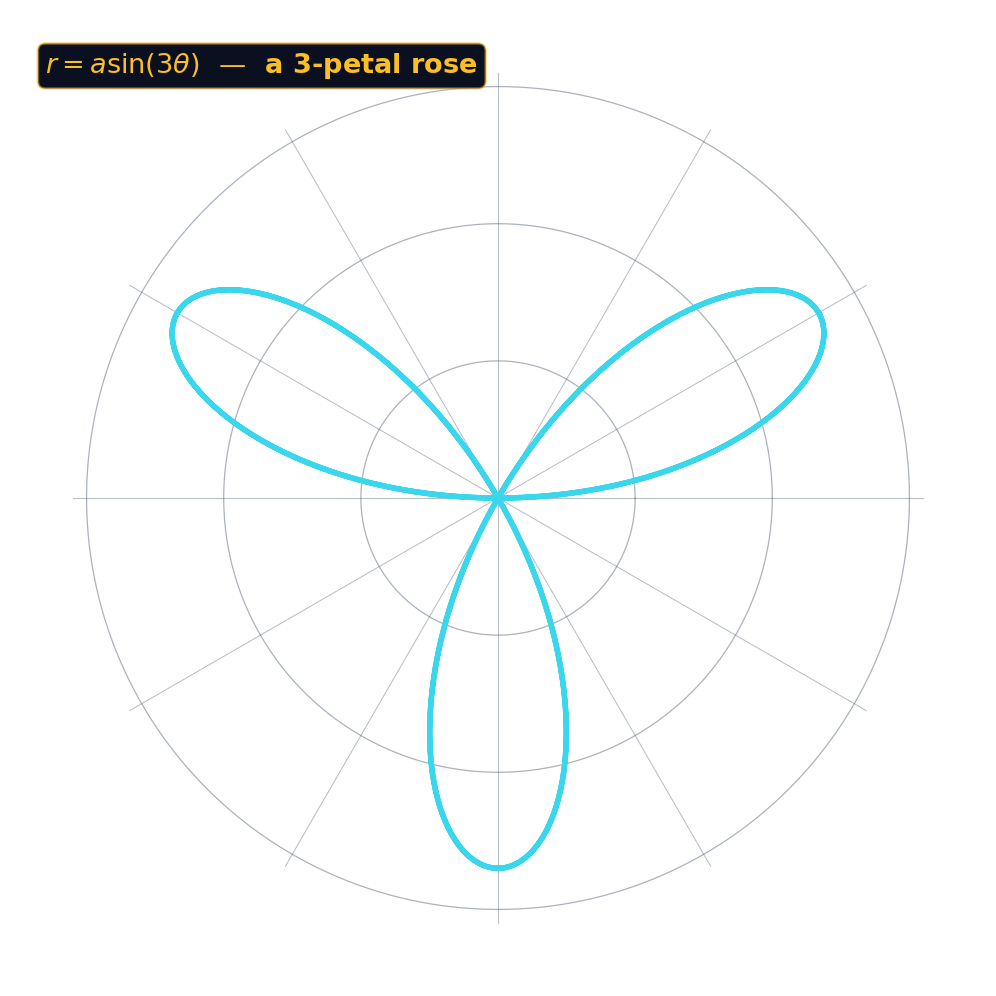
Draw a polar curve petal by petal · Desenhe uma curva polar pétala por pétala
A polar function sets r for each angle theta. Sweep theta around and the radius traces a rose, circle, or spiral. · Uma função polar define r para cada ângulo theta. Varie theta ao redor e o raio traça uma rosa, círculo ou espiral.
The curve $r = a\sin(3\theta)$ is a rose · rosa with how many petals? · A curva $r = a\sin(3\theta)$ é uma rosa com quantas pétalas?
For · A favor $r = a\sin(k\theta)$ with $k$ odd, the rose · rosa has exactly $k$ petals — here $3$. · Para $r = a\sin(k\theta)$ com $k$ ímpar, a rosa tem exatamente $k$ pétalas — aqui $3$.
The heart-shaped polar curve $r = 1 + \sin\theta$ is called a ____. · A curva polar em forma de coração $r = 1 + \sin\theta$ é chamada de ____.
A cardioid ("heart-shaped") is a classic polar curve of the form $r = a(1 + \sin\theta)$. · Um cardióide ("em forma de coração") é uma clássica curva polar da forma $r = a(1 + \sin\theta)$.
Select all · todos true statements about polar graphs. · Selecione todas as afirmações verdadeiras sobre gráficos polares.
Polar graphs include circles, roses, cardioids, and spirals — rarely straight lines. The other three are correct. · Gráficos polares incluem círculos, rosas, cardióides e espirais — raramente linhas retas. As outras três estão corretas.
Plotting point by point
- Make a table: choose angles, compute $r$ at each, and mark the points.
- Watch for where $r = 0$ (the curve passes through the origin) and where $r$ peaks.
- Join the points smoothly in order of increasing $\theta$.
- The pattern usually repeats after one full turn (or half, for even roses).
Plotando ponto a ponto
- Faça uma tabela: escolha ângulos, compute $r$ em cada um, e marque os pontos.
- Observe onde $r = 0$ (a curva passa pela origem) e onde $r$ atinge picos.
- Junte os pontos suavemente em ordem de aumento de $\theta$.
- O padrão geralmente se repete após uma volta completa (ou meia, para rosas pares).
Symmetry helps
- Many polar curves are symmetric about an axis, which halves the plotting work.
- A $\sin$ curve is often symmetric about the vertical axis; a $\cos$ curve about the horizontal.
- Spotting the symmetry lets you sketch one part and mirror the rest.
- Converting back to polar coordinates 极坐标 confirms exactly where each feature sits.
Simetria ajuda
- Muitas curvas polares são simétricas sobre um eixo, o que reduz pela metade o trabalho de plotagem.
- Uma curva $\sin$ é frequentemente simétrica sobre o eixo vertical; uma $\cos$ sobre o horizontal.
- Identificar a simetria permite esboçar uma parte e espelhar o resto.
- Converter de volta para coordenadas polares 极坐标 confirma exatamente onde cada característica está.
Do not read a polar graph like a rectangular one. A "loop" back to the origin means $r$ passed through $0$, not that the function is undefined. And a single point can be reached at several different angles, so the same curve may be traced more than once.
Não leia um gráfico polar como um retangular. Um "loop" de volta à origem significa que $r$ passou por $0$, não que a função está indefinida. E um único ponto pode ser alcançado em vários ângulos diferentes, então a mesma curva pode ser traçada mais de uma vez.
Sketch $r = 2\cos\theta$ over $0 \le \theta \le \pi$.
- At $\theta = 0$: $r = 2$ (a point $2$ units right).
- At $\theta = \tfrac{\pi}{2}$: $r = 0$ (the origin).
- The points trace a circle of diameter $2$ sitting to the right of the origin.
Esboce $r = 2\cos\theta$ sobre $0 \le \theta \le \pi$.
- Em $\theta = 0$: $r = 2$ (um ponto $2$ unidades à direita).
- Em $\theta = \tfrac{\pi}{2}$: $r = 0$ (a origem).
- Os pontos traçam um círculo de diâmetro $2$ situado à direita da origem.
A polar function $r = f(\theta)$ gives a radius for each angle. Sweeping $\theta$ traces circles, roses ($r = a\sin k\theta$), cardioids ($r = a(1+\sin\theta)$), and spirals. Plot point by point using polar coordinates, and use symmetry to speed up the sketch.
Uma função polar $r = f(\theta)$ fornece um raio para cada ângulo. Varrendo $\theta$ traça círculos, rosas ($r = a\sin k\theta$), cardióides ($r = a(1+\sin\theta)$) e espirais. Plote ponto a ponto usando coordenadas polares, e use simetria para acelerar o esboço.