Compton Scattering
Introduzido| English | Significado |
|---|---|
| Compton scattering/ˈkɒmptn ˈskætərɪŋ/ | espalhamento Compton |
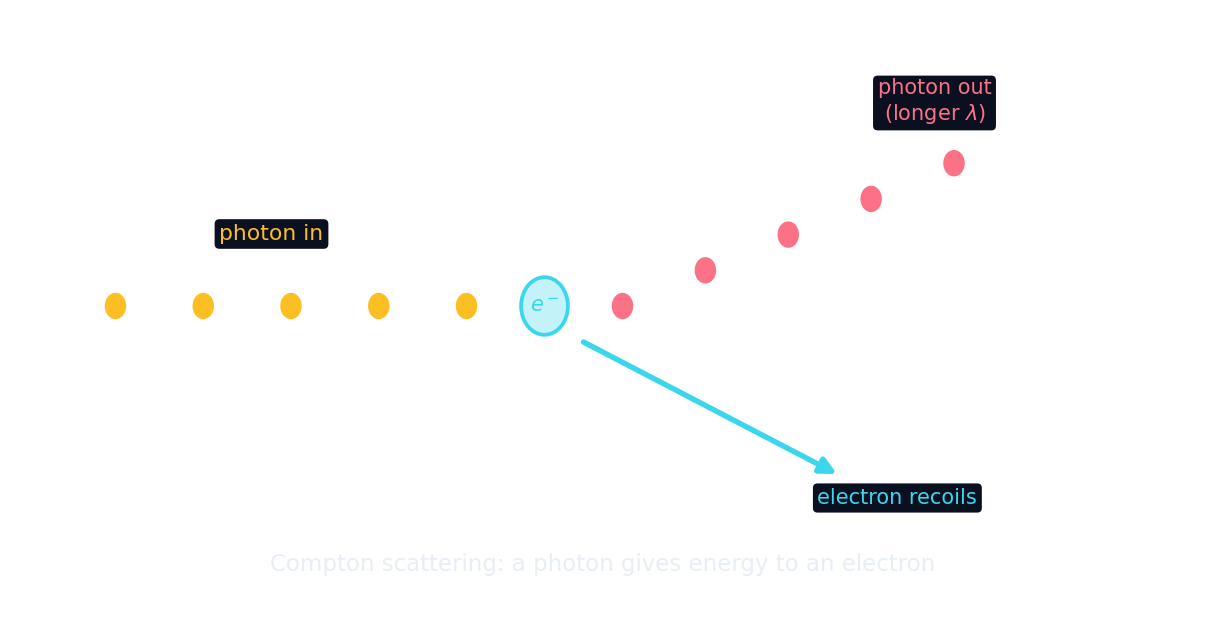
A photon bounces off an electron — like billiard balls
- A high-energy photon can scatter from a free electron initially at rest, transferring energy and momentum; relativistic collision rules apply.
- The photon comes away with less energy; the electron recoils, taking the difference.
- This is Compton scattering 康普顿散射, and it clinched the case that light carries momentum.
- This reveals particle-like momentum transfer; interference still reveals the wave behaviour of light.
A photon has momentum
- A photon carries not just energy but also momentum: $p = \dfrac{h}{\lambda}$.
- In the collision, both energy and momentum are conserved — just like a normal collision.
- The photon transfers some of both to the electron, which recoils away.
- Treating the photon as a particle with momentum predicts the outcome exactly.
A photon's momentum is given by:
Dificuldade 1/5 · Moedas 100 + pequeno bônus na primeira conclusão hoje
A photon carries momentum $p = h/\lambda$.
In Compton scattering, which quantities are conserved?
Dificuldade 1/5 · Moedas 100 + pequeno bônus na primeira conclusão hoje
It is a genuine collision — both energy and momentum are conserved.
The scattered photon is redder
- Since the photon gives energy to the electron, the scattered photon has less energy.
- Less energy means a lower frequency and a longer wavelength — a shift toward red.
- For a free electron initially at rest and fixed incident photon energy, a larger scattering angle transfers more energy; zero-angle scattering leaves photon energy unchanged.
- Measuring this wavelength shift confirmed the photon's momentum.
A photon scatters through a nonzero angle from a free electron initially at rest. Its wavelength becomes:
Dificuldade 1/5 · Moedas 100 + pequeno bônus na primeira conclusão hoje
The photon loses energy to the electron, so its wavelength gets longer.
A larger scattering angle means the photon transfers more energy to the electron.
Dificuldade 1/5 · Moedas 100 + pequeno bônus na primeira conclusão hoje
The bigger the angle, the more energy (and momentum) is handed to the electron.
Why it mattered
- The photoelectric effect showed photons carry energy; Compton showed they carry momentum.
- Together they made the particle nature of light undeniable.
- Energy and momentum conservation must use photon relations $E = pc = hc/\lambda$ and relativistic electron energy; ordinary equal-mass billiard-ball formulas do not apply.
- Compton scattering is used today in gamma-ray astronomy and medical imaging.
Compton scattering
A photon scatters through a nonzero angle from a free electron initially at rest. Sort each outcome.
Compton scattering shows that photons carry ____ as well as energy.
Dificuldade 1/5 · Moedas 100 + pequeno bônus na primeira conclusão hoje
The collision only makes sense if photons carry momentum.
Select todos true statements for a photon scattering through a nonzero angle from a free electron initially at rest.
Dificuldade 2/5 · Moedas 140 + pequeno bônus na primeira conclusão hoje
For an initially stationary free electron and nonzero scattering angle, the photon loses energy and has a longer wavelength. Total energy and vector momentum are conserved. A moving electron can instead transfer energy to a photon.
In Compton scattering the photon loses energy to the electron, so the scattered light has a longer wavelength (redder), not a shorter one. It is a genuine collision: both energy and momentum are conserved, exactly as for colliding balls.
A photon scatters through a nonzero angle from a free electron initially at rest. What happens to the photon's wavelength?
- The photon gives energy to the electron, so it leaves with less energy.
- Less energy means a longer wavelength — the scattered photon is shifted toward red.
Compton scattering is a photon colliding with an electron like a billiard ball, conserving energy and momentum. The photon has momentum $p = h/\lambda$; after the collision it has less energy and a longer wavelength, and the electron recoils. It proved light carries momentum — confirming the photon particle.
Write from the data: find the wavelength increase
- A photon of wavelength 200 pm scatters from a free electron initially at rest.
- Its scattered wavelength is 204 pm. Find the increase and explain the energy transfer.
A photon of wavelength 200 pm scatters through a nonzero angle from a free electron initially at rest. Its final wavelength is 204 pm. Find the wavelength increase and explain what this shows about the photon.
Δλ = 204 − 200 = 4 pm. A longer photon wavelength means less photon energy and momentum magnitude; energy and vector momentum are conserved with the recoiling electron.
A photon scatters from a free electron initially at rest and its wavelength changes from 200 pm to 204 pm. What is the increase?
Dificuldade 1/5 · Moedas 100 + pequeno bônus na primeira conclusão hoje
Δλ = λfinal − λinitial = 204 − 200 = 4 pm. 200 pm and 204 pm are wavelengths, not the increase. This is below the free-electron maximum Compton shift of about 4.85 pm.