The First Law of Thermodynamics
Introduzido| English | Significado |
|---|---|
| internal energy/ɪnˈtɜːnl ˈenədʒi/ | energia interna |
| first law of thermodynamics/fɜːst lɔː ɒv ˌθɜːməʊdaɪˈnæmɪks/ | primeira lei da termodinâmica |
A gas can't make energy from nothing
- Heat a gas in a cylinder and it can push a piston, doing useful work.
- Its output comes from energy entering the gas or a decrease in its stored internal energy.
- Energy is conserved, even for jiggling gas particles.
- Bookkeeping that energy is the first law of thermodynamics 热力学第一定律.
The first law
- The internal energy 内能 $U$ includes microscopic kinetic and potential energies; an ideal monatomic gas has only translational kinetic energy.
- The first law: $\Delta U = Q - W$.
- $Q$ is the heat added to the gas; $W$ is the work done by the gas.
- It is simply conservation of energy applied to a gas.
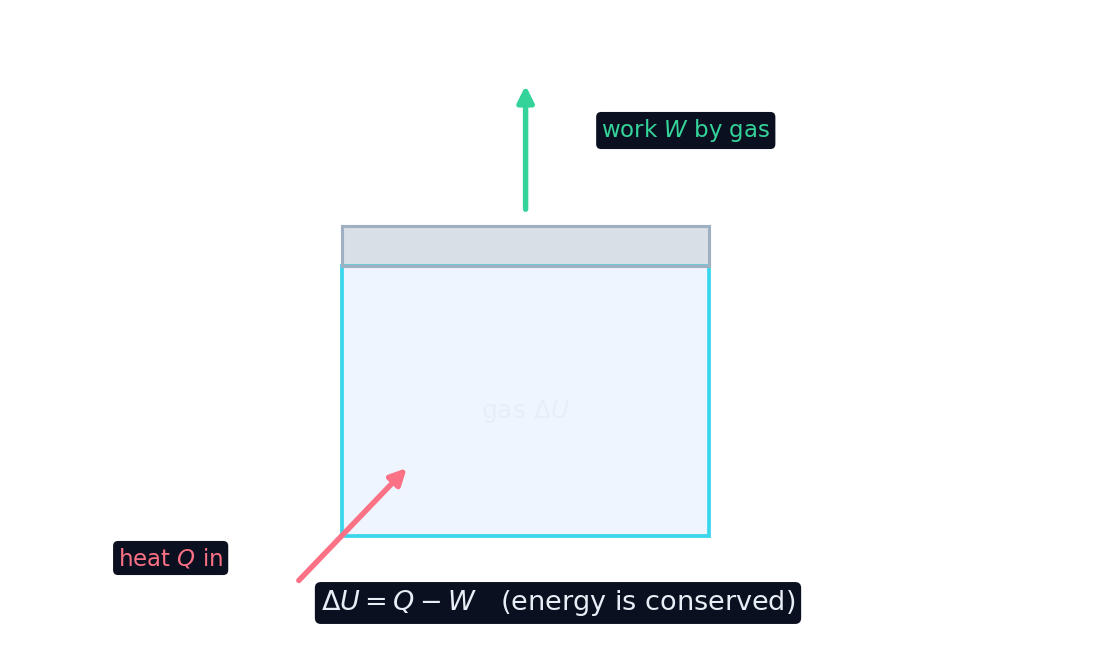
Heat, work and internal energy
Let the gas expand against a piston and see energy leave as work while heat flows in.
A gas absorbs $500\ \text{J}$ of heat and does $200\ \text{J}$ of work. What is its change in internal energy, in joules?
Dificuldade 2/5 · Moedas 140 + pequeno bônus na primeira conclusão hoje
$\Delta U = Q - W = 500 - 200 = 300\ \text{J}$.
The first law of thermodynamics is really a statement of:
Dificuldade 1/5 · Moedas 100 + pequeno bônus na primeira conclusão hoje
$\Delta U = Q - W$ is energy conservation applied to a gas.
Where the energy goes
- Add heat and do no work: all of it raises the internal energy ($\Delta U = Q$).
- Let the gas expand and push a piston: some energy leaves as work, so $U$ rises less.
- Compress the gas with no heat transfer: work done on it raises its internal energy.
- The gas is just an energy account: heat in, work out, and what's left is $\Delta U$.
A gas absorbs $400\ \text{J}$ of heat but does no work (rigid container). What is $\Delta U$, in joules?
Dificuldade 2/5 · Moedas 140 + pequeno bônus na primeira conclusão hoje
With $W = 0$, $\Delta U = Q = 400\ \text{J}$ — all the heat raises the internal energy.
Internal energy and temperature
- For an ideal gas, internal energy depends only on temperature.
- More internal energy means faster particles, so a higher temperature.
- So $\Delta U > 0$ means the gas got hotter; $\Delta U < 0$ means it cooled.
- For the same added heat, preventing expansion leaves more energy to raise the temperature.
For an ideal gas, internal energy depends only on its ____.
Dificuldade 1/5 · Moedas 100 + pequeno bônus na primeira conclusão hoje
Internal energy is the particles' kinetic energy, which tracks temperature.
A positive $\Delta U$ for an ideal gas means the gas got hotter.
Dificuldade 1/5 · Moedas 100 + pequeno bônus na primeira conclusão hoje
More internal energy means faster particles and a higher temperature.
Watch the signs. $W$ in $\Delta U = Q - W$ is the work done by the gas (positive when it expands). Heat added is positive $Q$; heat removed is negative. Mixing up "work by" and "work on" the gas is the classic first-law error.
In $\Delta U = Q - W$, select todos true statements about the signs.
Dificuldade 2/5 · Moedas 140 + pequeno bônus na primeira conclusão hoje
Q is heat added and W is work done by the gas, positive on expansion. Compression gives W < 0, so it can raise U; heat loss may offset that increase.
A gas absorbs $500\ \text{J}$ of heat and does $200\ \text{J}$ of work pushing a piston out.
- $\Delta U = Q - W = 500 - 200 = 300\ \text{J}$.
The internal energy rises by $300\ \text{J}$, so the gas ends up hotter.
The first law of thermodynamics is conservation of energy for a gas: $\Delta U = Q - W$, where $Q$ is heat added and $W$ is work done by the gas. For an ideal gas, internal energy depends only on temperature, so $\Delta U > 0$ means it warmed up.
Write from the data: find the internal-energy change
- A gas absorbs 350 J of heat and does 90 J of work.
- Find the change in internal energy.
A gas absorbs 350 J of heat and does 90 J of work on the surroundings. What is the change in its internal energy, in joules?
350 minus 90 is 260.
A gas absorbs 350 J of heat and does 90 J of work on its surroundings. What is the change in internal energy?
Dificuldade 1/5 · Moedas 100 + pequeno bônus na primeira conclusão hoje
Heat in minus work out is 350 minus 90. Other options — 300 J (the lesson change); 440 J (the heat and the work added).