How European Culture Changed
Introduzido| English | Significado |
|---|---|
| existentialism | A philosophy, associated with Sartre, holding that people must create meaning through their own free choices. |
| postmodernism | A late twentieth-century outlook that doubts any single explanation of history, truth or art. |
| consumerism | A culture centred on buying goods. |
"Be realistic: demand the impossible", May 1968
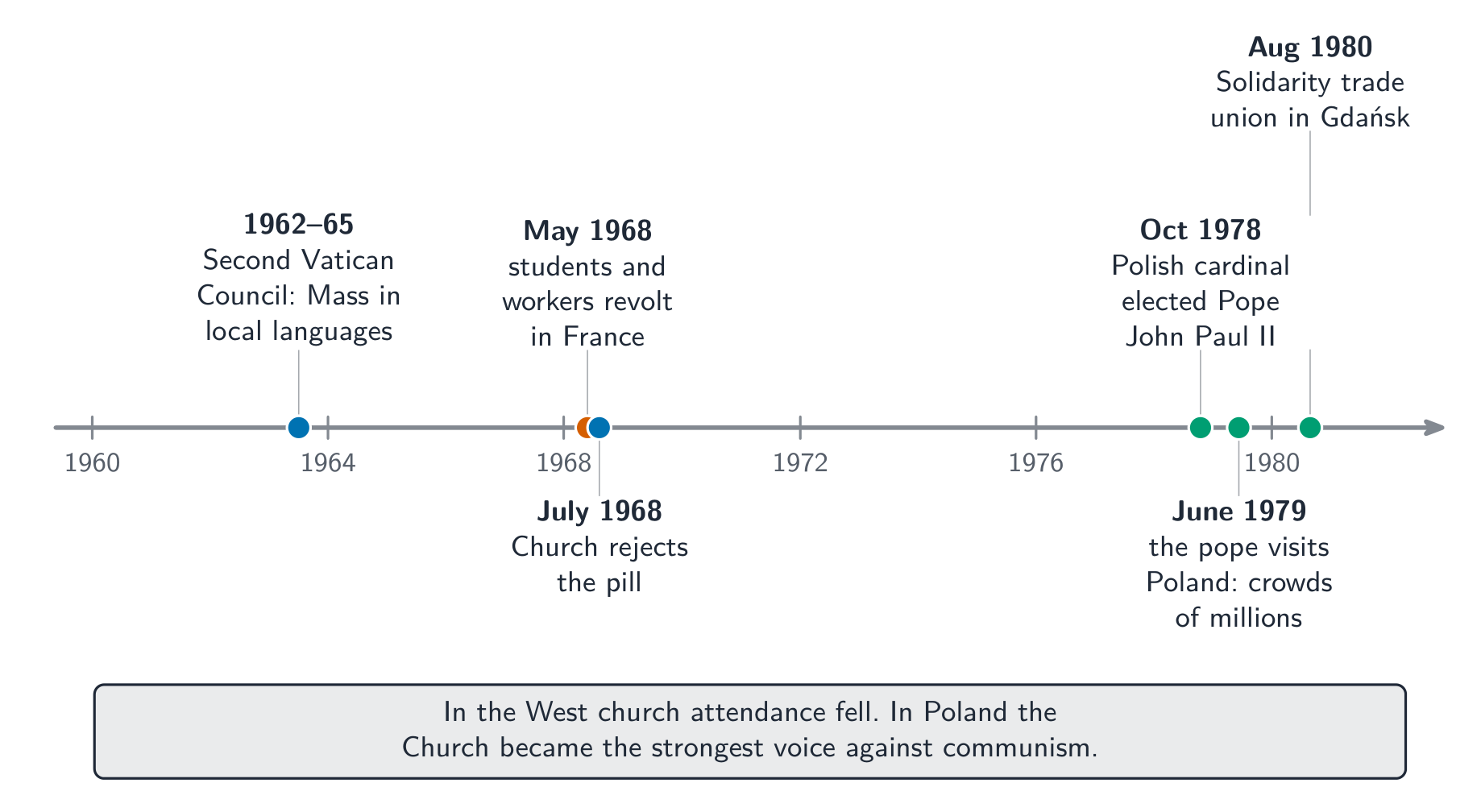
- In May 1968, students in Paris occupied the Sorbonne and built barricades in the Latin Quarter. Within days, about 10 million French workers — roughly two-thirds of the workforce — were on strike. On the walls, students painted slogans such as "Be realistic: demand the impossible". The young people revolting had grown up in the most prosperous society France had ever known.
- After 1945, European culture changed in thought, religion, the arts and daily life — and was challenged by its own young people.
About how many million French workers went on strike in May 1968?
Dificuldade 2/5 · Moedas 140 + pequeno bônus na primeira conclusão hoje
About two-thirds of the workforce.
Confidence undermined
- After the Holocaust and Hiroshima, many lost faith in progress. Existentialism 存在主义 (Sartre, Camus) said life has no given meaning; each person must create it through free choices.
- Later, postmodernism 后现代主义 doubted that any single explanation of history or truth could be trusted.
Match each idea to its description.
Dificuldade 2/5 · Moedas 140 + pequeno bônus na primeira conclusão hoje
Thought and religion.
Religion persists — and changes
- Church attendance fell sharply in Western Europe. The Catholic Church responded with the Second Vatican Council (1962–65), allowing Mass in local languages instead of Latin.
- In Poland, the Church stayed strong; the election of a Polish pope, John Paul II (1978), inspired opposition to communism.
Thought, religion, the arts, or daily life?
Sort each postwar cultural development.
Why was the election of John Paul II important?
Dificuldade 1/5 · Moedas 100 + pequeno bônus na primeira conclusão hoje
1978.0
Worked example: consumer culture and youth
- Baby boom: high birth rates after 1945 produced a large generation of teenagers by the 1960s.
- Money and music: with more spending money, young people bought records, clothes and scooters; the Beatles and American rock music spread a youth culture across Western Europe.
- The revolt: many of these same young people rejected consumerism 消费主义, the authority of parents, universities and the state, and the Vietnam War — as in 1968.
What did many young people reject in 1968?
Dificuldade 2/5 · Moedas 140 + pequeno bônus na primeira conclusão hoje
They loved the music.
The arts and American influence
- New York replaced Paris as the centre of modern art. Hollywood films and television spread American culture.
- European film-makers, such as the French "New Wave", developed their own style in response.
New York replaced Paris as the centre of modern art after 1945.
Dificuldade 1/5 · Moedas 100 + pequeno bônus na primeira conclusão hoje
American influence.
New movements
- From the late 1960s, feminist, environmental, gay rights and peace movements grew, many led by the 1968 generation.
- These movements changed laws on divorce, abortion and the environment in the following decades.
The 1968 revolt did not overthrow governments. De Gaulle won a large election victory in June 1968. Its effects were cultural and social — on attitudes, universities and later movements.
The May 1968 revolt overthrew the French government.
Dificuldade 1/5 · Moedas 100 + pequeno bônus na primeira conclusão hoje
De Gaulle won the June election.
After 1945, existentialism and postmodernism questioned certainty; religion declined in the West but adapted and stayed strong in Poland. The baby boom and consumer prosperity created a youth culture shaped by American influence — and a youth revolt in 1968 whose lasting effects were cultural and social.
Explain why young people in Western Europe revolted in 1968.
Causation.