Conflict After the Peace
Introduzido| English | Significado |
|---|---|
| separatism/ˈsepərətɪzəm/ | A movement by a group within a state to break away and form its own independent state. |
| ethnic cleansing | Forcing out or killing people of another ethnic group to make a territory ethnically "pure". |
Srebrenica, July 1995
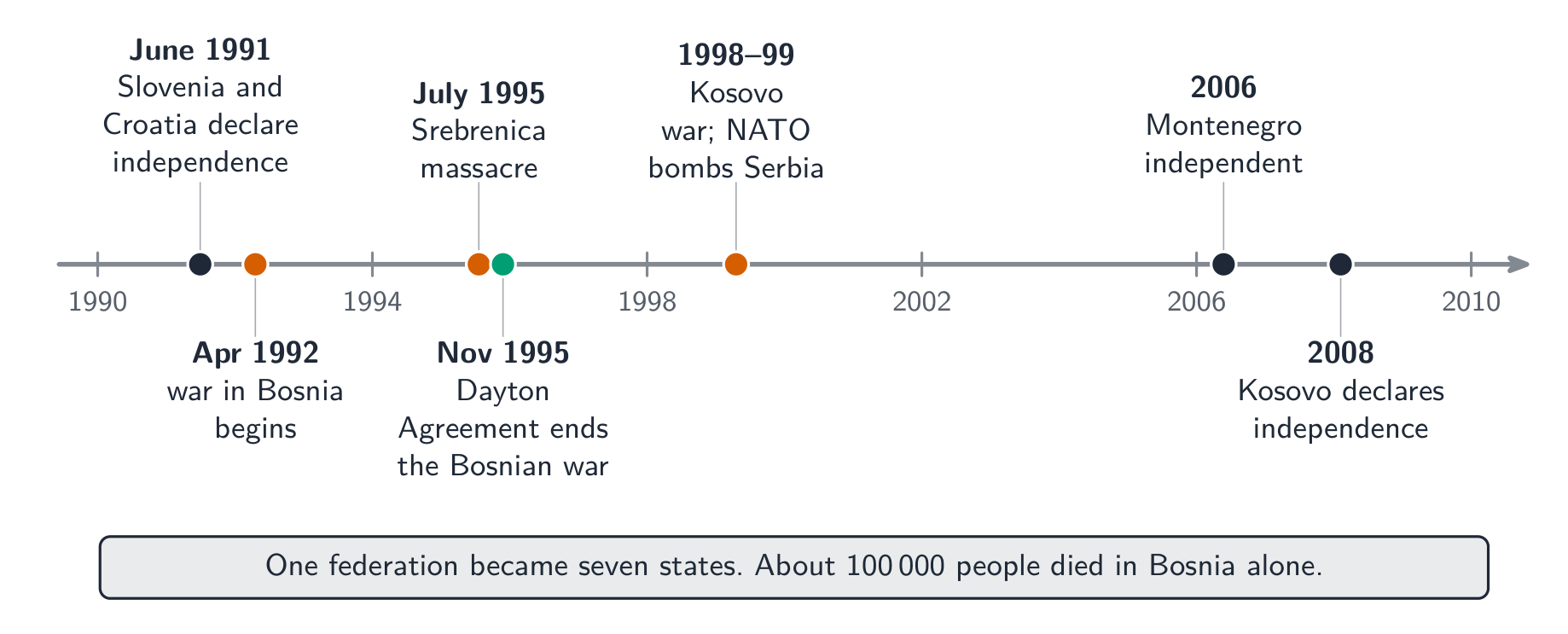
- In July 1995, Bosnian Serb forces captured Srebrenica, a town in eastern Bosnia that the United Nations had declared a "safe area". About 400 Dutch UN soldiers could not stop them. Over several days, about 8000 Bosniak (Bosnian Muslim) men and boys were murdered — the worst killing in Europe since the Second World War. International courts later ruled it a genocide.
- After the Cold War ended, ethnic conflict and separatism returned to parts of Europe.
About how many Bosniak men and boys were murdered at Srebrenica?
Dificuldade 2/5 · Moedas 140 + pequeno bônus na primeira conclusão hoje
July 1995.
When the outer structure goes
- Communist rule had held together multi-ethnic states such as Yugoslavia and the Soviet Union. When it ended in 1989–91, nationalist leaders competed for power.
- In Yugoslavia, Slovenia and Croatia declared independence in 1991, and war followed.
Why did conflict break out in Yugoslavia after 1989?
Dificuldade 1/5 · Moedas 100 + pequeno bônus na primeira conclusão hoje
The outer structure went.
The Yugoslav wars
- The Bosnian War (1992–95) killed about 100 000 people. Serb forces carried out ethnic cleansing 种族清洗 — forcing out or killing people of other groups to create ethnically "pure" territory.
- The Dayton Agreement (1995) ended the Bosnian War; NATO bombing in 1999 ended Serbian attacks in Kosovo.
A cause, a named phenomenon, or an effect?
Sort each element of postwar conflict.
Worked example: separatism and ethnic conflict
- Separatism 分离主义: a group seeks independence from a state. The Basque group ETA used terrorism for independence from Spain, killing about 850 people between 1968 and 2010.
- Ethnic conflict: groups fight over territory and power, as in Bosnia, Kosovo and Chechnya (wars with Russia in 1994–96 and 1999–2009).
- A peaceful case: Czechoslovakia split into the Czech Republic and Slovakia in 1993 without violence — the "Velvet Divorce".
Match each case to its type.
Dificuldade 2/5 · Moedas 140 + pequeno bônus na primeira conclusão hoje
Distinct kinds.
Peace in Northern Ireland
- The Troubles between nationalists and unionists killed about 3500 people from the late 1960s.
- The Good Friday Agreement (1998) created shared government and ended most of the violence.
Put these events in order.
Dificuldade 3/5 · Moedas 200 + pequeno bônus na primeira conclusão hoje
1991, 1993, 1995, 1998.
The Good Friday Agreement created shared government in Northern Ireland.
Dificuldade 1/5 · Moedas 100 + pequeno bônus na primeira conclusão hoje
1998.0
A recurring pattern
- Throughout the twentieth century, conflict came back whenever empires or states broke apart: in 1918, after 1945 and after 1989.
- Nationalism, which had built states in the nineteenth century, could also tear them apart.
Do not call every conflict "ancient hatreds". The Yugoslav wars were driven by modern leaders who used nationalism to gain power after communism collapsed.
The Yugoslav wars were simply caused by ancient hatreds.
Dificuldade 1/5 · Moedas 100 + pequeno bônus na primeira conclusão hoje
Modern leaders used nationalism.
The end of communism released national rivalries. Yugoslavia broke apart in wars marked by ethnic cleansing and the Srebrenica genocide; Russia fought separatists in Chechnya; ETA and Northern Ireland's conflict continued until peace processes. Czechoslovakia showed that separation could also be peaceful.
Explain why the end of the Cold War led to ethnic conflict in parts of Europe.
Causation.