Building Your Own Line of Reasoning
Introduzido| English | Significado |
|---|---|
| line of reasoning/laɪn ɒv ˈriːzənɪŋ/ | An order of claims with a reason for that order. |
A list of points, or an argument?
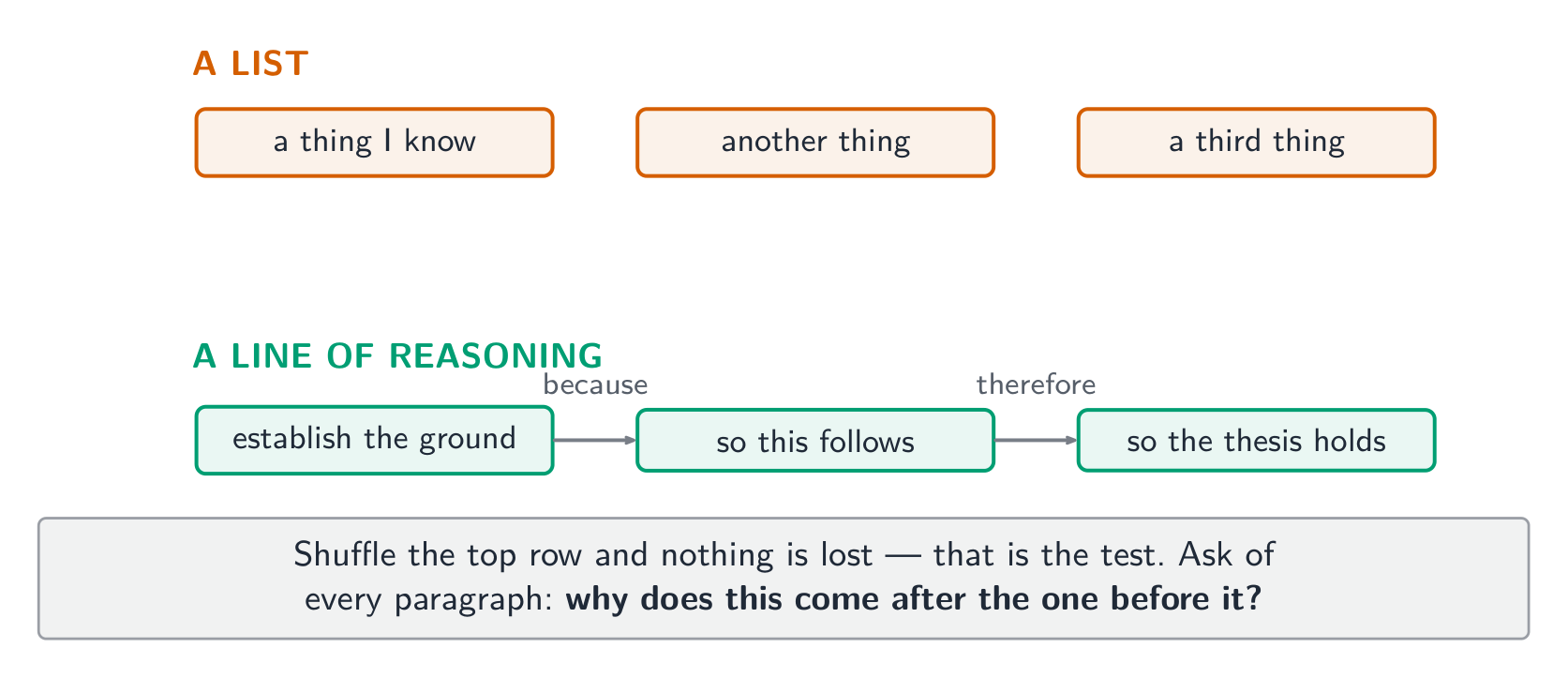
- Two students answer the same argument prompt with the same three points. One essay reads like a list: "First... Also... Finally...". The other reads like a path: each paragraph answers a question the one before it raised. Only the second earns the top of the 0–4 evidence-and-commentary row, which rewards a line of reasoning 推理思路.
- A line of reasoning is an order of claims with a reason for that order. Plan it before you write any paragraph.
The test for an order
- For each paragraph ask: why does this come after the one before it? If the only answer is "it is another thing I know", you have a list.
- A good answer sounds like: "because the last paragraph raised a cost, and this one shows the cost is worth paying", or "because this paragraph answers the obvious objection to the last one".
Climb the four rungs of commentary
'Explain your evidence' is unusable; four questions, each answerable in a sentence, make it a procedure.
Which answer shows that paragraph 3 belongs after paragraph 2?
Dificuldade 1/5 · Moedas 100 + pequeno bônus na primeira conclusão hoje
Each paragraph should follow from the one before it.
Common orders and when to use them
| Order | Use it when… |
|---|---|
| Weakest to strongest | your points differ in strength; end on the best one |
| Objection first | your audience already disagrees; answer them before pressing your case |
| Cause to effect | the argument is a chain of consequences |
| Narrow to wide | a local example builds towards a general principle |
Match each situation to a suitable order.
Dificuldade 2/5 · Moedas 140 + pequeno bônus na primeira conclusão hoje
Choose the order that fits the argument and audience.
Worked plan: list vs reasoning
Prompt: Argue whether cities should ban private cars from their centres.
List plan (topic sentences): (1) Car bans reduce pollution. (2) Car bans make streets safer. (3) Some people need cars.
Reasoning plan (topic sentences): (1) Car-free centres cut the air pollution that harms people who live and work there. (2) That health gain, however, would mean little if residents and shoppers simply stopped coming, so the real question is whether people can still reach the centre. (3) Cities that combine bans with frequent buses and exceptions for disabled drivers, such as Oslo's car-light centre, show that access can be kept, which is why a ban works only as part of a transport plan, not on its own.
- Why the second scores higher: each topic sentence grows from the last ("That health gain, however..."; "which is why..."), and the essay ends on a qualified, more complex claim, which also opens the way to the sophistication point.
Put these topic sentences in an order that forms a line of reasoning.
Dificuldade 3/5 · Moedas 200 + pequeno bônus na primeira conclusão hoje
Each sentence grows from the one before.
Commentary carries the path
- Each paragraph's commentary connects its evidence to its own claim. Its last sentence should also point towards the next claim, so the reader is carried forward.
- Test a draft: read only your topic sentences in order. They should make an argument on their own.
"Firstly, secondly, finally" is not a line of reasoning. Those words number paragraphs; they do not explain why one follows another. Use connectors that show logic: however, so, which means, this raises the question.
Using "firstly, secondly, finally" is enough to create a line of reasoning.
Dificuldade 1/5 · Moedas 100 + pequeno bônus na primeira conclusão hoje
Those words number paragraphs but do not explain why one follows another.
A line of reasoning is an order of claims with a reason for the order. Test each paragraph: why does it follow the one before? Choose an order (weakest to strongest, objection first, cause to effect, narrow to wide) that fits the argument, and end each paragraph's commentary by pointing to the next claim.
Practice. Prompt: argue whether schools should replace written exams with projects. Write three topic sentences that form a line of reasoning, each connected to the one before.
The topic sentences alone should make an argument.