Distribuição quântica de chaves
Introduzido| English | Significado |
|---|---|
| quantum cryptography/ˈkwɒntəm krɪpˈtɒɡrəfi/ | criptografia quântica |
| quantum key distribution/ˈkwɒntəm kiː ˌdɪstrɪˈbjuːʃn/ | distribuição de chaves quântica |
| photon/ˈfəʊtɒn/ | fóton |
| authenticated/ɔːˈθentɪkeɪtɪd/ | autenticado |
A key that cannot be photocopied quietly
- A shop can send an encrypted file over an ordinary network, but first it must share a secret key. Making the key longer does not explain how the two sides obtain it safely.
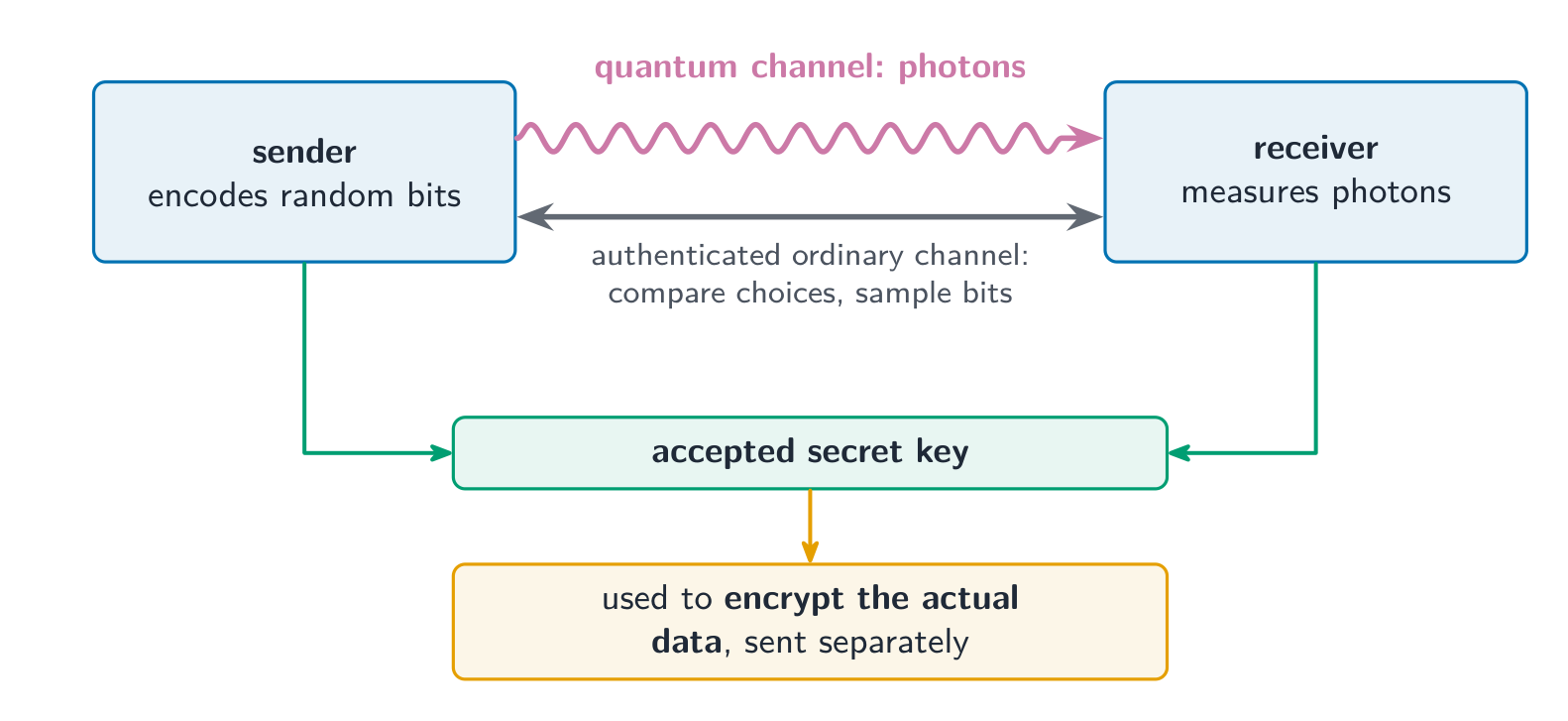
- Quantum cryptography 量子密码学 includes quantum key distribution 量子密钥分发 (QKD): sharing key material using quantum states. The key exchange and the encrypted file are two separate jobs.
Qual é a principal função da DQC?
Dificuldade 1/5 · Moedas 100 + pequeno bônus na primeira conclusão hoje
A DQC compartilha material de chave; um esquema de criptografia usa uma chave para proteger a mensagem.
Photons carry the key material
- A sender encodes random bits in quantum states of photons 光子. The receiver measures the incoming photons. In a simple protocol, the two sides use different measurement choices and later keep results from compatible choices.
- Measuring an unknown quantum state can disturb it; an attacker cannot make a perfect copy of an arbitrary unknown state. Interception can therefore leave a statistical error signal in the retained results.
Um atacante pode sempre copiar perfeitamente um estado quântico arbitrário desconhecido e deixá-lo inalterado.
Dificuldade 1/5 · Moedas 100 + pequeno bônus na primeira conclusão hoje
Um estado desconhecido não pode ser clonado perfeitamente; a interceptação pode afetar os resultados medidos.
A sample test, not a detector on every photon
- The two sides compare a sample of retained bits over an authenticated channel: they must know who is speaking. They do not publish the whole secret key; revealed sample bits are discarded.
- Too many errors mean aborting the exchange and discarding the proposed key. Errors may come from interception or equipment noise, so an error does not identify an attacker. Accepted results still need error correction and privacy processing.
Organize esta troca simplificada de QKD.
Dificuldade 3/5 · Moedas 200 + pequeno bônus na primeira conclusão hoje
Uma amostra é revelada para teste, então esses bits testados não podem permanecer parte da chave secreta.
Worked example: reject a noisy exchange
- A simplified classroom test compares 40 sample bits. Six differ. Calculate the sample error rate: $r = \dfrac{6}{40}\times100 = 15\%$. Suppose this exercise's stated acceptance limit is 10%; the exchange is rejected.
- Discard the candidate key and investigate or retry. Do not use the revealed sample bits in a secret key, and do not conclude that six errors prove six bits were stolen. The 10% limit is an exercise assumption, not a universal QKD threshold.
Seis 40 bits da amostra diferem. Qual porcentagem difere?
Dificuldade 2/5 · Moedas 140 + pequeno bônus na primeira conclusão hoje
Taxa de erro = 6 / 40 × 100 = 15 pontos.
A taxa de erro da amostra é 15%; o limite de aceitação do exercício é 10%. O que as partes devem fazer?
Dificuldade 1/5 · Moedas 100 + pequeno bônus na primeira conclusão hoje
15% excede o limite declarado. Descarte a chave do candidato; o resultado não prova quem causou os erros.
The benefit follows from the mechanism
- In an ideal protocol, the key's secrecy is supported by quantum physics rather than only the difficulty of a mathematical problem. Attempts to measure the transmitted states can affect the test results.
- This helps with key distribution. It does not protect a stolen endpoint, authenticate the other party on its own, or make every practical implementation immune to attack.
Why ordinary networks still need ordinary encryption
- Practical QKD needs special equipment and a suitable quantum link, such as optical fibre or a free-space path. Loss, distance and key-generation rate constrain deployment; ordinary routers cannot simply copy and forward arbitrary quantum states.
- The agreed key is then used by an encryption scheme to protect the actual data on an ordinary channel. QKD supplies key material, not a new way of emailing a whole document as photons.
Quais restrições permanecem com QKD prático? Selecione todas as que se aplicam.
Dificuldade 2/5 · Moedas 140 + pequeno bônus na primeira conclusão hoje
QKD não fornece, por si só, garantia de identidade ou terminais seguros, e requer equipamentos adequados e enlaces.
Marks that slip away
- Explain a benefit through its cause: unknown states cannot be perfectly copied, and interception can introduce detectable errors. Avoid “every attack is instantly detected” or “the whole system is unhackable”.
- Explain a drawback through its effect: specialised links and equipment increase cost and limit where the method can be deployed. Authentication and secure endpoints are still necessary.
Choose the right job for each tool
- QKD shares key material; ordinary encryption protects the message with a key. A sample error test can cause the exchange to be rejected, and tested bits are not kept secret.
- A complete answer gives the purpose, the physical reason interception can be noticed, a benefit and a practical limit. It also keeps identity checks separate from key distribution.
Further reading: QKD in an authenticated key-exchange framework and practical deployment limitations. Sources checked 2 October 2026; this lesson is original classroom material.
Atribua a tarefa ao mecanismo.
Dificuldade 2/5 · Moedas 140 + pequeno bônus na primeira conclusão hoje
Distribuição de chaves, criptografia de dados e autenticação servem para tarefas diferentes.