Pular para o conteúdo
Matérias

Pearson Edexcel · International GCSE · Physics

  • 1

    1 · Forces and motion

    Programa de aprendizado em breve

    Material de apoio

    Descrevendo e explicando o movimento

    A Física começa com o movimento. Esta primeira seção constrói as ferramentas: gráficos que descrevem o movimento, equações que ligam velocidade, aceleração e distância, forças que causam toda mudança, e (P) momento e momentos que explicam zonas de amassamento e vigas equilibradas.

    Física Edexcel International GCSE 4PH1, Seção 1 (afirmações 1.1–1.33P). As afirmações sufixadas com P são a extensão de ciência separada, avaliadas na Prova 2P; unidades a aprender incluem newton (N) e, (P), newton metro e kg m/s.

    Movimento e posição
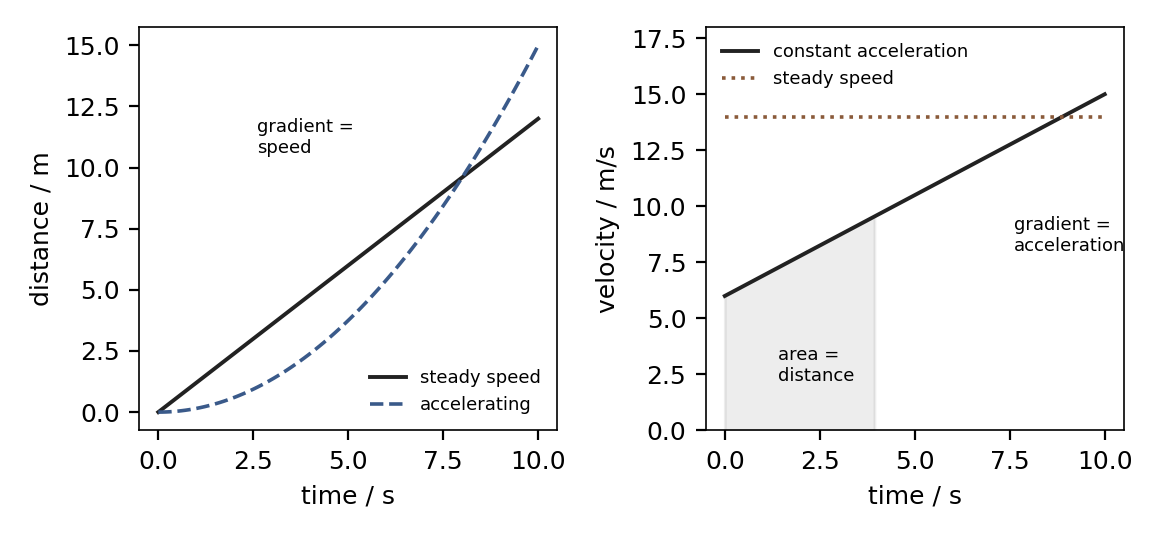
    Gráficos de distância-tempo e velocidade-tempo: a inclinação significa velocidade num, aceleração no outro; a área sob um gráfico de velocidade-tempo é a distância.

    Velocidade média = distância percorrida ÷ tempo gasto. Num gráfico de distância–tempo, a inclinação é a velocidade: uma linha reta inclinada é velocidade constante, uma curva é aceleração, uma linha plana é repouso. Aceleração é a variação de velocidade por segundo:

    $$a = \frac{v - u}{t} \qquad v^2 = u^2 + 2as$$

    Num gráfico de velocidade–tempo, a inclinação é a aceleração e a área entre a linha e o eixo temporal é a distância percorrida.

    Verificação resolvida. Um carro acelera de 4 m/s para 16 m/s em 6 s: $a = (16 - 4)/6 = 2\ \mathrm{m/s^2}$. Distância percorrida $= \frac{1}{2}(4 + 16) \times 6 = 60$ m.

    Forças e movimento

    Forças alteram a velocidade, forma ou direção de um corpo. Força é um vetor (tamanho + direção); escalares como velocidade têm apenas tamanho. Ao longo de uma linha, as forças somam-se: duas trações de 5 N contra uma tração de 8 N resultam em uma força resultante de 2 N. Atrito opõe-se ao movimento. A força desequilibrada causa aceleração:

    $$F = m \times a \qquad W = m \times g$$

    Verificação resolvida. Um carro de 1200 kg com força motriz de 3600 N contra 1200 N de arrasto: $F = 2400$ N; $a = 2400/1200 = 2\ \mathrm{m/s^2}$. Peso a $g = 10$ N/kg: $W = 1200 \times 10 = 12\,000$ N.

    Distância de parada = distância de reação + distância de frenagem. A distância de reação aumenta com a velocidade e o tempo de reação (fadiga, álcool, uso do celular); a distância de frenagem aumenta com o quadrado da velocidade, massa, freios fracos ou aderência reduzida (estradas molhadas ou geladas, pneus desgastados).
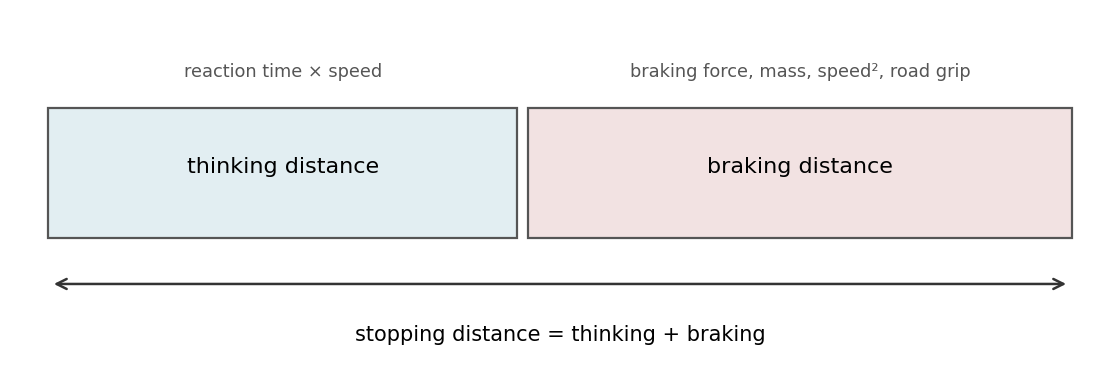
    A distância de parada divide-se em distância de reação (tempo de resposta) e distância de frenagem.

    Queda livre: objetos aceleram enquanto o peso supera a resistência do ar; à medida que a velocidade aumenta, a resistência também aumenta, resultando em uma força resultante decrescente até peso = resistência — velocidade terminal.
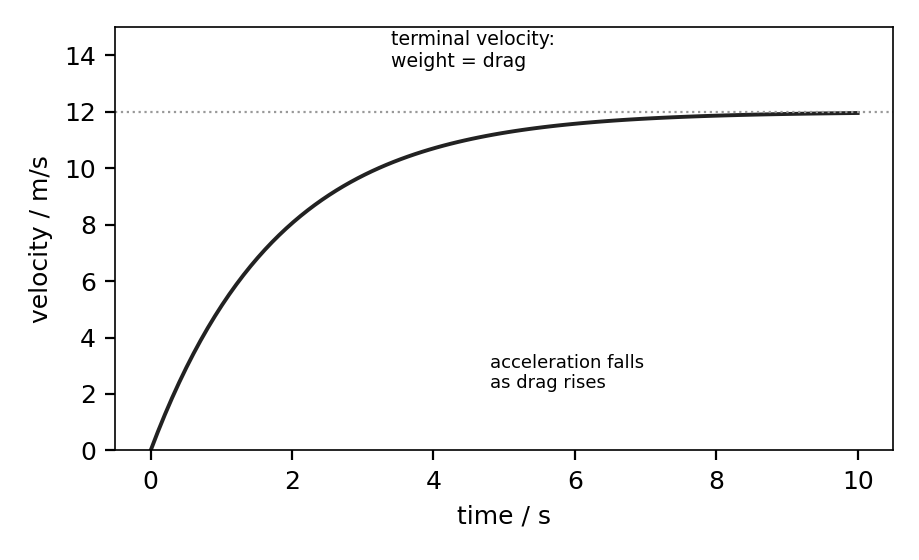
    Velocidade contra tempo para um objeto em queda: a aceleração diminui até zero na velocidade terminal.

    Forças e forma

    Uma mola estica sob carga. Na região linear inicial, a extensão é proporcional à força — Lei de Hooke; após o limite de proporcionalidade, ela se curva. Comportamento elástico recupera a forma original quando a força é removida. Prático: pendure massas em uma mola (ou elástico), plote força contra extensão.
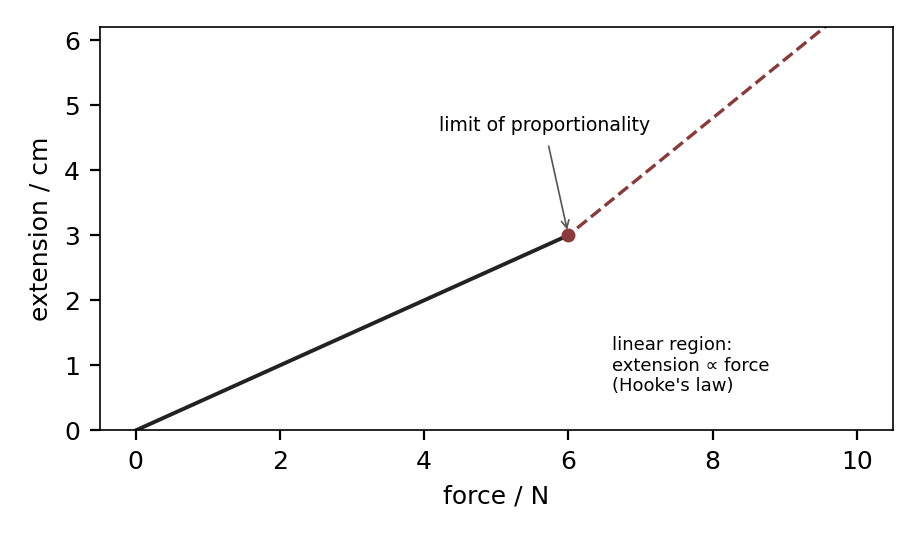
    Gráfico de força-extensão: linha reta até o limite de proporcionalidade, depois curvatura.

    Momento linear e momentos (P)

    $$p = m \times v \qquad F = \frac{mv - mu}{t}$$

    O momento linear (kg·m/s) é conservado em colisões: total antes = total depois. Recursos de segurança funcionam aumentando o tempo da colisão, então para a mesma variação de momento, a força é menor — zonas de amassamento, cinto de segurança, airbags. Terceira Lei de Newton: a toda ação corresponde uma reação igual e oposta.

    Momento = força × distância perpendicular ao pivô. Uma viga equilibra quando momentos horários = momentos anti-horários; o peso de um corpo atua através do seu centro de gravidade.
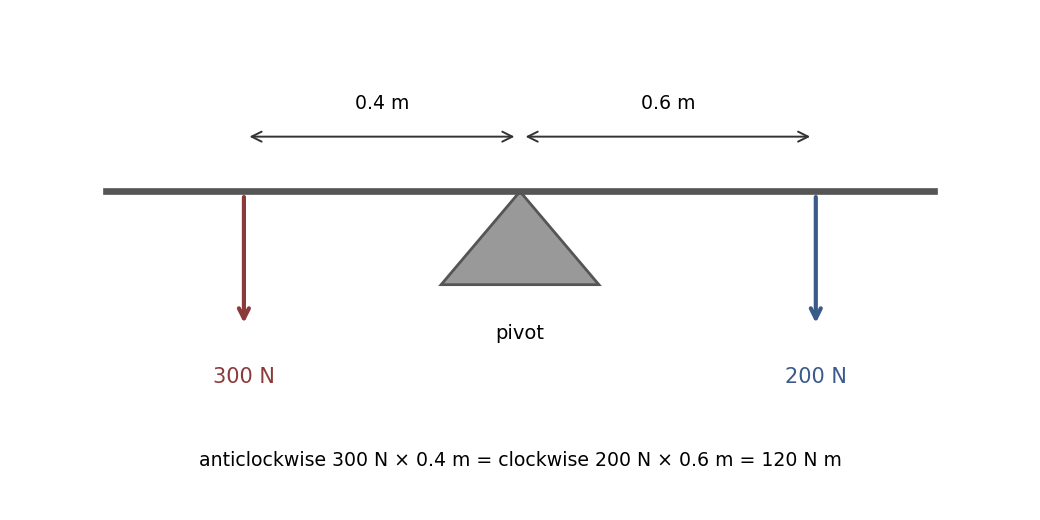
    Viga carregada: os momentos em cada apoio se equilibram quando os horários são iguais aos anti-horários.

    Exemplo resolvido. Duas crianças (300 N a 0.4 m, 200 N a 0.6 m do pivô) em uma balança: horário $200 \times 0.6 = 120$ N·m; anti-horário $300 \times 0.4 = 120$ N·m — equilibrada.

    Verifique você mesmo

    1. O que a inclinação de um gráfico de distância-tempo e de velocidade-tempo fornece?
    2. Um ciclista percorre 900 m em 3 minutos. Calcule a velocidade média em m/s.
    3. Calcule a aceleração partindo de 30 m/s até parar em 5 s.
    4. Enuncie a equação que relaciona força resultante, massa e aceleração, e sua unidade.
    5. Cite dois fatores que aumentam a distância de reação e dois que aumentam a distância de frenagem.
    6. Explique, em termos de forças, por que um paraquedista atinge a velocidade terminal.
    7. Enuncie a Lei de Hooke.
    8. (P) Corredor de 60 kg a 8 m/s: calcule o momento linear.
    9. (P) Explique como uma zona de amassamento protege os passageiros.
    10. (P) Qual é o momento de uma força 50 N a 0.3 m da articulação?

    Respostas: 1 velocidade; aceleração (e a área sob a linha de velocidade-tempo é distância); 2 $900/180 = 5$ m/s; 3 $a = (0 - 30)/5 = -6\ \mathrm{m/s^2}$ (desaceleração de 6 m/s²); 4 F = ma, com F em newtons; 5 pensamento — maior velocidade, tempo de reação mais longo; frenagem — maior velocidade (velocidade²), massa, freios/pneus ruins, estradas molhadas ou geladas; 6 arrasto aumenta com a velocidade até igualar ao peso — resultante e aceleração atingem zero, logo a velocidade é constante; 7 extensão é proporcional à força, até o limite de proporcionalidade; 8 (P) $p = 60 \times 8 = 480\ \mathrm{kg\,m/s}$; 9 (P) ela se amassa, aumentando o tempo da colisão; força = variação do momento ÷ tempo, logo um tempo maior significa uma força menor sobre os passageiros; 10 (P) $50 \times 0.3 = 15$ N m.
    Vocabulário
    English Português
    acceleration/əkˌseləˈreɪʃn/ aceleração
    vector/ˈvektə/ vetor
    resultant force/rɪˈzʌltənt fɔːs/ força resultante
    friction/ˈfrɪkʃn/ atrito
    terminal velocity/ˈtɜːmɪnl vəˈlɒsɪti/ velocidade terminal
    elastic behaviour comportamento elástico
    Hooke law Lei de Hooke
    momentum/məʊˈmentəm/ quantidade de movimento
    moment/ˈməʊmənt/ momento
    centre of gravity/ˈsentə ɒv ˈɡrævɪti/ centro de gravidade
  • 2

    2 · Electricity

    Programa de aprendizado em breve

    Material de apoio

    English

    The energy you cannot see

    Press a switch and a room lights. Between the power station and the lamp stands everything in this section: how domestic wiring keeps you safe, how voltage drives current through circuits, and — (P) — how electrons rubbed from one surface to another make charges that attract, repel and sometimes spark.

    Edexcel International GCSE Physics 4PH1, Section 2 (statements 2.1–2.28P). Units: ampere (A), coulomb (C), joule (J), ohm (Ω), volt (V), watt (W). P-suffixed statements are the Physics-only extension, assessed on Paper 2P.

    Mains electricity

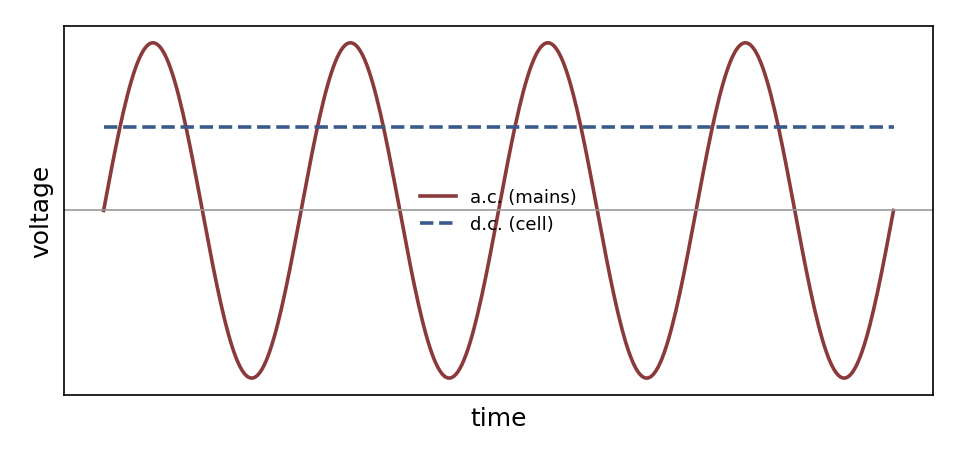
    Mains electricity is alternating current (a.c.) 交流电 — direction reverses many times a second; a cell gives direct current (d.c.) 直流电 — one direction only.

    An a.c. trace oscillates about zero; a d.c. line is flat.

    Safety: insulation on wires; double insulation (plastic casing, no earth needed); earthing 接地 (a low-resistance path so a fault current blows the fuse); fuses 保险丝 and circuit breakers 断路器 (melt or trip on excess current, protecting wiring and people). Current in a resistor transfers electrical energy to thermal energy — the point of kettles and heaters, and the reason fuse ratings matter:

    $$P = I \times V \qquad E = I \times V \times t$$

    Worked check (fuse choice). A 230 V, 1.15 kW heater draws $I = P/V = 1150/230 = 5$ A — fit a 13 A fuse (next standard rating above the current); a 3 A fuse would blow in normal use.

    Circuits

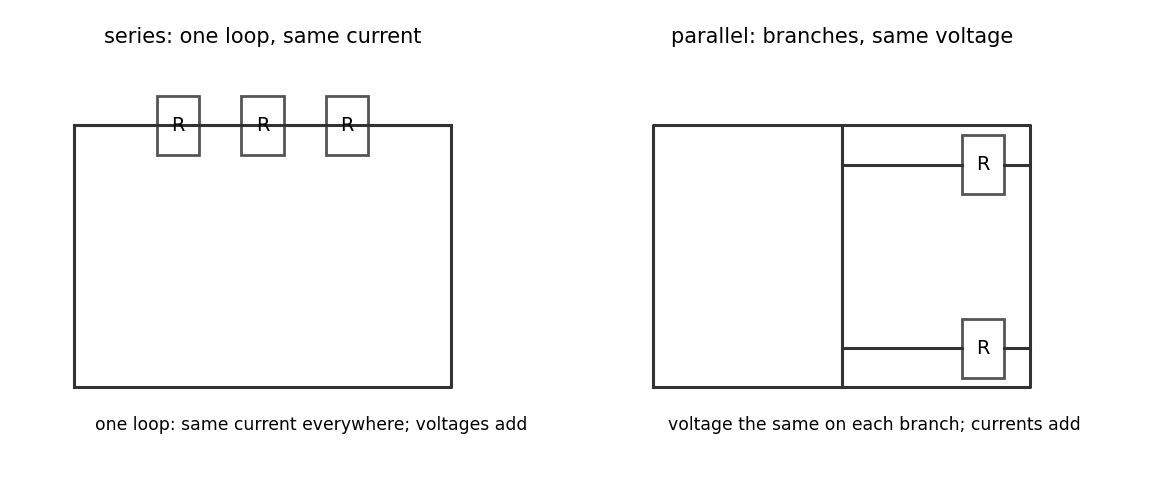
    Series: one loop, same current, voltages add. Parallel: branches share the same voltage, currents add.

    Series 串联 suits chains (switches, ammeters, fairy lights) — the same current everywhere, voltages add, and one failure breaks all. Parallel 并联 suits domestic lighting — each lamp gets the full supply voltage, works independently, and currents add at junctions (charge is conserved at a junction).

    $$V = I \times R \qquad Q = I \times t \qquad E = Q \times V$$

    Current is a flow of negatively charged electrons in metals. Voltage is the energy transferred per unit charge (1 V = 1 J/C). Two resistors in series: $R = R_1 + R_2$; in parallel the combined resistance is less than either alone.

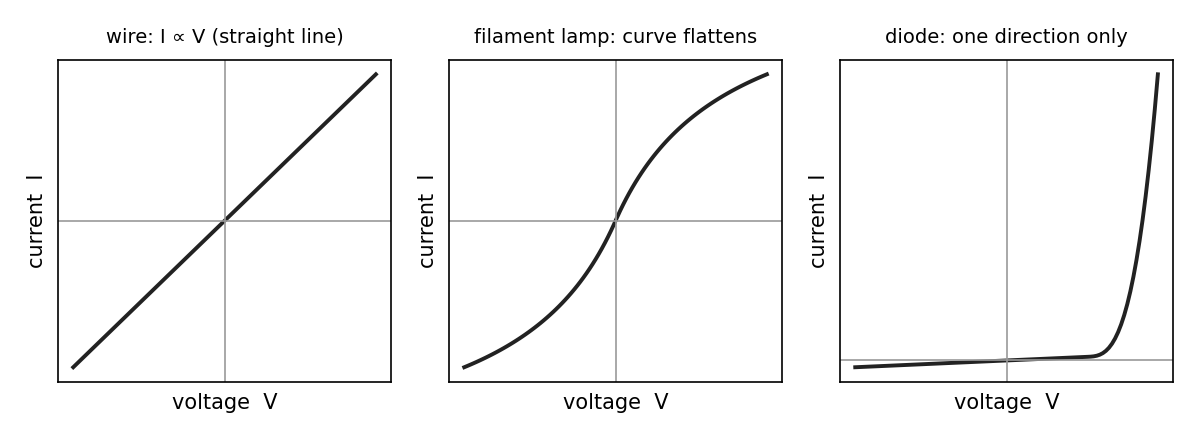
    I–V characteristics 伏安特性: a wire gives a straight line through the origin (constant resistance); a filament lamp curves as heating raises its resistance; a diode conducts in one direction only. LDRs: resistance falls as light rises. Thermistors: resistance falls as temperature rises (or rises as it cools — used in temperature sensors). Lamps and LEDs indicate current.

    I-V curves for a wire, a filament lamp and a diode.

    Worked check. Two resistors, 4 Ω and 6 Ω, in series across 10 V: total 10 Ω, $I = 10/10 = 1$ A; voltages 4 V and 6 V. In parallel across 10 V: each branch draws 10/4 = 2.5 A and 10/6 ≈ 1.67 A — total ≈ 4.17 A, equivalent resistance ≈ 2.4 Ω (less than either).

    Electric charge (P)

    Conductors (metals) let charge flow; insulators (plastics) 绝缘体 do not.

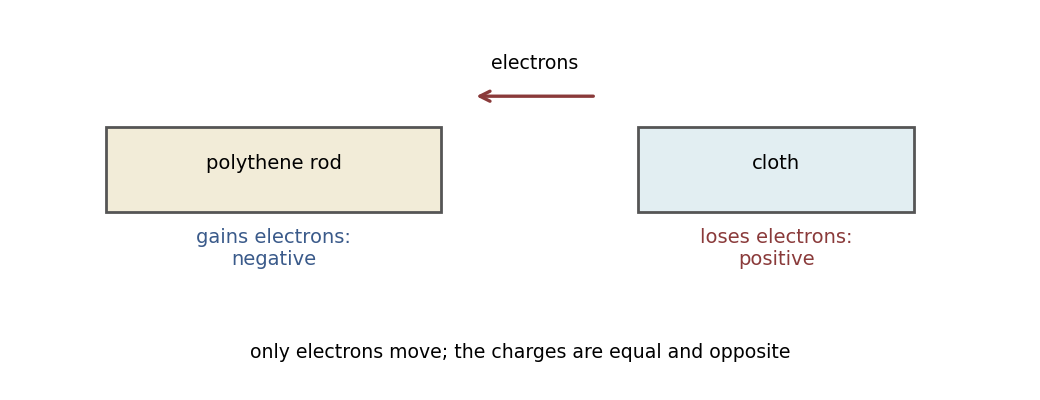
    Rubbing transfers electrons from cloth to rod: the rod becomes negative, the cloth positive.

    Rubbing an insulator transfers electrons: the loser becomes positive, the gainer negative — never protons moving. Unlike charges attract; like charges repel. A charged rod attracts tiny uncharged paper because it induces charge separation. Dangers: sparks while fuelling aircraft and tankers — earthed bonds drain charge safely. Uses: photocopiers and inkjet printers steer charged toner or droplets.

    Check yourself

    1. State the difference between a.c. and d.c. and give one source of each.
    2. Explain how earthing and a fuse work together to protect a user.
    3. A 230 V kettle is rated 2.0 kW. Calculate the current and the best fuse.
    4. State two reasons domestic lighting is wired in parallel.
    5. State the I–V shapes for a wire, a filament lamp and a diode.
    6. What happens to an LDR's resistance in bright light?
    7. Define voltage in terms of energy and charge.
    8. Calculate the charge passing when 2 A flows for 30 s.
    9. (P) Explain how rubbing a polythene rod with a cloth makes it negative.
    10. (P) Give one danger and one use of electrostatic charge.

    Answers: 1 a.c. reverses direction repeatedly — the mains; d.c. flows one way — a cell or battery; 2 the earth wire gives a low-resistance path, so the large fault current flows to earth and melts the fuse, cutting off the supply before a user can touch the live casing; 3 $I = 2000/230 = 8.7$ A — a 13 A fuse; 4 each lamp receives the full mains voltage; one lamp failing leaves the others working (and switches control lamps independently); 5 straight line through the origin; S-shaped curve (gradient falls as it heats); zero until a forward threshold then steep (one direction); 6 it falls; 7 voltage is the energy transferred per unit charge (1 volt = 1 joule per coulomb); 8 $Q = 2 \times 30 = 60$ C; 9 (P) friction transfers electrons from the cloth to the rod — the rod gains electrons and becomes negative, the cloth positive; 10 (P) danger — sparking while fuelling aircraft/tankers; use — photocopier or inkjet printer.

    Vocabulário
    English Português
    alternating current/ˈɔːltəneɪtɪŋ ˈkʌrənt/ corrente alternada
    direct current/daɪˈrekt ˈkʌrənt/ corrente contínua
    earthing aterramento
    fuse/fjuːz/ fusível
    circuit breaker disjuntor
    series/ˈsɪəriːz/ em série
    parallel/ˈpærəlel/ em paralelo
    I-V characteristics características I-V
    insulator/ˈɪnsjuːleɪtə/ isolante
  • 3

    3 · Waves

    Programa de aprendizado em breve

    Material de apoio

    English

    Waves: energy that travels

    Ripples cross a pond, light crosses a room, sound crosses air — waves carry energy and information without transferring matter. This section gives you their vocabulary and equations, the electromagnetic spectrum with its uses and dangers, and the behaviour of light and (P) sound: reflection, refraction and total internal reflection.

    Edexcel International GCSE Physics 4PH1, Section 3 (statements 3.1–3.29P). Units: degree (°), hertz (Hz), metre (m), m/s, second (s).

    Properties of waves

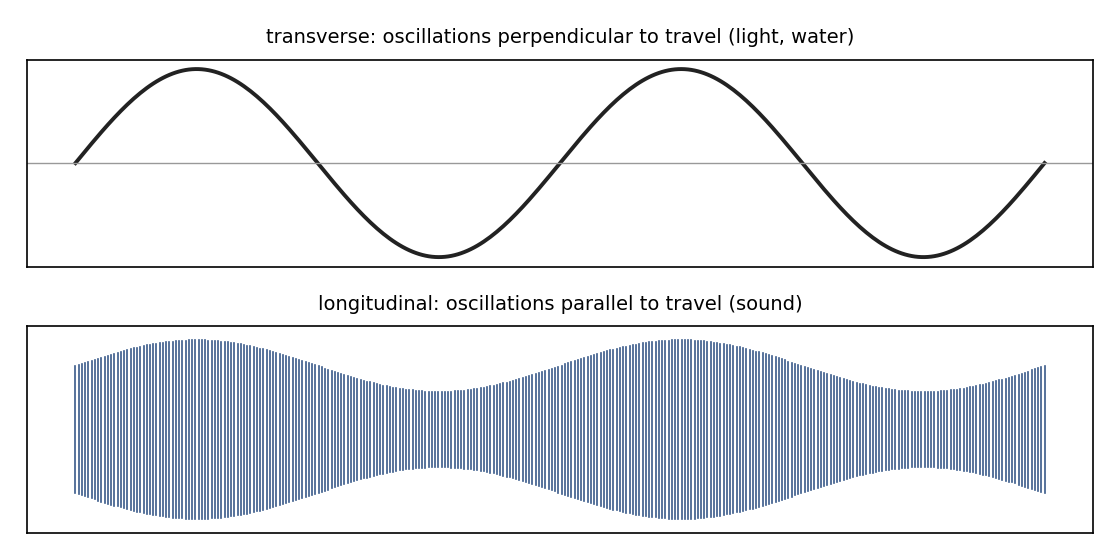
    A transverse wave oscillates across its travel; a longitudinal wave oscillates along it, making compressions.

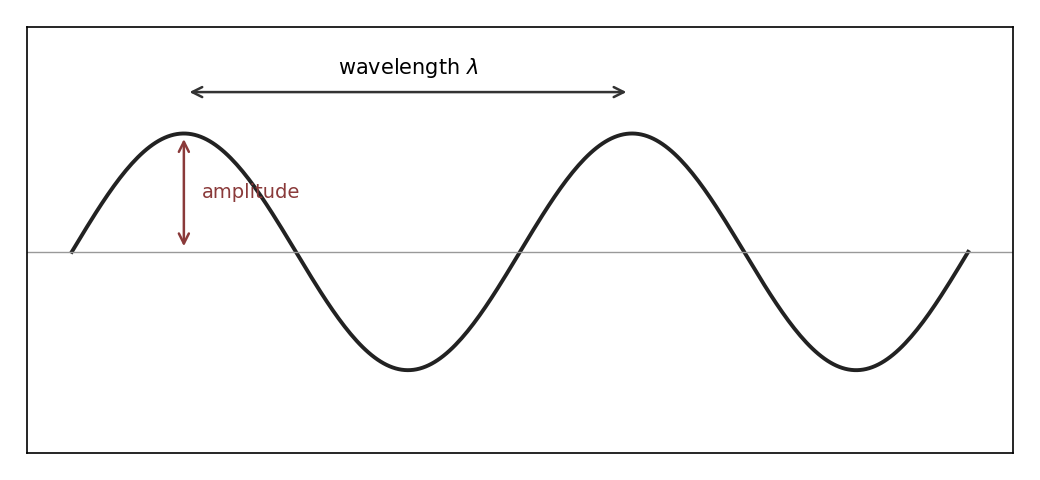
    Transverse waves 横波 oscillate perpendicular to travel (light, water). Longitudinal waves 纵波 oscillate along the travel direction as compressions and rarefactions (sound). Vocabulary: amplitude 振幅 (maximum displacement), wavelength λ 波长 (one crest to the next), frequency f 频率 (waves per second, Hz), period T (time per wave), wavefront (a line of simultaneous crests).

    A labelled wave with amplitude and wavelength marked.
    $$v = f \times \lambda \qquad f = \frac{1}{T}$$

    Worked check. A 340 Hz sound wave at 340 m/s: $\lambda = 340/340 = 1$ m; period $= 1/340 \approx 2.9$ ms. The Doppler effect 多普勒效应: a source moving towards an observer bunches wavefronts — higher observed frequency; moving away stretches them — lower.

    The electromagnetic spectrum

    One family, same speed in free space, ordered by decreasing wavelength (increasing frequency): radio → microwave → infrared → visible (red to violet) → ultraviolet → X-ray → gamma.

    Radiation Use Danger
    radio broadcasting, communications —
    microwave cooking, satellite TV internal heating of tissue
    infrared heaters, night vision skin burns
    visible optical fibres, photography —
    ultraviolet fluorescent lamps damage to surface cells, blindness
    X-ray imaging inside objects/bodies cancer, mutation (ionising)
    gamma sterilising food and equipment cancer, mutation

    Protection: limit exposure time, shielding, sun cream (UV).

    Light and sound

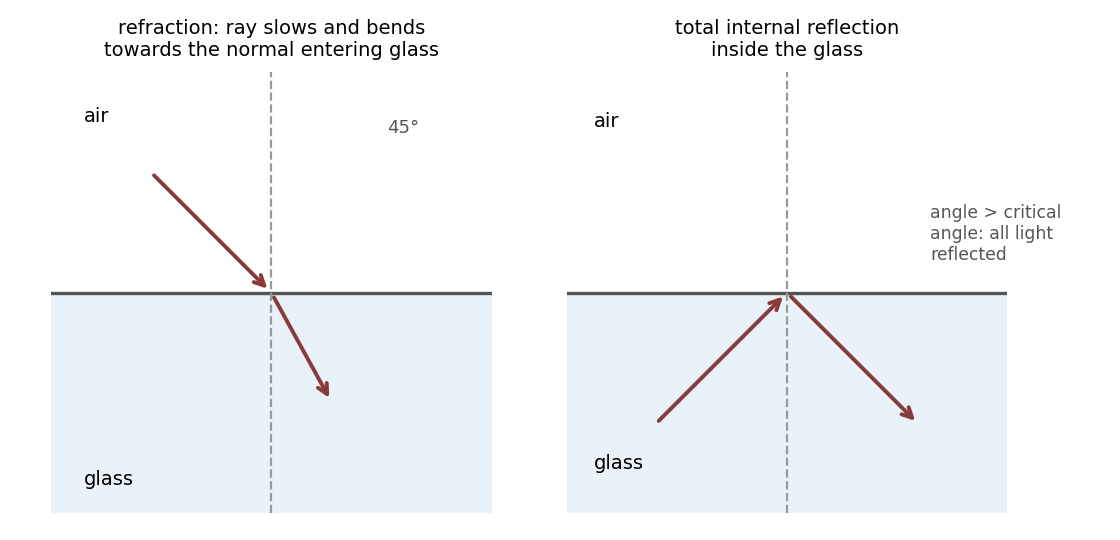
    Light is transverse and reflects and refracts. Law of reflection: angle of incidence = angle of reflection. Refraction 折射: entering glass (optically denser), light slows and bends towards the normal; leaving, it bends away.

    Refraction bends a ray towards the normal entering glass; beyond the critical angle light is totally internally reflected.
    $$n = \frac{\sin i}{\sin r} \qquad \sin c = \frac{1}{n}$$

    Total internal reflection 全内反射 happens when the angle inside the denser medium exceeds the critical angle 临界角 — the principle of optical fibres (communications, endoscopes) and prisms in periscopes.

    Worked check. Glass with $n = 1.5$: $\sin c = 1/1.5 = 0.667$, so $c \approx 41.8°$. A ray inside the glass hitting the boundary at 45° exceeds 41.8° — totally internally reflected.

    (P) Sound is longitudinal, 20–20 000 Hz for human hearing; pitch rises with frequency, loudness with amplitude. An oscilloscope with a microphone displays the wave; practicals time echoes or resonances to find the speed of sound in air.

    Check yourself

    1. Give one similarity and one difference between transverse and longitudinal waves.
    2. Define amplitude, wavelength and frequency.
    3. A wave of frequency 500 Hz travels at 340 m/s. Calculate its wavelength.
    4. State the order of the electromagnetic spectrum by increasing frequency.
    5. Give one use each of microwaves, infrared and gamma rays, and one danger of UV.
    6. State the law of reflection.
    7. Which way does light bend entering glass, and leaving it?
    8. Glass has n = 1.5. Calculate the critical angle.
    9. (P) State the human hearing frequency range, and what raises pitch and loudness.
    10. (P) How does an oscilloscope trace change when a sound gets louder at the same pitch?

    Answers: 1 both transfer energy without transferring matter; transverse oscillates across the travel direction (light), longitudinal along it as compressions (sound); 2 amplitude — maximum displacement from the rest position; wavelength — distance between successive identical points; frequency — number of waves passing per second; 3 $\lambda = 340/500 = 0.68$ m; 4 radio, microwave, infrared, visible, ultraviolet, X-ray, gamma; 5 microwaves — cooking/satellite; infrared — heaters/night vision; gamma — sterilising; UV damages surface cells and can blind; 6 angle of incidence = angle of reflection; 7 towards the normal entering, away from the normal leaving; 8 $\sin c = 1/1.5$, $c \approx 41.8°$; 9 (P) 20–20 000 Hz; higher frequency raises pitch, larger amplitude raises loudness; 10 (P) the trace's peaks grow taller (amplitude) while the number of cycles per second (frequency) stays the same.

    Vocabulário
    English Português
    transverse wave/trænsˈvɜːs weɪv/ onda transversal
    longitudinal wave/ˌlɒŋɡɪˈtjuːdɪnl weɪv/ onda longitudinal
    amplitude/ˈæmplɪtjuːd/ amplitude
    wavelength/ˈweɪvleŋθ/ comprimento de onda
    frequency/ˈfriːkwənsi/ frequência
    Doppler effect/ˈdɒplə ɪˈfekt/ efeito Doppler
    refraction/rɪˈfrækʃn/ refração
    total internal reflection/ˈtəʊtl ɪnˈtɜːnl rɪˈflekʃn/ reflexão interna total
    critical angle/ˈkrɪtɪkl ˈæŋɡl/ ângulo crítico
  • 4

    4 · Energy resources and energy transfers

    Programa de aprendizado em breve

    Material de apoio

    English

    Energy: stored, transferred, wasted

    Nothing uses energy up — energy only moves between stores and leaks along the way. This section names the stores and transfers, measures efficiency 效率 with Sankey diagrams 桑基图, follows heat by conduction, convection and radiation, links work, GPE and kinetic energy, and (P) weighs how electricity is generated.

    Edexcel International GCSE Physics 4PH1, Section 4 (statements 4.1–4.19P). Units: joule (J), watt (W), newton (N), and (P) J/kg °C.

    Energy transfers

    Eight stores: chemical, kinetic, gravitational, elastic, thermal, magnetic, electrostatic, nuclear. Four transfer pathways: mechanically, electrically, by heating, by radiation (light and sound). Energy is conserved — the total is unchanged; devices just divert part of it from the store we want to ones we do not.

    $$\text{efficiency} = \frac{\text{useful energy output}}{\text{total energy output}} \times 100\%$$
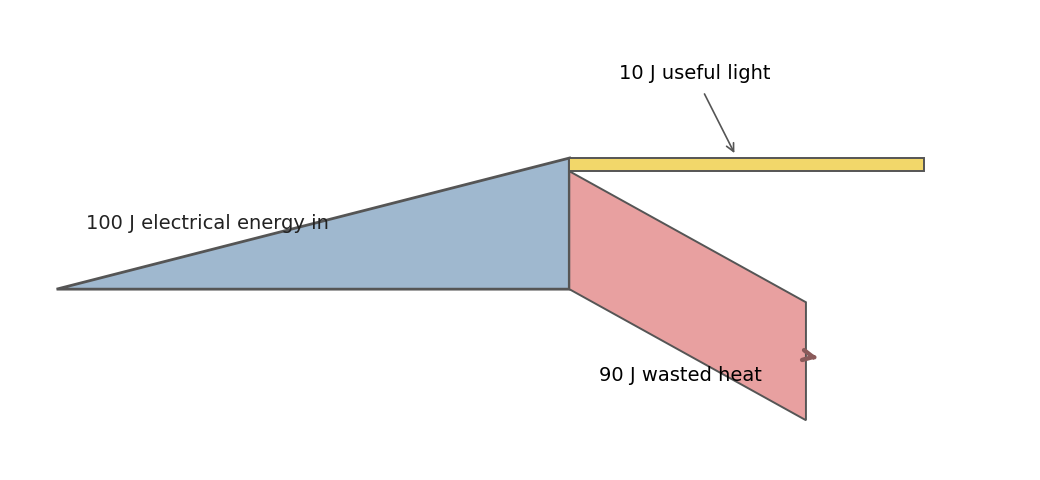
    A Sankey diagram: an incandescent lamp turns 100 J of electrical energy into 10 J of light and 90 J of wasted heat.

    Worked check. The lamp above: efficiency $= 10/100 \times 100 = 10\%$.

    Thermal energy transfer

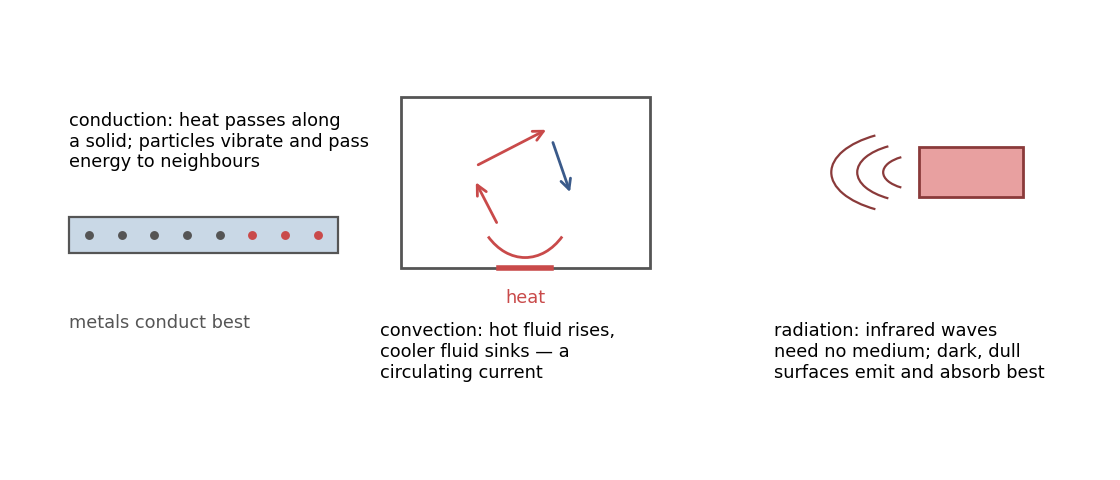
    Heat moves three ways, each with its own mechanism and each beaten by a different defence.

    Conduction passes heat along a solid; convection circulates fluid; radiation carries infrared waves with no medium.

    Conduction 传导: particle vibrations pass energy along a solid — fast in metals (free electrons). Convection 对流: fluid warms, expands, becomes less dense and rises; cooler fluid sinks to replace it — sea breezes, radiators heating rooms. Radiation 辐射: infrared waves travel through a vacuum; dark, dull surfaces are the best emitters and absorbers; light, shiny surfaces reflect. Reducing unwanted transfer: insulation (cavity wall, loft, double glazing cuts conduction and convection; shiny foil reflects radiation).

    Work, power and the energy equations

    $$W = F \times d \qquad GPE = mgh \qquad KE = \tfrac{1}{2}mv^2 \qquad P = \frac{W}{t}$$

    Work done equals energy transferred. Falling, GPE converts to KE (minus work against drag).

    Worked check. A 2 kg book lifted 1.5 m at g = 10 N/kg: $GPE = 2 \times 10 \times 1.5 = 30$ J. Dropped, at the ground $KE = 30$ J → $v = \sqrt{2 \times 30/2} = \sqrt{30} \approx 5.5$ m/s. A 60 W lamp runs 10 s: $W = 60 \times 10 = 600$ J.

    Energy resources and electricity generation (P)

    Every power station is an energy-transfer chain from a store to electricity; the table names the seven the specification requires.

    Method Energy transfer Advantages Disadvantages
    wind kinetic → electrical renewable, no fuel cost unreliable, visual/noise impact
    hydroelectric gravitational → electrical renewable, instant supply floods valleys, few sites
    geothermal thermal → electrical renewable, steady few suitable locations
    solar heating thermal (hot water) renewable, no running cost daytime/cloud dependent
    solar cells light → electrical renewable, silent expensive, low intensity output
    fossil fuels chemical → thermal → electrical reliable, concentrated CO₂ emissions, non-renewable
    nuclear nuclear → thermal → electrical huge energy per kg, no CO₂ radioactive waste, decommissioning

    Check yourself

    1. Name four energy stores and two transfer pathways.
    2. A motor uses 500 J and delivers 350 J of useful work. Calculate the efficiency.
    3. Name the three thermal transfer methods and the one needing no medium.
    4. Which surfaces emit infrared best?
    5. State two ways a house reduces unwanted heat loss.
    6. Calculate the work done by a 40 N force moving 3 m.
    7. Calculate the KE of a 800 kg car at 20 m/s.
    8. A heater transfers 12 000 J in 30 s. Calculate its power.
    9. (P) Give one advantage and one disadvantage each of wind and nuclear power.
    10. (P) Which two renewable methods extract energy already stored as heat in the ground or in falling water?

    Answers: 1 chemical, kinetic, gravitational, thermal (also elastic, magnetic, electrostatic, nuclear); mechanically and electrically (also heating, radiation); 2 $350/500 \times 100 = 70\%$; 3 conduction, convection, radiation — radiation needs no medium; 4 dark, dull (matt black) surfaces; 5 loft/cavity-wall insulation and double glazing (also reflective foil, draught excluders); 6 $W = 40 \times 3 = 120$ J; 7 $KE = \frac{1}{2} \times 800 \times 400 = 160\,000$ J; 8 $P = 12\,000/30 = 400$ W; 9 (P) wind — renewable with no fuel cost, but unreliable and visually intrusive; nuclear — enormous energy per kilogram with no CO₂, but radioactive waste must be stored safely for centuries; 10 (P) geothermal (ground heat) and hydroelectric (gravitational store of water).

    Vocabulário
    English Português
    conduction/kənˈdʌkʃn/ condução
    convection/kənˈvekʃn/ convecção
    radiation/ˌreɪdɪˈeɪʃn/ radiação
    efficiency/ɪˈfɪʃənsi/ eficiência
    Sankey diagram/ˈsæŋki ˈdaɪəɡræm/ diagrama de Sankey
  • 5

    5 · Solids, liquids and gases

    Programa de aprendizado em breve

    Material de apoio

    English

    Matter under pressure

    The same substance can be solid, liquid or gas, and its molecules never stop moving. This section measures matter: density and pressure, the (P) energy needed to heat or melt things, and the ideal-gas behaviour that links pressure, volume and temperature.

    Edexcel International GCSE Physics 4PH1, Section 5 (statements 5.1–5.22). Units include the pascal (Pa), kelvin (K) and (P) J/kg °C.

    Density and pressure

    $$\rho = \frac{m}{V} \qquad p = \frac{F}{A} \qquad p = h \times \rho \times g$$

    Density is measured directly — mass on a balance, volume by displacement (irregular solid) or dimensions (regular shape). Pressure in a fluid at rest acts equally in all directions, and the pressure difference between two depths comes from the weight of fluid between them.

    Worked check. A diver at 10 m in water ($\rho = 1000\ \mathrm{kg/m^3}$, $g = 10$ N/kg): pressure difference $= 10 \times 1000 \times 10 = 100\,000$ Pa on top of atmospheric pressure.

    Change of state (P)

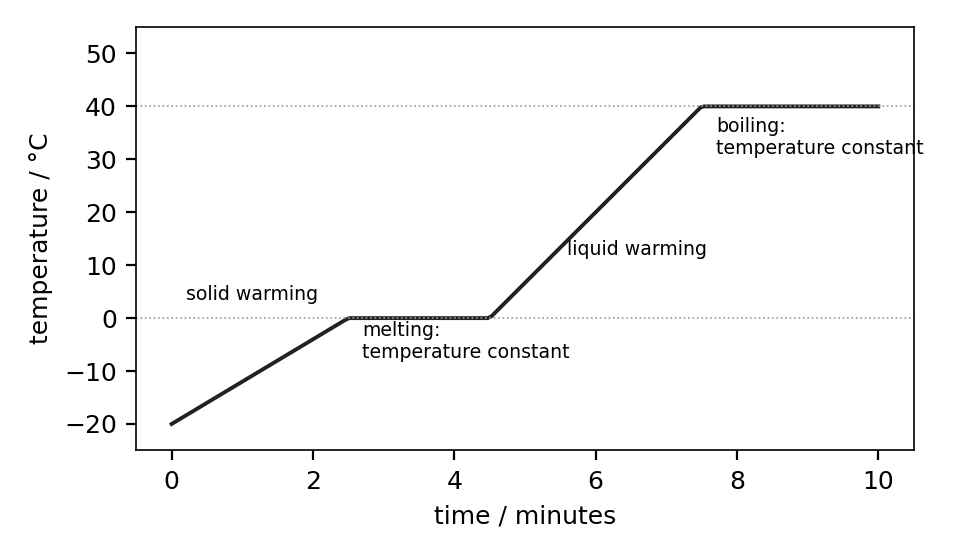
    A heating curve: temperature rises, plateaus at melting, rises, plateaus again at boiling.

    Heating raises the energy stored in a system — either its temperature rises, or at a melting point or boiling point the extra energy breaks bonds while the temperature stays constant. Particles: solids vibrate about fixed points; liquids move randomly but touch; gases move fast, far apart, in straight lines between collisions. Specific heat capacity 比热容 is the energy needed to raise 1 kg by 1 °C:

    $$\Delta Q = m \times c \times \Delta T$$

    Worked check. Heating 2 kg of water ($c = 4200\ \mathrm{J/(kg\ °C)}$) by 30 °C: $\Delta Q = 2 \times 4200 \times 30 = 252\,000$ J.

    Ideal gas molecules

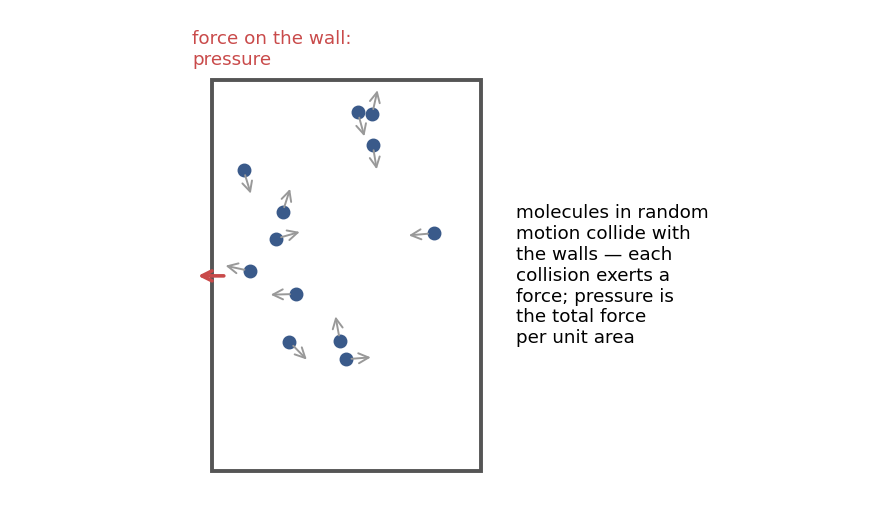
    Gas molecules collide with the container walls; the collisions' total force per area is the pressure.

    Gas molecules move randomly, exerting force — and so pressure — on the walls at every collision. Absolute zero 绝对零度 (−273 °C) is the temperature at which molecular kinetic energy is minimum: K = °C + 273. Higher temperature → faster average molecular speed, and the Kelvin temperature is proportional to the average kinetic energy of the molecules.

    For a fixed mass of gas: at constant temperature, pressure × volume is constant (squeeze it and the molecules hit the walls more often); at constant volume, pressure/T (K) is constant (hotter molecules hit harder):

    $$\frac{p_1 V_1}{1} = p_2 V_2 \qquad \frac{p_1}{T_1} = \frac{p_2}{T_2}$$

    Worked check. A gas at 100 kPa and 300 K is heated (constant volume) to 450 K: $p_2 = 100 \times 450/300 = 150$ kPa. Squashed from 2 dm³ to 0.5 dm³ at constant temperature: $p_2 = 100 \times 2/0.5 = 400$ kPa.

    Check yourself

    1. A 240 g block has volume 40 cm³. Calculate its density in kg/m³.
    2. State the pressure equation and its unit.
    3. Calculate the pressure under a 500 N boot heel of area 0.01 m².
    4. (P) What stays constant in a substance's temperature while it melts?
    5. (P) Calculate the energy to heat 0.5 kg of aluminium (c = 900 J/(kg °C)) by 40 °C.
    6. Convert 27 °C to kelvin, and 373 K to °C.
    7. Why does a gas exert pressure on its container?
    8. What happens to average molecular speed as temperature rises?
    9. A gas at 120 kPa in 3 dm³ is compressed to 1 dm³ at constant temperature. Find the new pressure.
    10. State two conditions that make a gas's pressure double.

    Answers: 1 $m = 0.24$ kg, $V = 4.0 \times 10^{-5}\ \mathrm{m^3}$; $\rho = 0.24/4.0\times10^{-5} = 6000\ \mathrm{kg/m^3}$; 2 $p = F/A$, in pascals (N/m²); 3 $p = 500/0.01 = 50\,000$ Pa; 4 (P) temperature — the energy goes to breaking intermolecular bonds, not to faster molecules; 5 (P) $\Delta Q = 0.5 \times 900 \times 40 = 18\,000$ J; 6 300 K; 100 °C; 7 its molecules collide with the walls, each collision exerting a force; the total force per unit area is the pressure; 8 it increases; 9 $p_2 = 120 \times 3/1 = 360$ kPa; 10 doubling the Kelvin temperature at constant volume, or halving the volume at constant temperature.

    Vocabulário
    English Português
    specific heat capacity/spəˈsɪfɪk hiːt kəˈpæsɪti/ calor específico
    absolute zero/ˈæbsəluːt ˈzɪərəʊ/ zero absoluto
  • 6

    6 · Magnetism and electromagnetism

    Programa de aprendizado em breve

    Material de apoio

    English

    Magnetism to mains

    A magnet moves, and current appears in a wire kilometres away. This section builds that chain: permanent magnets and field patterns, the magnetic effect of a current, the motor force with its left-hand rule, induction in coils and generators, and (P) the transformers that move electrical energy across a country.

    Edexcel International GCSE Physics 4PH1, Section 6 (statements 6.1–6.20P). P-suffixed statements are the Physics-only extension.

    Magnetism

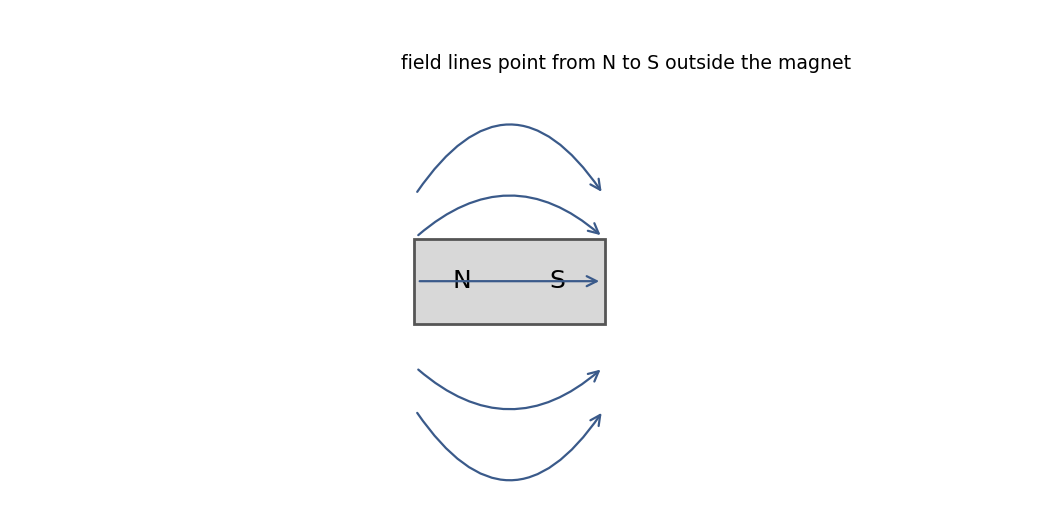
    Magnets repel like poles and attract unlike ones, and attract magnetic materials (iron, steel, nickel, cobalt). Magnetically hard materials (steel) keep their magnetism — permanent magnets; soft materials (iron) magnetise and demagnetise easily — electromagnet cores. Field lines 磁感线 point from N to S outside a magnet (never cross); magnetism is induced in a magnetic material placed in a field. Two unlike poles facing each other give a uniform field 匀强磁场 between them.

    A bar magnet's field lines, N to S outside, never crossing.

    Electromagnetism and the motor effect

    A current in a conductor creates a magnetic field around it — concentric circles, right-hand grip rule. (P) Electromagnets: a coil (solenoid) 螺线管 around a soft-iron core, switchable and adjustable. (P) Field patterns for a straight wire, flat coil and solenoid.

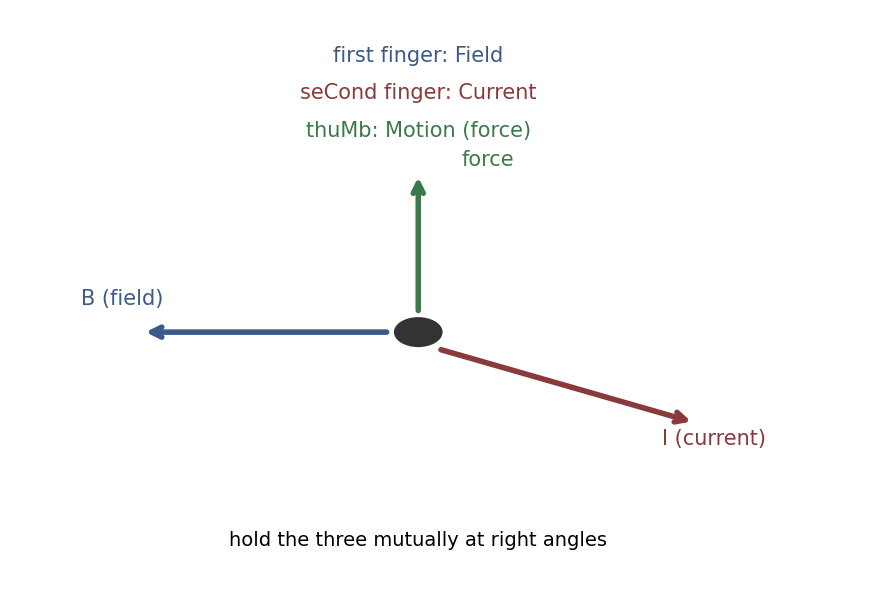
    A wire carrying current across a magnetic field feels a force — the motor effect, used in d.c. motors (rotating coil + commutator) and loudspeakers. Predict the direction with the left-hand rule 左手定则: first finger Field, seCond finger Current, thuMb Motion. The force grows with stronger field and larger current, and reverses if either reverses.

    The left-hand rule: field, current and force mutually at right angles.

    Electromagnetic induction

    A voltage is induced 感生 in a conductor or coil when it moves through a magnetic field or when the field through it changes. The induced voltage is larger with faster movement, a stronger field, more turns and (for generators) faster rotation. Generators rotate a magnet inside a coil (or a coil inside a magnet) — the size and frequency of the induced a.c. follow the rotation.

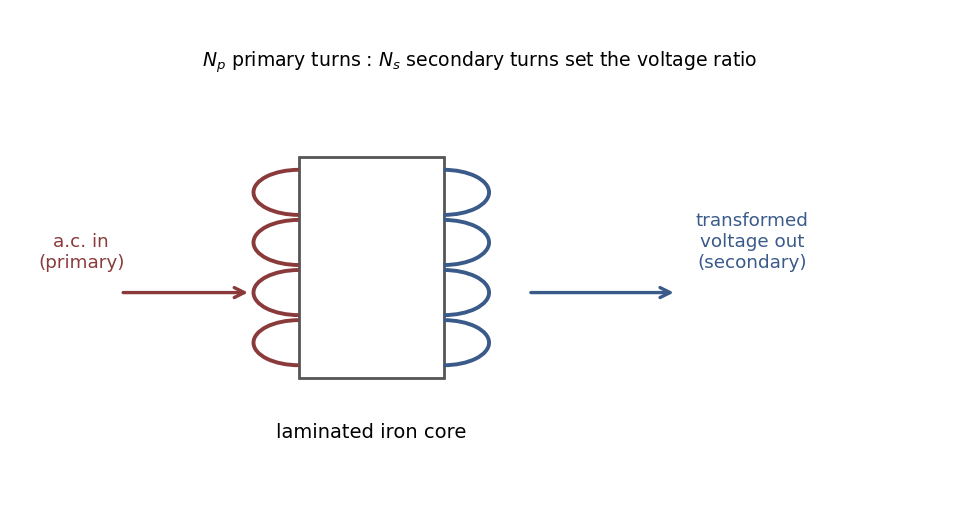
    (P) Transformers change an alternating voltage using two coils on an iron core:

    $$\frac{V_p}{V_s} = \frac{N_p}{N_s} \qquad V_p I_p = V_s I_s \ (100\% \text{ efficient})$$
    A transformer: primary and secondary coils on a laminated iron core.

    Step-up transformers raise the voltage (and cut the current) for transmission — high voltage means low current, so far less energy lost as heat in the cables; step-down transformers bring it back to safe levels for use.

    Worked check. A transformer has 200 primary turns and 50 secondary turns; the primary is 230 V. $V_s = 230 \times 50/200 = 57.5$ V — a step-down. If the primary current is 0.5 A: $I_s = 230 \times 0.5/57.5 = 2.0$ A.

    Check yourself

    1. State two differences between magnetically hard and soft materials.
    2. In which direction do field lines point outside a magnet?
    3. Describe how to produce a uniform magnetic field with two bar magnets.
    4. What does a current in a wire create around it?
    5. State the left-hand rule's three fingers.
    6. Name two factors that increase the force on a current-carrying wire in a field.
    7. State two ways to induce a voltage in a coil.
    8. Name two factors that increase the size of an induced voltage.
    9. (P) A step-down transformer has 1000 primary and 100 secondary turns; input 230 V. Calculate the output.
    10. (P) Why is electricity transmitted at high voltage?

    Answers: 1 hard keeps its magnetism (permanent magnets, steel); soft loses it easily (temporary, iron — electromagnet cores); 2 from N to S; 3 place N and S poles facing each other with a gap — the parallel field lines between them are uniform; 4 a magnetic field of concentric circles (grip rule); 5 first finger Field, second finger Current, thumb Motion; 6 stronger field; larger current.

    Answers continued: 7 move the coil or magnet so the coil cuts field lines, or change the field through a stationary coil; 8 faster movement; stronger magnet; more turns; 9 (P) $V_s = 230 \times 100/1000 = 23$ V; 10 (P) high voltage gives low current for the same power; cable heating is $I^2R$, so losses fall sharply over long distances.

    Vocabulário
    English Português
    field line/fiːld laɪn/ linha de campo
    solenoid/ˈsəʊlənɔɪd/ solenoide
    left-hand rule/left hænd ruːl/ regra da mão esquerda
    induce induzir
    uniform field/ˈjuːnɪfɔːm fiːld/ campo uniforme
  • 7

    7 · Radioactivity and particles

    Programa de aprendizado em breve

    Material de apoio

    English

    The nucleus at work

    Some nuclei are unstable: they throw out radiation at random, decay by half-lives, and — in reactors and stars — release energy by splitting or joining. This section covers atomic notation, the three ionising radiations with their penetrating powers, half-life calculations, the fission chain reaction, and why fusion lights the stars but not our power stations.

    Edexcel International GCSE Physics 4PH1, Section 7 (statements 7.1–7.26). Units: becquerel (Bq), with time in s, min or h.

    Radioactivity

    An atom holds protons and neutrons in a nucleus; notation $^{A}_{Z}X$ gives mass (nucleon) number A and atomic (proton) number Z. Isotopes share Z but differ in neutrons.

    Unstable nuclei emit — randomly — alpha α (helium nucleus, $^4_2$He), beta-minus β⁻ (an electron, created as a neutron turns proton) and gamma γ (high-energy electromagnetic wave, no particles). Balancing: both mass number and charge are conserved.

    Worked check. Carbon-14: $^{14}_{6}C \rightarrow {}^{14}_{7}N + {}^{0}_{-1}e$ — A stays 14; charge 6 = 7 + (−1) ✓. Radon: $^{222}_{86}Rn \rightarrow {}^{218}_{84}Po + ^{4}_{2}He$.

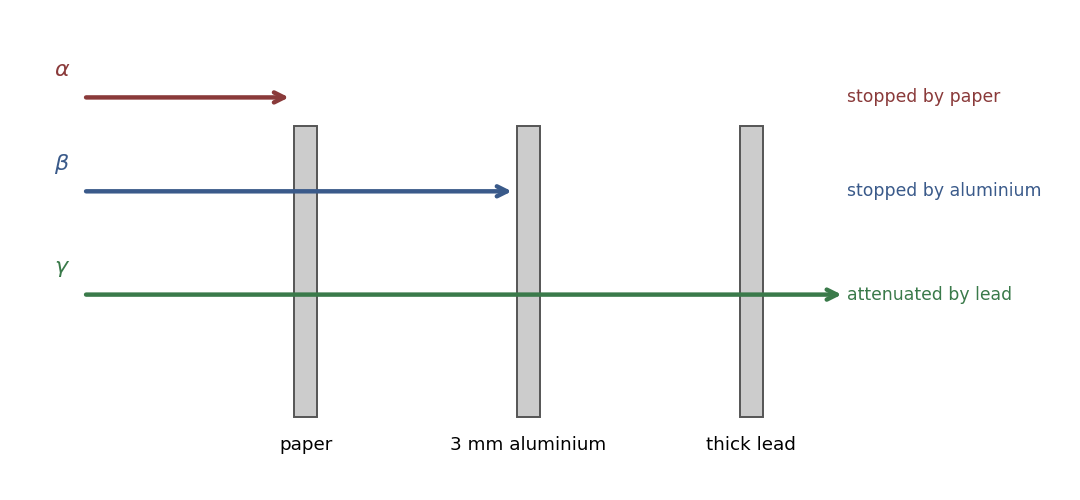
    Penetration: alpha stopped by paper, beta by a few mm of aluminium, gamma attenuated by lead.
    Radiation Nature Ionising Range in air
    alpha 2p + 2n strongest a few cm
    beta fast electron medium tens of cm
    gamma EM wave weakest metres

    Detection: photographic film (badge) or a Geiger–Müller tube. Background radiation comes from rocks and cosmic rays (space), food, medical uses and fallout.

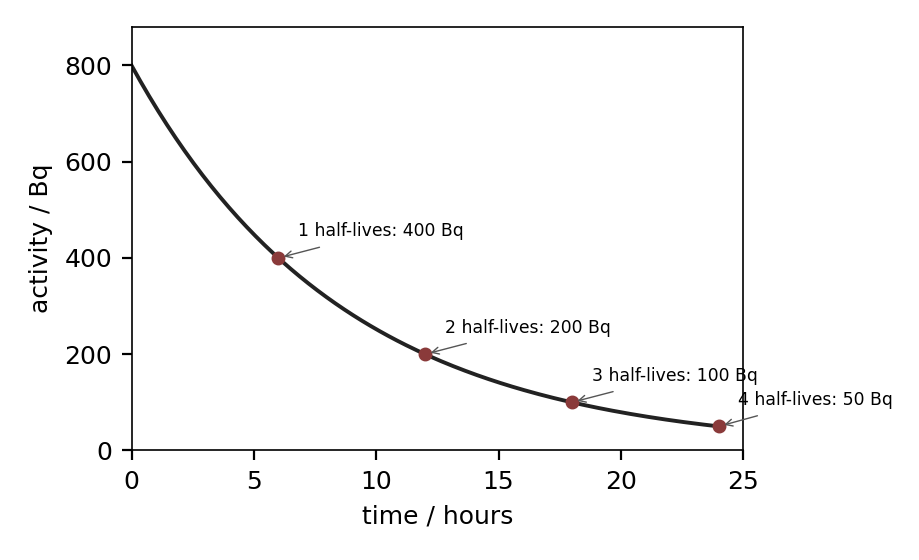
    Activity 活度 (in becquerels; 1 Bq = 1 decay/s) falls steadily: the half-life 半衰期 is the time for half the undecayed nuclei to decay. Worked check. 800 Bq with half-life 6 h: after 24 h (4 half-lives) activity $= 800/2^4 = 50$ Bq.

    A decay curve halving every half-life.

    Uses: medical tracers (short half-life, gamma), cancer treatment, sterilising, thickness control (beta through paper). Contamination (radioactive material on you — must be removed) differs from irradiation (exposure to radiation — stops when the source leaves). Dangers: mutation of DNA, cell and tissue damage; radioactive waste must be stored safely for its long half-lives.

    Fission and fusion

    Split a big nucleus or join two small ones — both release energy, and each powers a different machine.

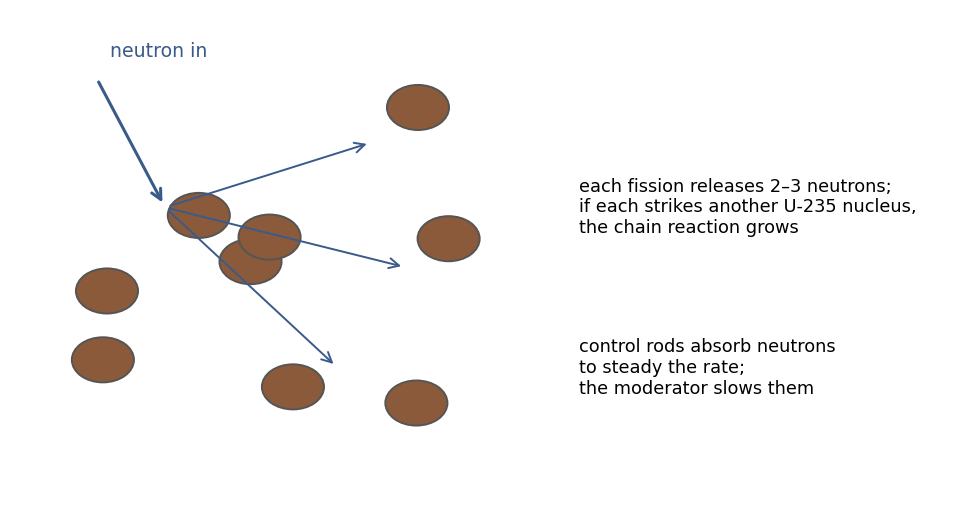
    A chain reaction: each fission's neutrons strike further U-235 nuclei; control rods and moderator manage it.

    Fission 裂变: a neutron strikes U-235, splitting it into two radioactive daughter nuclei, 2–3 neutrons and kinetic energy — and if those neutrons strike more U-235, a chain reaction runs. The moderator 慢化剂 slows neutrons so they split nuclei efficiently; control rods 控制棒 absorb neutrons to hold the rate steady; shielding protects workers. Fusion 聚变 joins small nuclei into a larger one, converting mass to energy — the Sun's source. Fusion needs enormous temperature and pressure because positively charged protons electrostatically repel — the nuclei must collide fast enough to overcome that repulsion.

    Check yourself

    1. In $^{19}_{9}F$, state the numbers of protons, neutrons and electrons in the neutral atom.
    2. Name the three ionising radiations and their natures.
    3. Write the full equation for alpha decay of $^{226}_{88}Ra$.
    4. Which radiation is stopped by paper, and which passes through aluminium?
    5. Give two sources of background radiation.
    6. Define half-life.
    7. A source of 3200 Bq has half-life 8 days. Find its activity after 32 days.
    8. State the difference between contamination and irradiation.
    9. Name the roles of the moderator, control rods and shielding in a reactor.
    10. Why does fusion need such high temperatures?

    Answers: 1 9 protons, 10 neutrons, 9 electrons; 2 alpha — helium nucleus (2p+2n); beta-minus — fast electron; gamma — high-energy electromagnetic wave; 3 $^{226}_{88}Ra \rightarrow {}^{222}_{86}Rn + {}^{4}_{2}He$; 4 alpha stopped by paper; gamma passes aluminium (needs thick lead); 5 any two: rocks/building materials, cosmic rays, food/drink, medical, radon gas, nuclear fallout; 6 the time taken for half the undecayed nuclei (or the activity) to decay; 7 32 days = 4 half-lives: $3200 \rightarrow 1600 \rightarrow 800 \rightarrow 400 \rightarrow 200$ Bq; 8 contamination — radioactive material stuck to you, hazard remains until removed; irradiation — exposure to radiation from a source, ends when the source is removed; 9 moderator slows neutrons for efficient fission; control rods absorb neutrons to control the rate; shielding absorbs escaping radiation to protect workers; 10 the positively charged protons of two nuclei repel electrostatically, so nuclei must collide at enormous speed — only reached at very high temperature and pressure — to get close enough to fuse.

    Vocabulário
    English Português
    activity/ækˈtɪvɪti/ atividade
    half-life/hɑːf laɪf/ meia-vida
    fission/ˈfɪʃn/ fissão
    fusion/ˈfjuːʒn/ fusão
    moderator moderador
    control rod haste de controle
  • 8

    8 · Astrophysics

    Programa de aprendizado em breve

    Material de apoio

    O universo e sua história

    O universo é composto por bilhões de galáxias; cada galáxia contém bilhões de estrelas; o Sol é uma estrela na Via Láctea. A gravidade molda todas as órbitas, as estrelas nascem e morrem segundo padrões definidos por sua massa, e o desvio para o vermelho das galáxias distantes indica que todo o universo está em expansão — evidência de um início: o Big Bang.

    Edexcel International GCSE Physics 4PH1, Seção 8 (afirmações 8.1–8.18P). As afirmações sufixadas com P são extensões exclusivas de Física (Prova 2P).

    Movimento no universo

    Universo → bilhões de galáxias → cada uma com bilhões de estrelas → nosso sistema solar situa-se na Via Láctea. A intensidade do campo gravitacional g varia conforme massa e tamanho — mais fraca na Lua, mais forte em Júpiter. A gravidade mantém todas as órbitas: luas orbitam planetas, planetas e cometas orbitam o Sol, satélites artificiais orbitam a Terra.

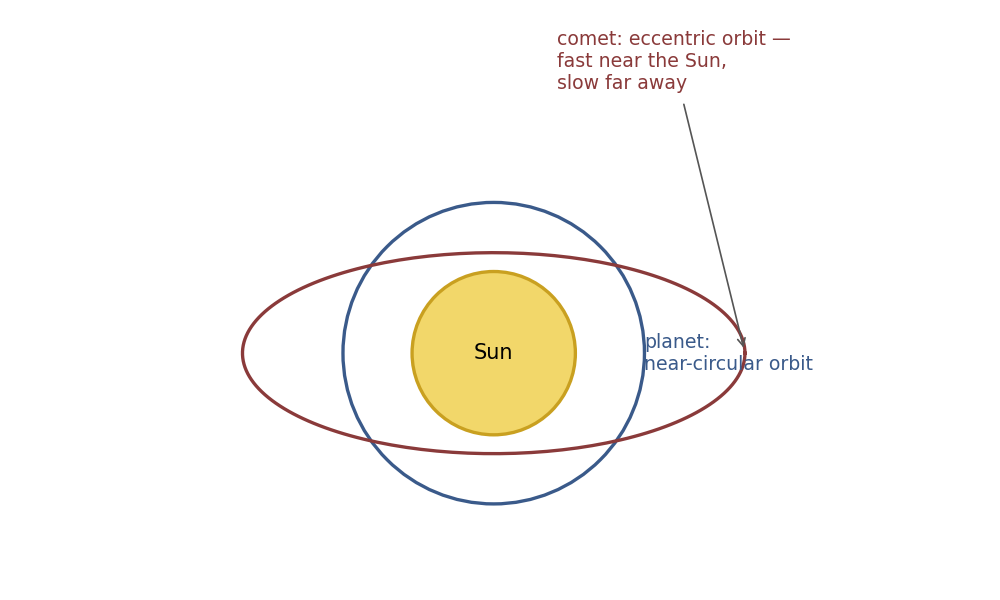
    Órbita quase circular de um planeta ao lado da órbita excêntrica de um cometa ao redor do Sol.

    As órbitas planetárias são quase circulares; as órbitas cometárias são altamente excêntricas — rápidas perto do Sol, lentas longe dele. A velocidade orbital provém de circunferência ÷ período:

    $$v = \frac{2 \times \pi \times r}{T}$$

    Exemplo resolvido. Um satélite em raio orbital 7000 km (r medido a partir do centro da Terra) com período 5800 s: $v = 2\pi \times 7.0 \times 10^6/5800 \approx 7580$ m/s ≈ 7.6 km/s.

    Evolução estelar

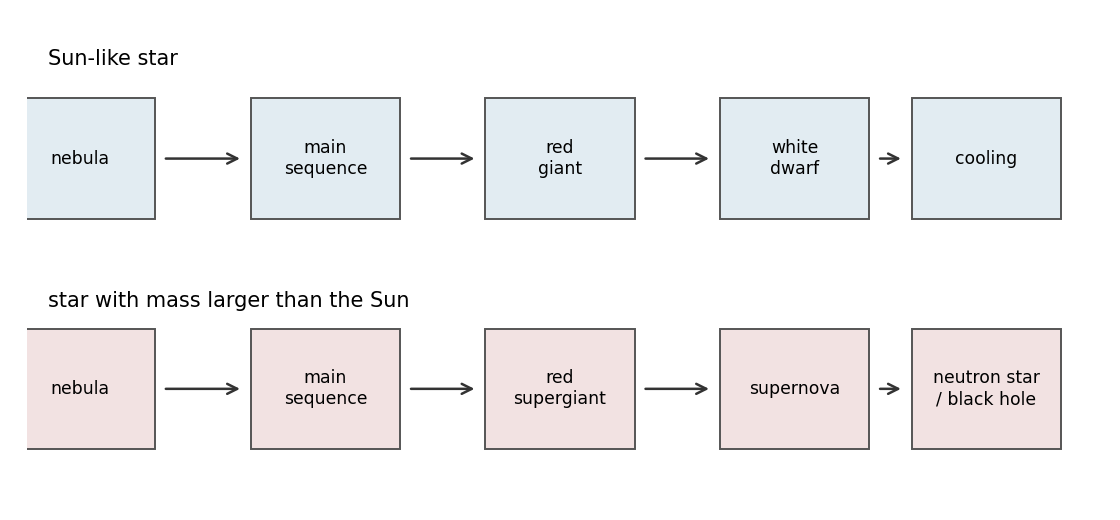
    Estrelas são classificadas por cor, que segue a temperatura superficial: azul mais quente → vermelha mais fria. Uma estrela semelhante ao Sol percorre nebulosa → sequência principal (fusão equilibra a gravidade por bilhões de anos) → gigante vermelha → anã branca; uma estrela mais massiva que o Sol percorre nebulosa → sequência principal → supergigante vermelha → supernova → estrela de nêutrons ou buraco negro.

    Dois ciclos de vida: estrelas semelhantes ao Sol terminam como anãs brancas; estrelas massivas terminam em supernovas, estrelas de nêutrons ou buracos negros.

    (P) O brilho de uma estrela é comparado usando magnitude absoluta a uma distância padrão; o diagrama Hertzsprung-Russell traça magnitude absoluta contra temperatura, com a sequência principal, gigantes e anãs brancas como suas faixas principais.

    Cosmologia (P)

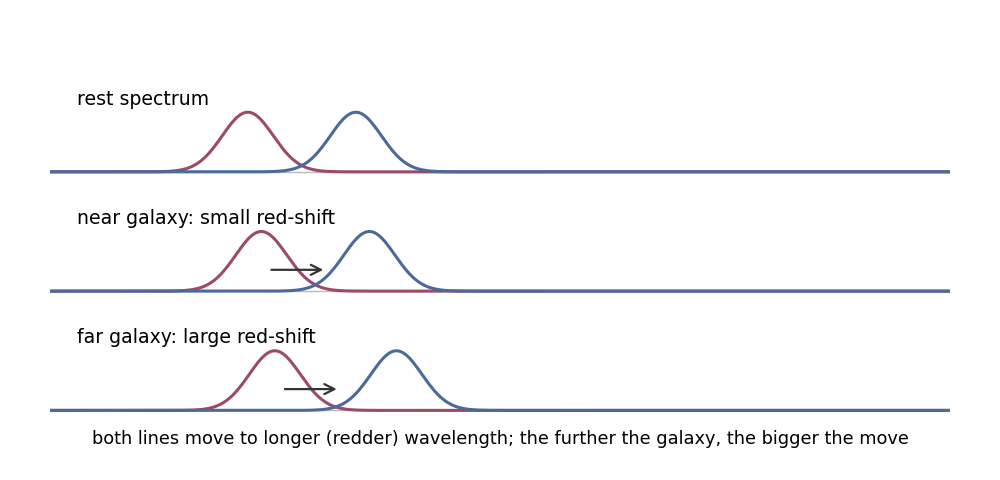
    Linhas espectrais deslocam-se para o vermelho à medida que uma galáxia se afasta mais rapidamente — quanto maior a distância, maior o deslocamento.

    Uma fonte de ondas em movimento altera o comprimento de onda observado (desvio para o vermelho para afastamento). O desvio para o vermelho das galáxias aumenta com a distância, e a relação é quantificada como:

    $$\frac{\Delta\lambda}{\lambda_0} = \frac{v}{c}$$

    Exemplo resolvido. Uma linha espectral em 500 nm aparece em 505 nm numa galáxia distante: $\Delta\lambda/\lambda_0 = 5/500 = 0.01$, logo $v = 0.01c = 3000$ km/s.

    O aumento do desvio para o vermelho com a distância significa que as galáxias se afastam mais rapidamente quanto mais distantes estão — o universo está expandindo, o que remete a um início quente e denso: o Big Bang. A radiação cósmica de micro-ondas (CMB) — micro-ondas fracas vindas de todas as direções — é o resfriado remanescente dessa radiação inicial, a segunda pilar de evidência.

    Verifique você mesmo

    1. Ordene por tamanho: galáxia, sistema solar, universo, estrela.
    2. Por que g difere entre a Terra e a Lua?
    3. Nomeie as duas formas orbitais de cometas e planetas.
    4. Calcule a velocidade orbital de um satélite em r = 42 000 km com T = 24 horas.
    5. Cite as duas fases após a sequência principal para uma estrela semelhante ao Sol.
    6. O que a cor de uma estrela indica?
    7. (P) Quais duas grandezas o diagrama HR plotam?
    8. (P) Uma linha em 400 nm desloca-se para 404 nm. Calcule v/c.
    9. (P) Cite as duas evidências do Big Bang.
    10. (P) Por que o desvio para o vermelho aumenta com a distância?

    Respostas: 1 estrela (menor) → sistema solar → galáxia → universo (maior); 2 g depende da massa e raio do corpo — a Lua é menor e menos massiva, logo seu g é cerca de 1.6 N/kg; 3 planetas — quase circulares; cometas — elipses altamente excêntricas; 4 $r = 4.2 \times 10^7$ m, $T = 86\,400$ s; $v = 2\pi \times 4.2\times10^7/86\,400 \approx 3060$ m/s ≈ 3.1 km/s; 5 gigante vermelha, depois anã branca; 6 sua temperatura superficial — azul mais quente, vermelho mais frio; 7 (P) magnitude absoluta contra temperatura (ou cor); 8 (P) $\Delta\lambda/\lambda_0 = 4/400 = 0.01 = v/c$; 9 (P) o aumento do desvio para o vermelho das galáxias com a distância e a radiação cósmica de fundo micro-ondas; 10 (P) quanto maior a distância da galáxia, maior a velocidade de recessão — o próprio espaço se expande, assim a velocidade de recessão cresce com a distância, deslocando a luz mais para o vermelho.

    Vocabulário
    English Português
    universe/ˈjuːnɪvɜːs/ universo
    galaxy/ˈɡæləksi/ galáxia
    red-shift/red ʃɪft/ desvio para o vermelho
    Big Bang/bɪɡ bæŋ/ Big Bang

Entrar ou criar conta

IGCSE, A-Level & AP