Iteration: FOR
FOR counts
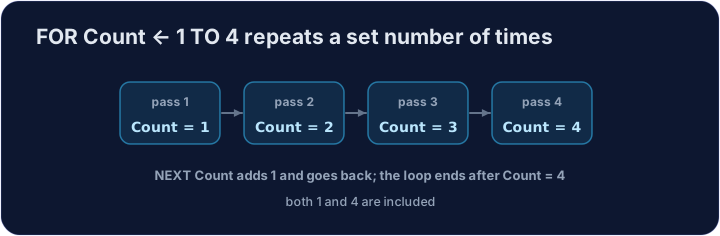
- A count-controlled loop runs once for each integer from the start to the end, inclusive.
- The counter is an
INTEGER. - It is good practice to repeat the counter's name after
NEXT.
DECLARE Total : INTEGER
DECLARE I : INTEGER
Total ← 0
FOR I ← 1 TO 5
  Total ← Total + I
NEXT I
OUTPUT Total
Trace the running total
A FOR loop repeats a set number of times. Step through and watch Total grow.
STEP changes the jump
STEPsets the gap between values. It can be negative.- If the start is already past the end in the step's direction, the body does not run.
DECLARE Minute : INTEGER
FOR Minute ← 0 TO 60 STEP 15
  OUTPUT Minute, " minutes"
NEXT Minute
- A negative
STEPcounts down:FOR Floor ← 10 TO 0 STEP -5gives 10, 5, then 0.
Watch out
NEXT Imust name the counter of this loop.- The body is indented.
NEXTlines up withFOR.
Common mistakes
Before a loop, distinguish DECLARE Count : INTEGER (choose a type) from Count ← 0 (store a value). The loop header changes the counter; the body changes the result you are computing.
1 TO 5includes both 1 and 5.- Do not change the counter yourself inside the body.
Now you try
- Use a
FORloop to print a run of numbers.
Independent transfer
The final task has no supplied algorithm. Plan its inputs, processing and outputs, then solve it before opening support. Check more than the sample case.
Dificuldade 2/5 · Moedas 140 + pequeno bônus na primeira conclusão hoje
Use a FOR loop to output the numbers 1 até 5, one per line.
Clique em Executar para ver a saída aqui.
Dificuldade 2/5 · Moedas 140 + pequeno bônus na primeira conclusão hoje
Saída 5, 3 e 1, using FOR with STEP -2.
Clique em Executar para ver a saída aqui.
Dificuldade 3/5 · Moedas 200 + pequeno bônus na primeira conclusão hoje
Read UpperLimit (1 to 10). Output the sum of the squares of integers from 1 to UpperLimit inclusive.
Clique em Executar para ver a saída aqui.