Properties and state: two numbers fix the fluid
Introduced| English | Meaning |
|---|---|
| state/steɪt/ | The macroscopic condition of a thermodynamic system described by its properties. |
| property diagram | A graph relating thermodynamic properties and showing states or process paths. |
| quality/ˈkwɒlɪti/ | The mass of vapour divided by the total liquid-vapour mixture mass, defined in the two-phase region. |
| saturation dome | The dome-shaped boundary of the liquid-vapour two-phase region on suitable thermodynamic property diagrams. |
| saturated water | saturated water |
| ideal gas/aɪˈdɪəl ɡæs/ | A model of a gas with point particles that exert no intermolecular forces except during perfectly elastic collisions. |
The state is a point
- The running case is a boiler feed line: before any law is applied, the water must be pinned down. A state 状态 is the fluid's condition at an instant, and two independent intensive properties fix it - on a property diagram 状态图 the state is a point, and everything else follows.
- A simple compressible substance obeys a two-variable equation of state $p = p(v, T)$, so any other equilibrium property is a function of the same pair. Pick any two independent ones and the rest are determined.
Walking the dome with quality
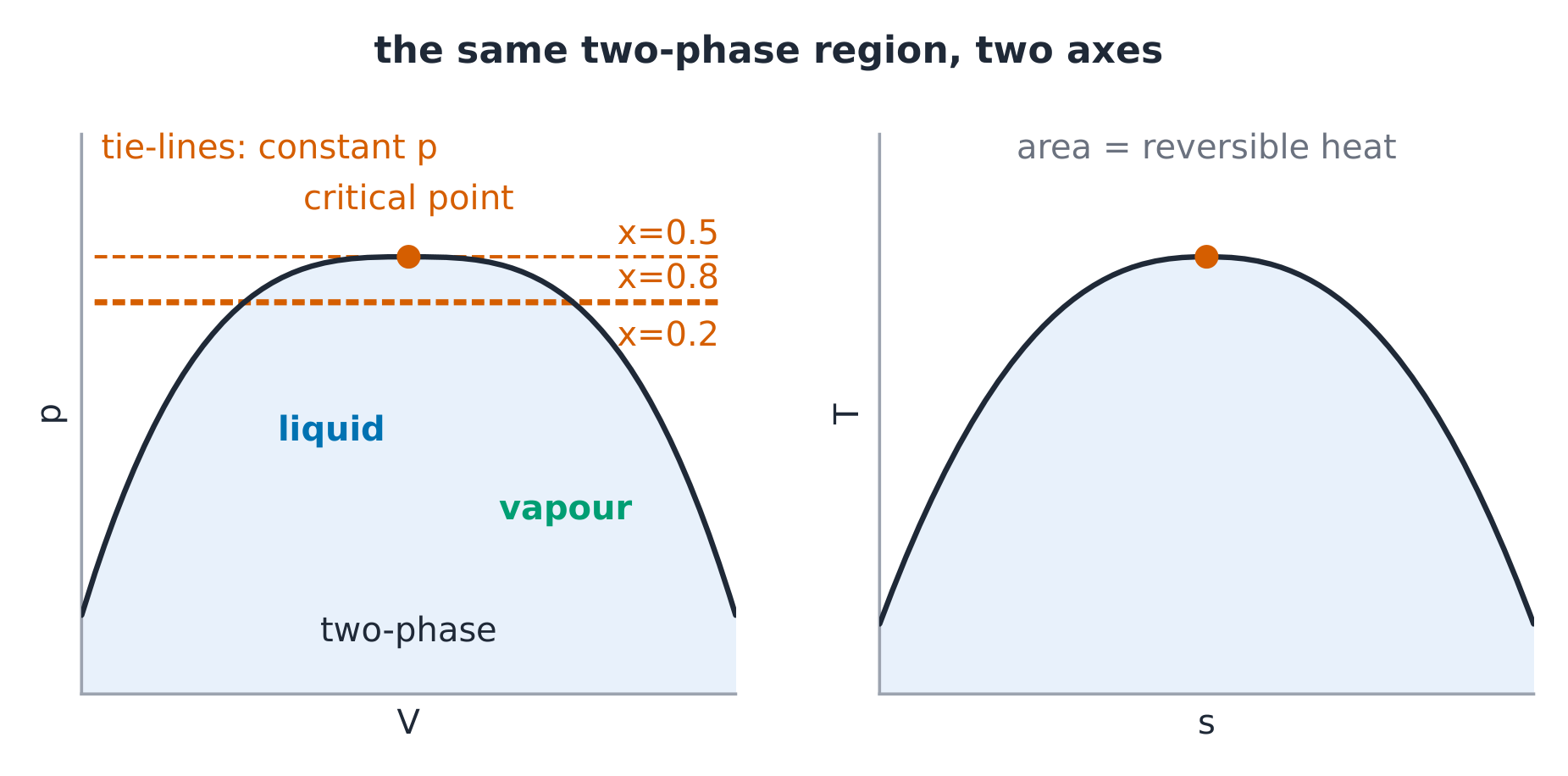
- Under the saturation dome 饱和线 lies the two-phase region, and quality 干度 $x$ - the vapour mass fraction - walks across it: $v = v_f + x(v_g - v_f)$, likewise $u$, $h$, $s$. Dome arithmetic is linear in $x$ because the two phases sit at the same $p$ and $T$.
- Saturated water 饱和水 at $100^\circ\mathrm{C}$: $p_{sat} = 101.35\ \mathrm{kPa}$, $v_f = 0.001044$, $v_g = 1.6729\ \mathrm{m^3/kg}$, $h_f = 419.04$, $h_{fg} = 2257.0\ \mathrm{kJ/kg}$. At $x = 0.5$: $v = \mathbf{0.837}\ \mathrm{m^3/kg}$ and $h = 419.04 + 0.5 \times 2257.0 = \mathbf{1547.5}\ \mathrm{kJ/kg}$ - one row of the table, one multiplication.
Which arithmetic, which territory?
Route each request to the rule that answers it.
Saturation pressure of water at 100 degrees C (two decimals, kPa)?
Difficulty 2/5 · 140 coins + a small bonus on first completion today
Read from the saturated-water temperature table.
Specific volume at x = 0.5, 100 degrees C (three decimals, m3/kg)?
Difficulty 2/5 · 140 coins + a small bonus on first completion today
v = 0.001044 + 0.5 x (1.6729 - 0.001044).
Enthalpy at x = 0.5, 100 degrees C (one decimal, kJ/kg)?
Difficulty 2/5 · 140 coins + a small bonus on first completion today
h = 419.04 + 0.5 x 2257.0.
Inside the saturation dome, quality x is:
Difficulty 1/5 · 100 coins + a small bonus on first completion today
Quality is defined on a mass basis - averaging by volume is the classic slip.
Outside the dome: the ideal gas
- Far from condensation, air obeys $pv = RT$ with $R = 0.287\ \mathrm{kJ/(kg\,K)}$. At $300\ \mathrm{K}$ and $101.325\ \mathrm{kPa}$: $v = RT/p = \mathbf{0.8497}\ \mathrm{m^3/kg}$; double the pressure at the same $T$ and $v = \mathbf{0.4248}$ - exactly half.
- The isotherm is a hyperbola because $T$ fixes the product $pv$; the ideal gas 理想气体 ends where condensation begins, and above the critical point the dome closes and there is no boiling at all.
Air at 300 K and 101.325 kPa: specific volume (four decimals, m3/kg)?
Difficulty 2/5 · 140 coins + a small bonus on first completion today
v = 0.287 x 300 / 101.325.
Same temperature, double the pressure (four decimals, m3/kg)?
Difficulty 2/5 · 140 coins + a small bonus on first completion today
v halves: 0.4248.
The ideal-gas law pv = RT is valid everywhere on the diagram, including inside the dome.
Difficulty 1/5 · 100 coins + a small bonus on first completion today
The ideal gas ends where condensation begins.
Three property slips
- Averaging $v$ by volume to get quality. Quality is a mass fraction.
- Reading a superheated row from a saturation column. Superheated states have their own table.
- Using $pv = RT$ inside the dome. Two-phase mixtures do not follow the gas law.
Recap
- Two independent intensive properties fix the state; inside the dome, $x$ is the walker.
- $v = v_f + x(v_g - v_f)$ and $h = h_f + x\,h_{fg}$ - linear in $x$, always.
- $pv = RT$ outside the dome only; $0.8497 \to 0.4248$ when the pressure doubles.