Linear algebra: intersections, modes, conditioning
Introduced| English | Meaning |
|---|---|
| condition number | A measure of a problem's sensitivity to changes in its inputs; a large value warns of potential error amplification. |
| basis/ˈbeɪsɪs/ | independent vectors that span the space; coordinates are basis-relative |
| eigenvalue/ˈaɪɡənvæljuː/ | the scaling a matrix applies along an eigenvector direction |
| eigenvector/ˈaɪɡənvektə/ | A nonzero vector that a linear transformation multiplies by a scalar without changing its line. |
Three afternoons, one subject
- The rig's frame is a truss, its vibration is a mode shape, its calibration is a least-squares line - linear algebra all three.
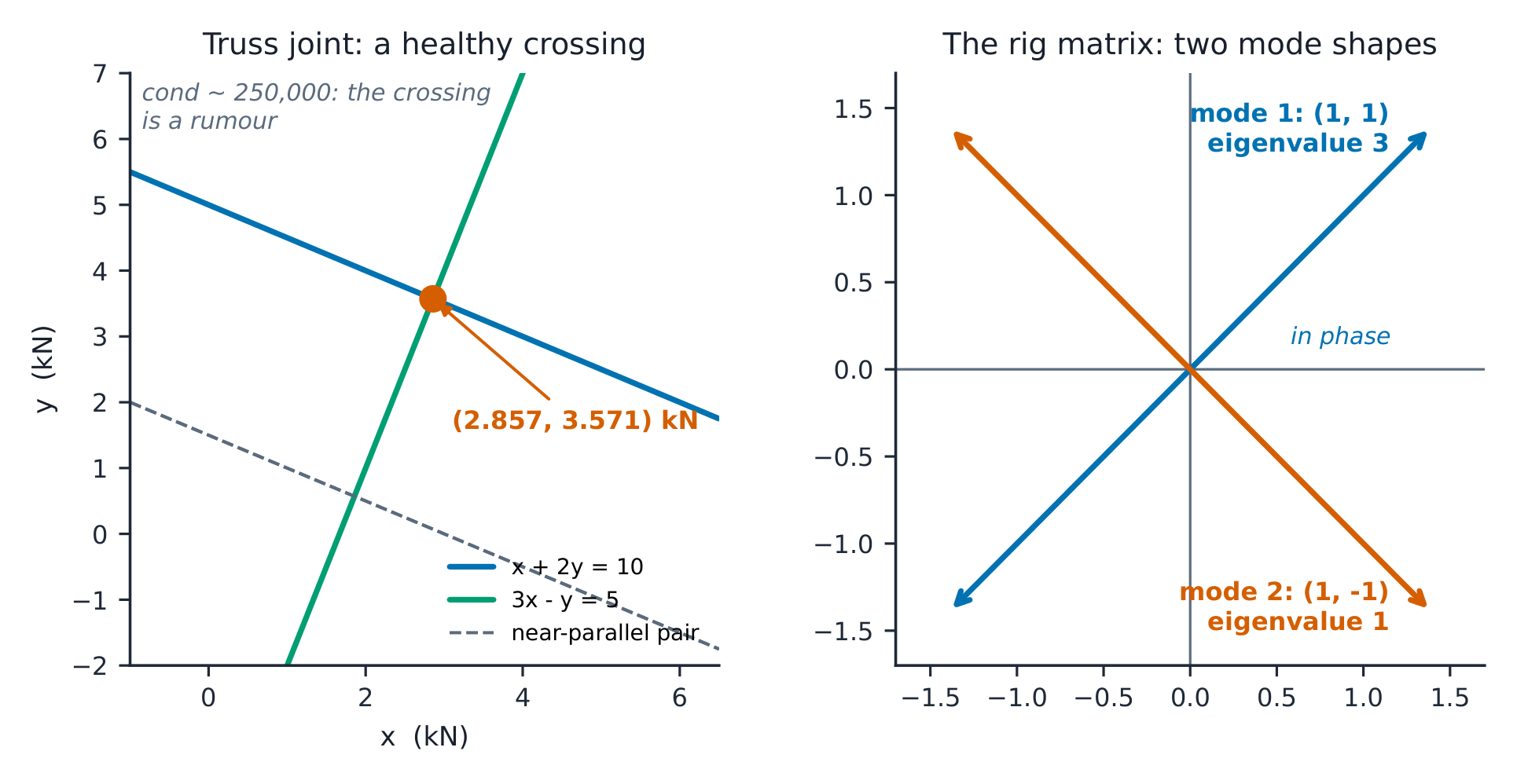
- The truss joint: $x + 2y = 10$, $3x - y = 5$ - one intersection, $(2.857, 3.571)$ kN.
Intersections and their angles
- Where lines cross at a shallow angle, the intersection is a rumour: rows (1, 2) and (2, 4.0001) give a condition number 条件数 near 250,000 - a 0.0001 nudge in the data moves the answer by whole units.
- The rig matrix with rows (2, 1) and (1, 2): condition number 3 - gentle.
Gentle or rumour?
Route each system by how much its answer can be trusted.
x + 2y = 10 and 3x - y = 5. x (three decimals)?
Difficulty 2/5 · 140 coins + a small bonus on first completion today
x = 20/7 = 2.857, y = 25/7 = 3.571.
The larger eigenvalue of the rig matrix (rows 2,1 and 1,2)?
Difficulty 2/5 · 140 coins + a small bonus on first completion today
3 and 1 - from (2 - L)(2 - L) - 1 = 0.
Match each vector to the mode it belongs to.
Difficulty 2/5 · 140 coins + a small bonus on first completion today
Direction is the content; length is a choice.
Modes as a basis
- Eigenvalues 特征值 3 and 1; eigenvectors 特征向量 $(1,1)$ and $(1,-1)$ - in phase and opposed, the two ways the rig shakes.
- Any initial shape is a mix of the two modes; each then oscillates at its own frequency. Basis 基: coordinates are relative, the vector is not.
A condition number of 250,000 means:
Difficulty 1/5 · 100 coins + a small bonus on first completion today
Nearly parallel lines: the intersection runs when the data nudges.
The rig mode (1, -1) means:
Difficulty 1/5 · 100 coins + a small bonus on first completion today
Eigenvalue 1: the opposed mode at sqrt(k/m).
Three algebra slips
- Solving without kappa. One line of code separates a measurement from a guess.
- Reading eigenvectors as sacred. Any nonzero multiple is the same direction.
- Treating basis change as a gimmick. It is why modes decouple.
A solved system with kappa = 3 deserves the same trust as one with kappa = 250,000.
Difficulty 1/5 · 100 coins + a small bonus on first completion today
Kappa is the error amplifier - three orders of magnitude apart.
Widening the calibration range lowers the fit’s condition number.
Difficulty 1/5 · 100 coins + a small bonus on first completion today
Spread anchors defeat the nearly-parallel trap.
Recap
- Truss joint (2.857, 3.571) kN; condition numbers 3 and 250,000.
- Eigenvalues 3 and 1; modes (1,1), (1,-1) - split, then solve one oscillator at a time.
- Ask for kappa before trusting any solved system.