Similar shapes
Introduced| English | Meaning |
|---|---|
| similar/ˈsɪmɪlə/ | Describing shapes with equal corresponding angles and proportional corresponding lengths. |
| scale factor/skeɪl ˈfæktə/ | The multiplier relating corresponding quantities, such as lengths in similar shapes. |
| congruent/ˈkɒŋɡruːənt/ | Having exactly the same size and shape. |
The architect's blueprint
- An architect draws a building at 1:100 scale. Every measurement on the plan is $\dfrac{1}{100}$ of the real thing.
- The drawing and the building are similar 相似 — same shape, different size.
What makes shapes similar?
- Two shapes are similar if they have the same angles and all sides are multiplied by the same scale factor 比例因子 $k$.
- All circles are similar. All equilateral triangles are similar. Not all rectangles are similar.
- Shapes that are the exact same size and shape are called congruent 全等.
A triangle with sides $3, 4, 5$ and one with sides $6, 8, 10$: scale factor $k = 2$. Same angles ($90^{\circ}$), sides doubled. They are similar.

The three angles of a triangle add up to 180 degrees
Similar shapes — enlargement
Similar shapes are the same shape but a different size. An enlargement scales every length by the same factor; angles stay the same.
Similar shapes have the same angles.
Difficulty 1/5 · 100 coins + a small bonus on first completion today
Similar shapes keep all angles equal; only the side lengths scale.
Two similar triangles have sides 5 cm and 15 cm. What is the scale factor k?
Difficulty 2/5 · 140 coins + a small bonus on first completion today
k = 15/5 = 3.
Shapes that are exactly the same size AND shape are called ______.
Difficulty 1/5 · 100 coins + a small bonus on first completion today
Congruent shapes are identical in both size and shape (scale factor = 1).
Area and volume scale differently (Extended) (Extended)
- Lengths scale by $k$, but:
Don't scale area like length. If the scale factor is $2$, the area ratio is $2^2 = 4$, not $2$. And the volume ratio is $2^3 = 8$.
Two similar shapes have lengths in the ratio 2:3. The area ratio is 4:b. What is b?
Difficulty 2/5 · 140 coins + a small bonus on first completion today
Area scales by k²: 2²:3² = 4:9, so b = 9.
If the scale factor is 4, the area ratio is k²:1. What is k²?
Difficulty 2/5 · 140 coins + a small bonus on first completion today
4² = 16. Area scales as the square of the length scale factor.
Worked example
- Two similar solids have lengths in the ratio $2:3$.
- Area ratio $= 2^2:3^2 = 4:9$.
- Volume ratio $= 2^3:3^3 = 8:27$.
- If the smaller has volume $40$ cm³: larger $= 40 \times \dfrac{27}{8} = 135$ cm³.
Two similar solids have lengths 2:3; the smaller has volume 40 cm³. Find the larger volume (cm³).
Difficulty 2/5 · 140 coins + a small bonus on first completion today
Volume ratio 8:27, so 40 × 27/8 = 135 cm³.
Fun fact
- The surface area of a sphere scales as $r^2$, but its volume scales as $r^3$. That's why elephants need big ears (surface area for cooling) while mice don't — volume grows faster than surface area.
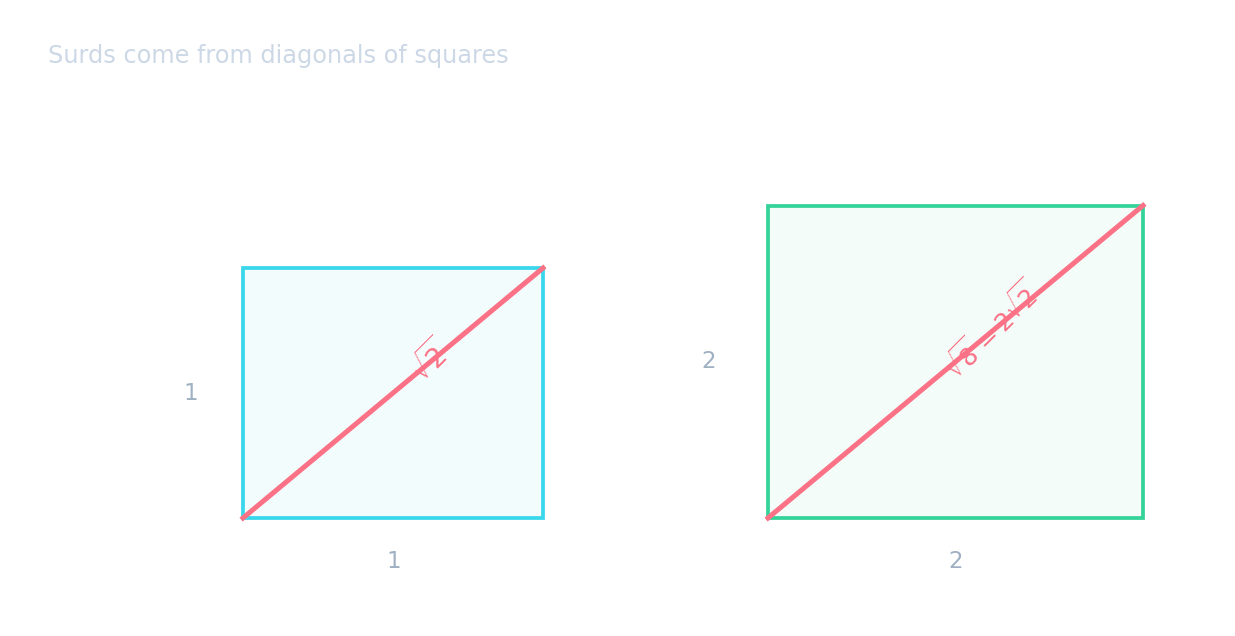
Two squares are always similar — same angles, sides scaled by a factor. Here the scale factor is $2$, so the area ratio is $4$.
Find a missing corresponding length
- Corresponding sides 4 cm and 10 cm give $k=10/4=2.5$ from small to large. A 6 cm side therefore becomes $L=kl=2.5(6)=15$ cm.
- In reverse, a 20 cm large side comes from $l=L/k=20/2.5=8$ cm. Core uses length ratios; Extended also uses area and volume ratios.

Similar shapes have scale factor 2.5 from small to large. Find the small side corresponding to 20 cm.
Difficulty 2/5 · 140 coins + a small bonus on first completion today
Reverse the enlargement: 20 / 2.5 = 8 cm.
You've got it
- similar = same angles, sides $\times$ scale factor $k$
- area scales by $k^2$, volume scales by $k^3$
- lengths $2:3 \Rightarrow$ areas $4:9 \Rightarrow$ volumes $8:27$