Employment and unemployment
Introduced| English | Meaning |
|---|---|
| unemployment/ʌnemˈplɔɪmənt/ | The state of being without work while willing and available to work and actively seeking a job. |
| unemployed/ʌnemˈplɔɪd/ | Without paid work, available to work and actively seeking work under the usual labour-force definition. |
| unemployment rate/ʌnemˈplɔɪmənt reɪt/ | The percentage of the labour force that is unemployed under the measure being used. |
| labour force/ˈleɪbə fɔːs/ | The people who are employed or are unemployed and actively seeking and available for work, under the definition used. |
| frictional/ˈfrɪkʃənl/ | Describing unemployment that occurs while people search for jobs or move between jobs. |
| structural/ˈstrʌktʃərəl/ | Describing economic effects caused by underlying features or changes in the organisation of production and labour markets. |
| cyclical/ˈsaɪklɪkl/ | Related to recurring expansions and contractions in economic activity. |
When people can't find work
- Unemployment 失业 wastes the one resource an economy can never get back — people's time and skills.
- Keeping it low is one of every government's central aims.
Development chain lab
Follow how policy and resources can change living standards.
The unemployed are people who are:
Difficulty 1/5 · 100 coins + a small bonus on first completion today
Unemployment counts only those actively seeking work.
The unemployment rate is the unemployed as a percentage of the labour ______.
Difficulty 1/5 · 100 coins + a small bonus on first completion today
Rate = unemployed ÷ labour force × 100.
What unemployment is
- The unemployed 失业者 are people willing and able to work who cannot find a job.
- The unemployment rate 失业率 = unemployed ÷ labour force 劳动力, as a percentage.
Worked example. A country has 24 million people working and 2 million unemployed and looking for work. The labour force = 24 + 2 = 26 million, so the unemployment rate = 2 ÷ 26 × 100 = 7.7%.
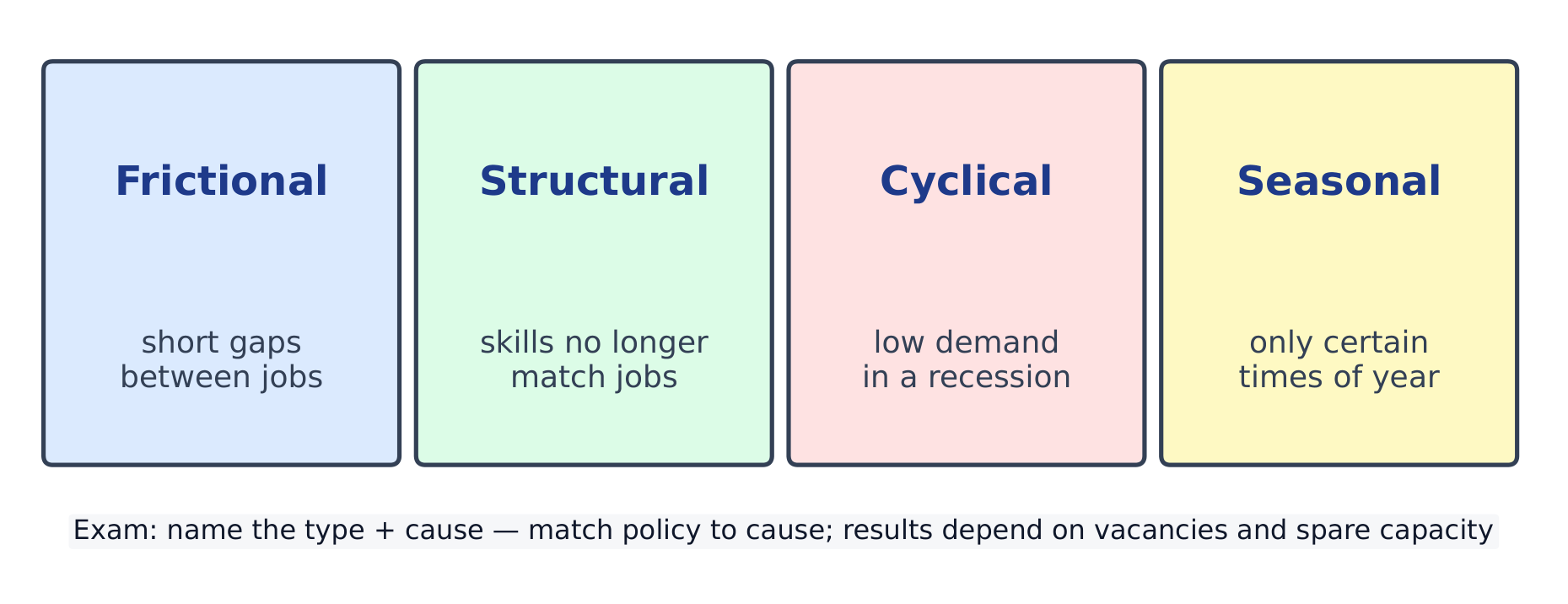
The four types of unemployment: frictional 摩擦性 (between jobs), structural 结构性 (skills no longer match), cyclical 周期性 (low demand in a recession) and seasonal
Unemployment caused by a recession (too little demand) is:
Difficulty 1/5 · 100 coins + a small bonus on first completion today
Cyclical unemployment rises when demand falls in a downturn.
A coal miner who loses his job when mines close, and whose skills no longer match new jobs, faces:
Difficulty 1/5 · 100 coins + a small bonus on first completion today
A skills/industry mismatch is structural unemployment.
Types of unemployment
- Cyclical: caused by recession — too little demand for goods, so fewer jobs.
- Structural: skills no longer match available jobs (an industry declines).
- Frictional: short-term, between jobs.

Four main aims: growth, low unemployment, stable prices, fair incomes
Retirees and full-time students are counted as unemployed.
Difficulty 1/5 · 100 coins + a small bonus on first completion today
They are not in the labour force, so they are not unemployed.
Why it matters
- Costs to the unemployed: lost income, lost skills, stress.
- Costs to society: lost output, lower tax revenue, higher benefit spending.
Not everyone without a job is "unemployed". Students, retirees and full-time carers are not in the labour force, so they don't count. Unemployment counts only those seeking work.
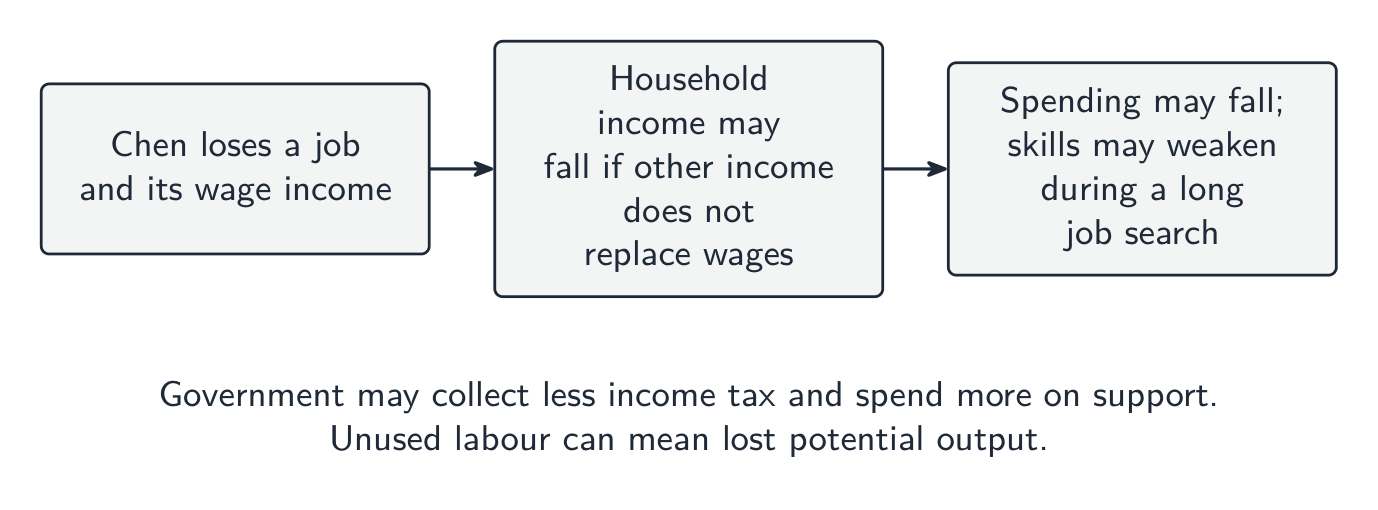
Unemployment means people who want a job cannot find one
You've got it
- the unemployed = willing and able to work but without a job
- types: cyclical (recession), structural (skills mismatch), frictional (between jobs)
- unemployment costs lost output, income and tax revenue