Inflation
Introduced| English | Meaning |
|---|---|
| inflation/ɪnˈfleɪʃn/ | A sustained increase in the general price level of goods and services. |
| general price level/ˈdʒenərəl praɪs ˈlevl/ | general price level |
| Consumer Price Index/kənˈsuːmə praɪs ˈɪndeks/ | An index tracking changes in the cost of a representative basket of goods and services purchased by consumers. |
| demand-pull/dɪˈmænd pʊl/ | Describing inflationary pressure caused by aggregate demand increasing relative to the economy's capacity to produce. |
| cost-push/kɒst pʊʃ/ | Describing inflationary pressure caused by rising production costs that reduce aggregate supply. |
| savings/ˈseɪvɪŋz/ | Income not spent on consumption and retained for future use. |
| deflation/diːˈfleɪʃn/ | A sustained fall in the general price level of goods and services. |
When money buys less each year
- A loaf that cost a little last year costs a little more this year. Multiply that across everything, every year, and you have inflation 通货膨胀.
- It quietly eats away at what money is worth.
Inflation is:
Difficulty 1/5 · 100 coins + a small bonus on first completion today
Inflation is a sustained rise in the overall price level.
The CPI rises from 100 to 105 over a year. What is the inflation rate (%)?
Difficulty 2/5 · 140 coins + a small bonus on first completion today
(105 − 100) / 100 × 100 = 5%.
Inflation is commonly measured using the Consumer Price ______.
Difficulty 1/5 · 100 coins + a small bonus on first completion today
The CPI tracks a basket of typical goods.
What inflation is
- Inflation = a sustained rise in the general price level 一般物价水平.
- It is measured by the Consumer Price Index 消费者价格指数 (CPI), which tracks the price of a typical "basket" of goods.
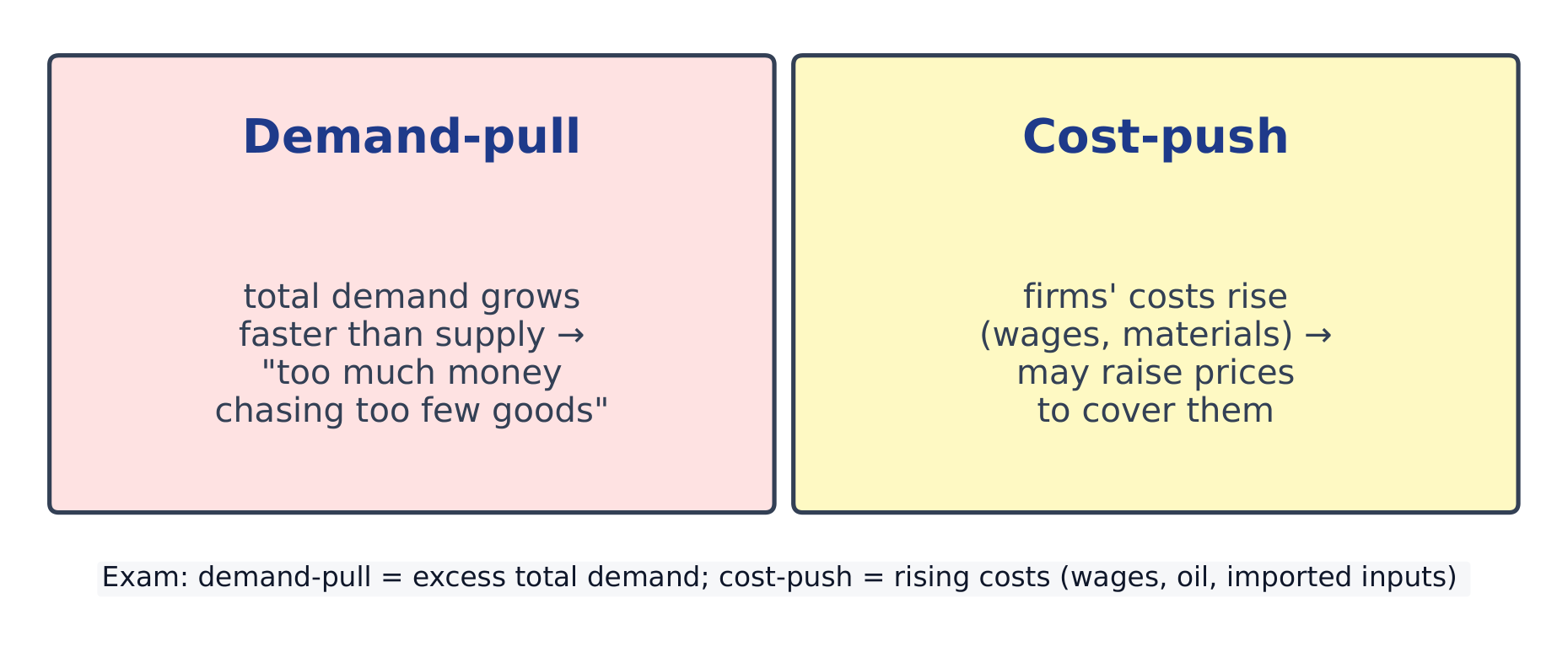
Inflation has two main causes: demand-pull and cost-push
Demand-pull inflation
When aggregate demand rises faster than supply, the price level is pulled up — that is inflation. Push demand and watch prices climb.
Inflation caused by rising wages and raw-material costs is:
Difficulty 1/5 · 100 coins + a small bonus on first completion today
Rising costs push prices up — cost-push inflation.
Two causes
- Demand-pull 需求拉动: demand grows faster than supply, pulling prices up.
- Cost-push 成本推动: rising costs (wages, raw materials) push prices up.
Worked example. If the CPI rises from 100 to 104 over a year, inflation is 4%. Prices, on average, are 4% higher than a year ago.
If inflation falls from 5% to 2%, prices are falling.
Difficulty 1/5 · 100 coins + a small bonus on first completion today
False. Prices are still rising, only more slowly. Prices fall only when inflation is negative (deflation).
Why inflation matters
- It erodes savings 储蓄 and fixed incomes, and creates uncertainty for firms.
- A little (low, steady) inflation is normal; high inflation is damaging, and falling prices (deflation 通货紧缩) can be worse.
Inflation falling ≠ prices falling. If inflation drops from 5% to 2%, prices are still rising — just more slowly. Prices only fall when inflation goes negative (deflation).
You've got it
- inflation = a sustained rise in the general price level, measured by the CPI
- causes: demand-pull (too much demand) and cost-push (rising costs)
- it erodes savings and fixed incomes; deflation (falling prices) can be worse
Write from inflation of 10 percent
- The CPI rises from 80 to 88.
- The next year, inflation falls from 10 percent to 3 percent.
The CPI rises from 80 to 88. What is the inflation rate? If that rate later falls from 10 percent to 3 percent, are prices falling?
8 divided by 80 is 0.10, which is 10 percent.
What is the inflation rate from 80 to 88?
Difficulty 1/5 · 100 coins + a small bonus on first completion today
The index rose by 10 percent. A smaller positive rate is still a rise in prices.