Economic growth
Introduced| English | Meaning |
|---|---|
| business cycle/ˈbɪznəs ˈsaɪkl/ | Fluctuations in economic activity between expansion and contraction over time. |
| economic growth/ˌiːkəˈnɒmɪk ɡrəʊθ/ | An increase in an economy's real output of goods and services over time. |
| real GDP/rɪəl ˌdʒiː diː ˈpiː/ | The value of domestic final output measured at constant prices to remove the effect of price changes. |
| inflation/ɪnˈfleɪʃn/ | A sustained increase in the general price level of goods and services. |
| living standards/ˈlɪvɪŋ ˈstændədz/ | The level of material well-being and access to goods, services and other conditions supporting quality of life. |
| recession/rɪˈseʃn/ | A significant, sustained decline in an economy's overall activity. |
| inequality/ɪniːˈkwɒlɪti/ | An unequal distribution of a quantity, opportunity or outcome between people or groups. |
Booms, busts and the cycle
- Economies don't grow at a steady pace — they speed up, overheat, slow down, and recover, again and again.
- This rhythm is the business cycle 经济周期, and growth is its long-run trend.
Economic growth is measured by an increase in:
Difficulty 1/5 · 100 coins + a small bonus on first completion today
Growth is a rise in real GDP — output adjusted for inflation.
What economic growth 经济增长 is
- Economic growth = an increase in a country's real GDP 实际GDP (the total value of output, adjusted for inflation 通货膨胀).
- Sustained growth raises average incomes and living standards 生活水平.

Investment in new buildings and machines adds to a country's capital and drives economic growth
Economic growth
Growth shifts the whole frontier outward — the economy can now produce more of both goods.
A recession is usually defined as:
Difficulty 1/5 · 100 coins + a small bonus on first completion today
Two quarters of falling real GDP signals a recession.
The repeated pattern of booms and recessions is the business ______.
Difficulty 1/5 · 100 coins + a small bonus on first completion today
Output cycles around the rising long-run trend.
The business cycle
- Output swings through boom → slowdown → recession 衰退 → recovery, around the rising trend.
- A recession is two quarters in a row of falling real GDP.
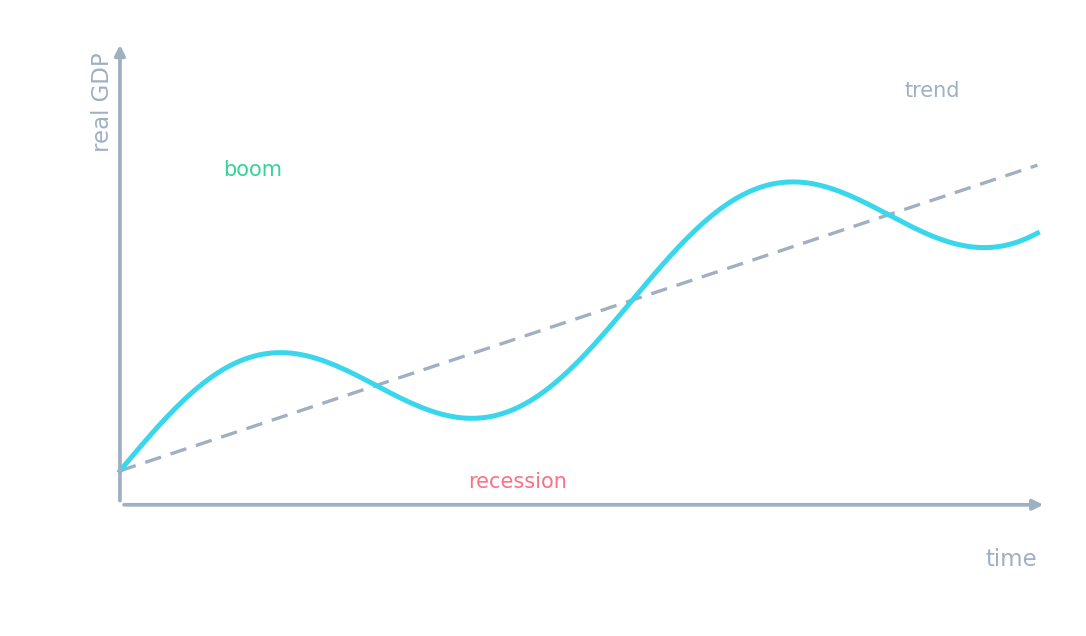
Real output cycles through booms and recessions while the long-run trend rises.
Real GDP strips out the effect of inflation.
Difficulty 1/5 · 100 coins + a small bonus on first completion today
Real GDP measures actual output, not just higher prices.
Which are potential costs of economic growth? (Select all that apply.)
Difficulty 2/5 · 140 coins + a small bonus on first completion today
Higher incomes is a benefit; the others can be costs.
Costs and benefits of growth
- Benefits: higher incomes, more jobs, better public services.
- Costs: possible inflation, inequality 不平等, and environmental damage.
Growth means real GDP, not just bigger numbers. If prices rise 5% and output figures rise 5%, real output hasn't grown at all. Always strip out inflation.
You've got it
- economic growth = a rise in real GDP → higher living standards
- the business cycle: boom → slowdown → recession → recovery
- growth brings higher incomes but risks inflation and environmental cost