Government macroeconomic intervention
Introduced| English | Meaning |
|---|---|
| macroeconomic aims/ˌmækrəˌriːkəˈnɒmɪk eɪmz/ | macroeconomic aims |
| economic growth/ˌiːkəˈnɒmɪk ɡrəʊθ/ | An increase in an economy's real output of goods and services over time. |
| unemployment/ʌnemˈplɔɪmənt/ | The state of being without work while willing and available to work and actively seeking a job. |
| inflation/ɪnˈfleɪʃn/ | A sustained increase in the general price level of goods and services. |
| balance of payments/ˈbæləns ɒv ˈpeɪmənts/ | A record of economic transactions between an economy's residents and the rest of the world over a period. |
| income distribution/ˈɪŋkʌm ˌdɪstrɪˈbjuːʃn/ | The way total income is shared among people, households or groups in an economy. |
| fiscal policy/ˈfɪskl ˈpɒlɪsi/ | Government decisions about taxation and spending used to influence economic activity. |
| monetary policy/ˈmʌnɪtəri ˈpɒlɪsi/ | Actions by a monetary authority to influence interest rates, credit or money conditions in pursuit of economic objectives. |
| supply-side policy/səˈplaɪ saɪd ˈpɒlɪsi/ | Measures intended to improve an economy's productive capacity, efficiency or incentives to supply goods and services. |
What governments are trying to do
- Every government wants a healthy economy — but "healthy" means several things at once, and they can pull against each other.
- These goals are its macroeconomic aims 宏观经济目标.
Which are macroeconomic aims of government? (Select all that apply.)
Difficulty 2/5 · 140 coins + a small bonus on first completion today
Government aims for the whole economy, not one firm.
Keeping inflation low and steady is the aim of stable ______.
Difficulty 1/5 · 100 coins + a small bonus on first completion today
Price stability means low, predictable inflation.
The main aims
- Economic growth 经济增长 — rising output and incomes.
- Low unemployment 失业 — most people who want jobs have them.
- Stable prices — low, steady inflation 通货膨胀.
- Balance of payments 国际收支 stability and fairer income distribution 收入分配.
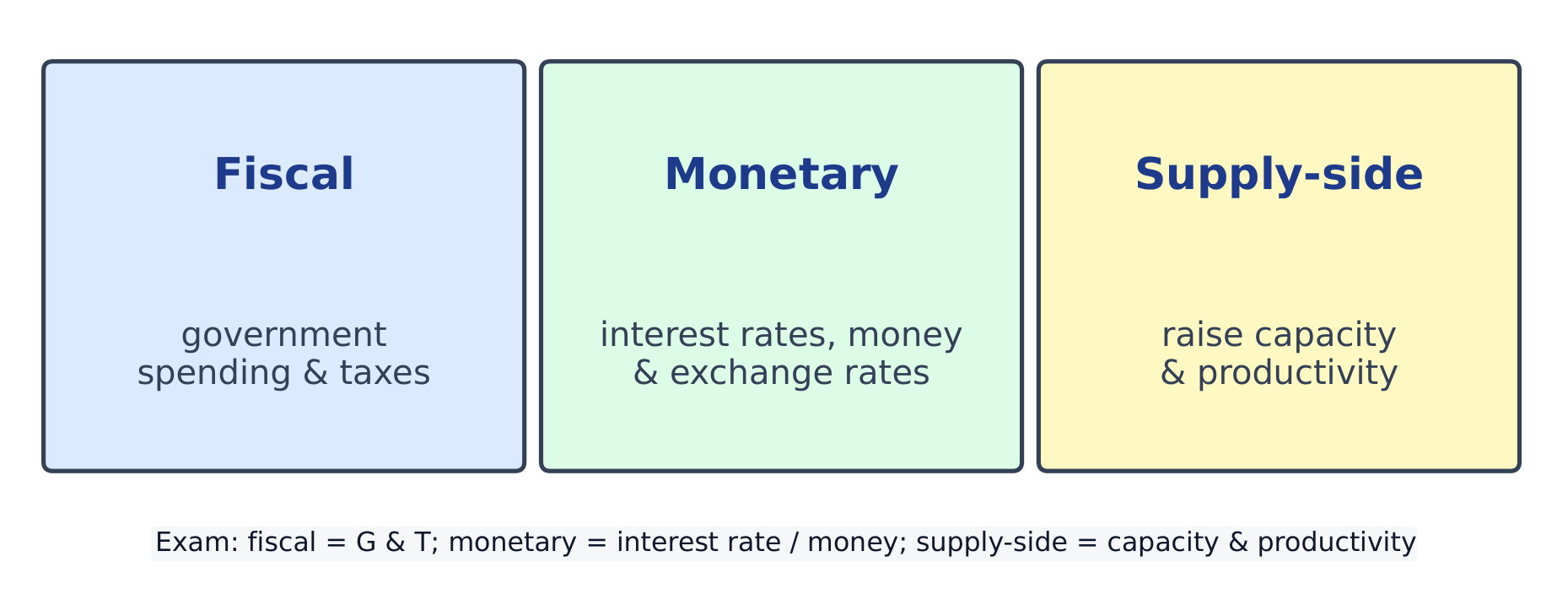
The three sets of government macro policy tools: fiscal (spending and taxes), monetary (interest rate and money supply), and supply-side (capacity and productivity)
Managing aggregate demand
Government policy moves aggregate demand against aggregate supply to steer output and the price level.
Which pair of aims can conflict?
Difficulty 1/5 · 100 coins + a small bonus on first completion today
Fast growth can stoke inflation, so the two aims can conflict.
Raising interest rates to fight inflation can increase unemployment.
Difficulty 1/5 · 100 coins + a small bonus on first completion today
Cooling demand reduces inflation but can cost jobs — a trade-off.
Aims can conflict
- Pushing growth and jobs can stoke inflation.
- Cutting inflation with high interest rates can raise unemployment.
- Governments must constantly trade off one aim against another.
Worked example. To fight rising inflation, a central bank raises interest rates. Borrowing falls, demand cools, prices steady — but firms invest less and unemployment may rise. One aim improves, another worsens.
Match each policy to its main tool.
Difficulty 2/5 · 140 coins + a small bonus on first completion today
Fiscal = budget; monetary = rates; supply-side = capacity.
The policy toolkit
- Fiscal policy 财政政策: government spending and taxation.
- Monetary policy 货币政策: interest rates and the money supply.
- Supply-side policy 供给侧政策: measures to raise productivity and capacity.
You've got it
- macro aims: growth, low unemployment, stable prices, balance of payments, fair distribution
- the aims often conflict — growth vs inflation, inflation vs jobs
- three policy types: fiscal, monetary, supply-side
Write from inflation rising to 7
- Growth is 4 percent. Inflation rises from 2 percent to 7 percent.
- Say whether those aims conflict.
An economy grows at 4 percent while inflation rises from 2 percent to 7 percent. Do these two government aims conflict here?
A boom can raise both output and the price level.
What do growth of 4 percent and inflation of 7 percent show?
Difficulty 1/5 · 100 coins + a small bonus on first completion today
Growth has arrived together with a higher inflation rate.