Price elasticity of supply (PES)
Introduced| English | Meaning |
|---|---|
| price elasticity of supply/praɪs ɪlæˈstɪsɪti ɒv səˈplaɪ/ | The percentage change in quantity supplied divided by the percentage change in price. |
| inelastic/ɪnɪˈlæstɪk/ | Describing demand or supply whose percentage response is smaller than the percentage change in its determining price or income. |
| elastic/ɪˈlæstɪk/ | Describing demand or supply whose percentage response exceeds the percentage change in its determining price or income. |
| spare capacity/speə kəˈpæsɪti/ | The difference between current output and the output that could be produced with available resources. |
| short run/ʃɔːt rʌn/ | A period in which at least one factor of production is fixed. |
| perishable/ˈperɪʃəbl/ | perishable |
Can sellers react fast?
- When strawberry prices jump, a farmer can't grow more overnight — the crop takes months. A factory can add a shift tomorrow.
- Price elasticity of supply 供给价格弹性 measures how quickly and easily sellers respond.
Price rises 20% and quantity supplied rises 10%. What is PES?
Difficulty 2/5 · 140 coins + a small bonus on first completion today
PES = 10% / 20% = 0.5 — inelastic.
PES is normally positive because supply curves slope upward.
Difficulty 1/5 · 100 coins + a small bonus on first completion today
Higher price → more supplied, so PES is positive.
Defining PES
- PES = how much quantity supplied responds to a price change.
- $\text{PES} = \dfrac{\%\ \text{change in quantity supplied}}{\%\ \text{change in price}}$ — normally positive.
Worked example. Price rises 10% and quantity supplied rises 5%. $\text{PES} = \dfrac{5\%}{10\%} = 0.5$. Supply is inelastic 缺乏弹性.
Demand & supply
Supply elasticity is how quantity responds to price.
Which makes supply more elastic?
Difficulty 1/5 · 100 coins + a small bonus on first completion today
Spare capacity lets firms raise output quickly.
What makes supply elastic 富有弹性
- Elastic supply (PES > 1): firms can change output easily — spare capacity 闲置产能, stock, quick production.
- Inelastic supply (PES < 1): output is hard to change — farming, mining, skilled labour.
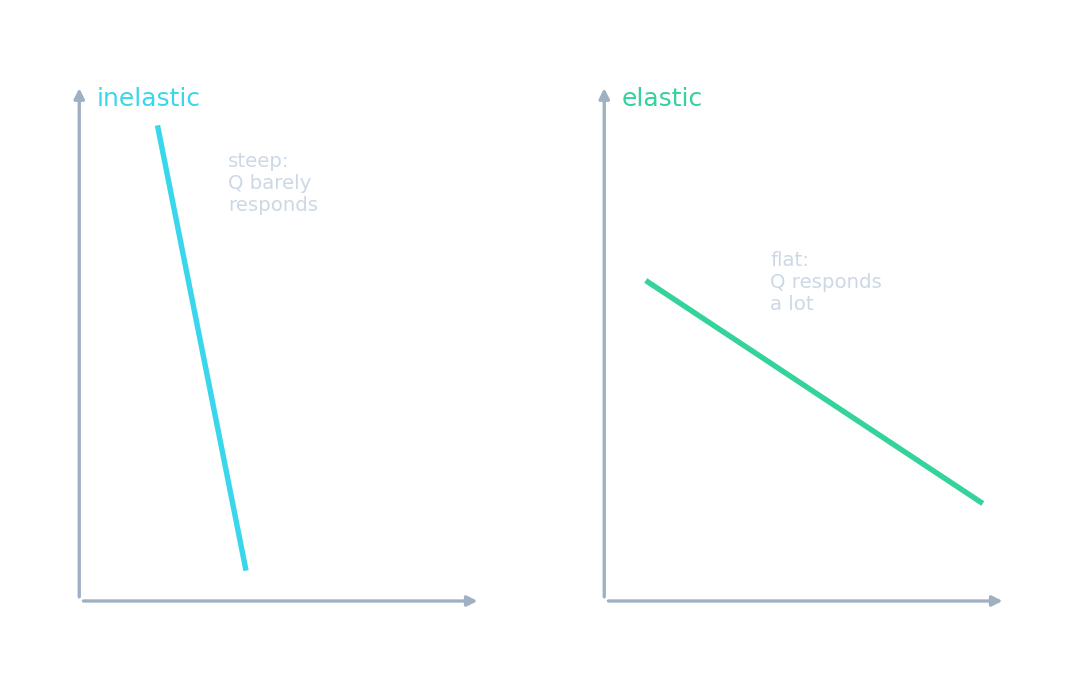
Steep = inelastic supply; shallow = elastic supply.
Supply tends to be most inelastic:
Difficulty 1/5 · 100 coins + a small bonus on first completion today
In the short run firms cannot easily change output, so supply is inelastic.
Given more ______, firms can build capacity and supply becomes more elastic.
Difficulty 1/5 · 100 coins + a small bonus on first completion today
Time lets fixed factors be varied, raising elasticity.
Time matters most
- In the short run 短期, supply is usually inelastic — factors are fixed.
- Given time, firms build capacity and supply becomes more elastic.
Perishable 易腐的 or slow-to-grow goods are supply-inelastic. Fresh fruit and minerals can't be produced quickly, so a price rise brings little extra supply at first.
You've got it
- $\text{PES} = \dfrac{\%\Delta Q_s}{\%\Delta P}$ — its size measures supply responsiveness
- elastic supply needs spare capacity, stocks or quick production
- supply is more inelastic in the short run, more elastic over time