Price changes
Introduced| English | Meaning |
|---|---|
| shifts/ʃɪfts/ | A movement of an entire curve caused by a change in a factor other than the variable plotted on its relevant axis. |
| demand/dɪˈmænd/ | The quantity of a good or service that buyers are willing and able to purchase at different prices over a period. |
| supply/səˈplaɪ/ | The quantity sellers are willing and able to offer at different prices over a specified period. |
| equilibrium/ˌiːkwɪˈlɪbrɪəm/ | A state in which opposing influences balance so there is no tendency for the relevant quantities to change. |
| shortage/ˈʃɔːtɪdʒ/ | A situation in which quantity demanded exceeds quantity supplied at the prevailing price. |
When the whole market moves
- A heatwave empties the shops of ice cream; a health scare empties them of a food. Prices jump or slump.
- These are shifts 移动 in demand 需求 or supply 供给 — and they move the equilibrium 均衡 to a new place.
A rise in demand (the demand curve shifts right) leads to:
Difficulty 1/5 · 100 coins + a small bonus on first completion today
More demand raises both equilibrium price and quantity.
A heatwave raises demand for ice cream. In that market:
Difficulty 1/5 · 100 coins + a small bonus on first completion today
Demand shifts right → higher price and quantity.
A demand shift
- More demand (right shift) → at the old price there's a shortage 短缺 → price rises, quantity rises.
- Less demand (left shift) → price falls, quantity falls.

A rise in demand shifts the curve right: the new equilibrium has a higher price and quantity.
Demand & supply
A shift in demand or supply moves the equilibrium.
A rise in supply (the supply curve shifts right) leads to:
Difficulty 1/5 · 100 coins + a small bonus on first completion today
More supply lowers the price and raises the quantity traded.
A fall in supply causes the equilibrium price to ______.
Difficulty 1/5 · 100 coins + a small bonus on first completion today
Less supply → higher price, lower quantity.
A supply shift
- More supply (right shift) → price falls, quantity rises.
- Less supply (left shift) → price rises, quantity falls.
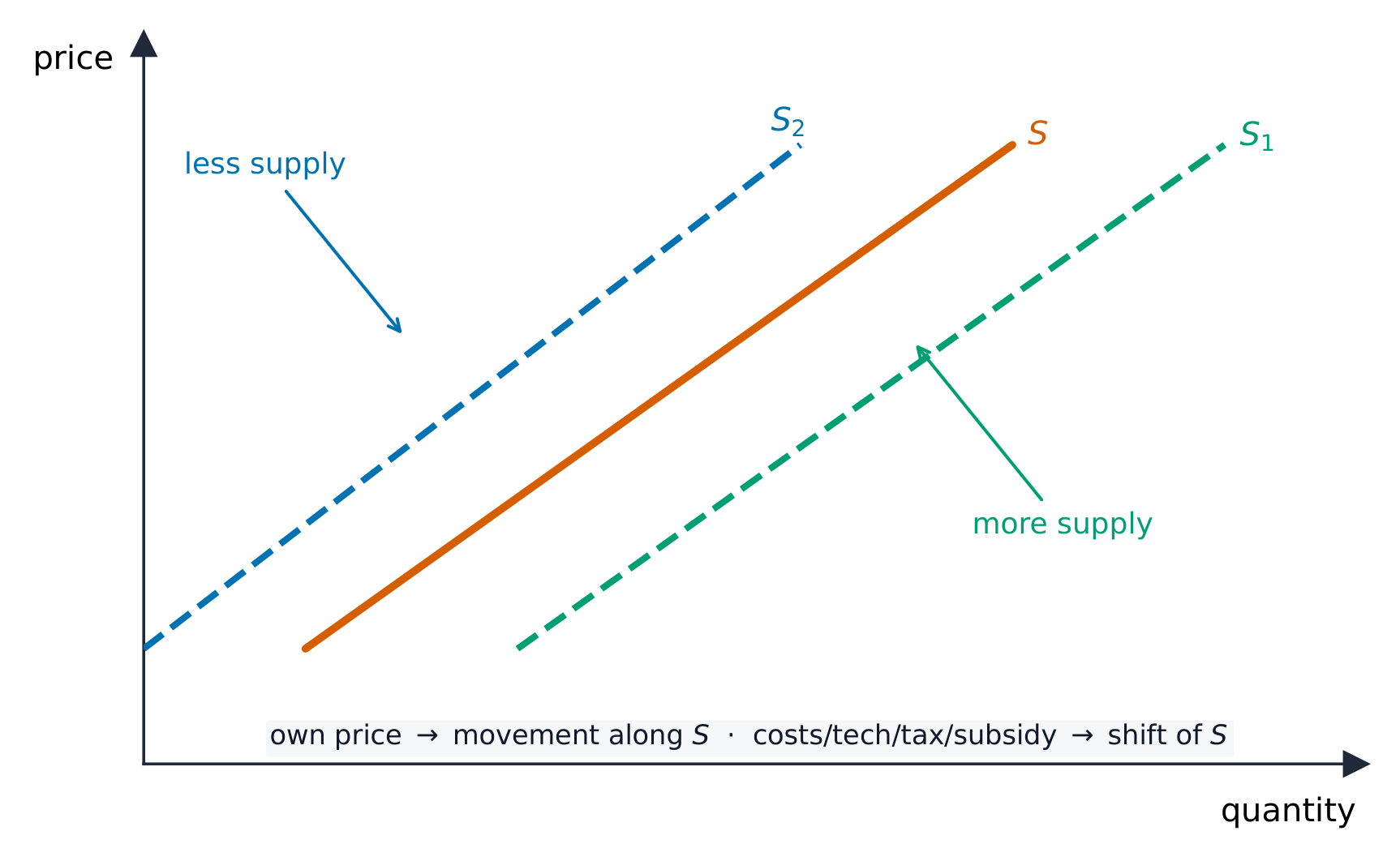
A rightward shift of supply lowers the price and raises the quantity; a leftward shift does the reverse
A shift in one curve changes both the equilibrium price and quantity.
Difficulty 1/5 · 100 coins + a small bonus on first completion today
Both move — always state the change in each.
A method that always works
-
- Decide which curve moves and which way.
-
- Mark the new crossing point.
-
- Read off the new price and quantity.
Two things move, not one. A shift changes both the equilibrium price and the quantity. Always state what happens to each.
You've got it
- a demand rise → price up, quantity up; a demand fall → both down
- a supply rise → price down, quantity up; a supply fall → price up, quantity down
- always report the change in both price and quantity