Properties of metals
Introduced| English | Meaning |
|---|---|
| conductors/kənˈdʌktəz/ | A material through which electric charge or thermal energy can pass readily. |
| malleable/ˈmæləbl/ | Able to be hammered or rolled into a different shape without breaking. |
| ductile/ˈdʌktaɪl/ | ductile |
What makes a metal a metal
- Metals share a family of useful properties — which is why we build with them and wire our homes with them.
- These properties all come from metallic bonding.
Metal property lab
Link metal properties to the particle model.
Metals conduct electricity because they have:
Difficulty 1/5 · 100 coins + a small bonus on first completion today
Mobile electrons carry the current.
A metal that can be drawn into a wire is described as:
Difficulty 1/5 · 100 coins + a small bonus on first completion today
Ductile means it can be drawn into wires.
A metal that can be hammered into shape is described as ______.
Difficulty 1/5 · 100 coins + a small bonus on first completion today
Malleable metals can be shaped without breaking.
Physical properties
- Metals are good conductors 导体 of electricity and heat (free electrons).
- They are shiny, malleable 可延展的 (can be hammered into shape) and ductile 可拉成丝的 (drawn into wires).
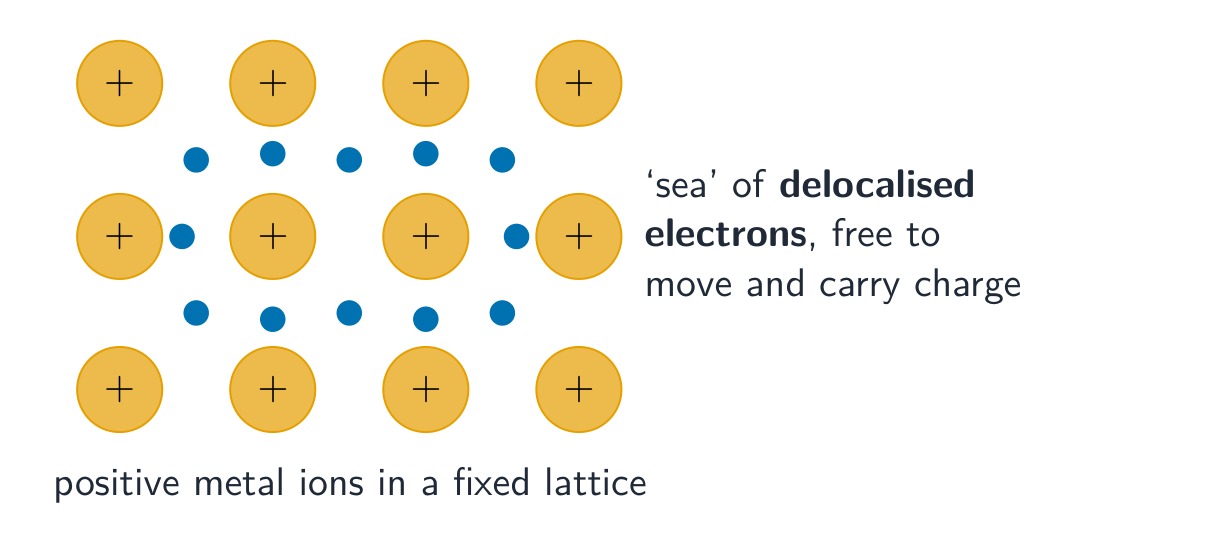
Metallic bonding: a lattice of positive ions in a sea of delocalised electrons
Metallic bonding
Positive ions sit in a sea of delocalised electrons — that is why metals conduct and bend. Push the layers and the bond holds.
Which are typical properties of metals? (Select all that apply.)
Difficulty 2/5 · 140 coins + a small bonus on first completion today
Metals are good electrical conductors, not poor ones.
Most metals have low melting points.
Difficulty 1/5 · 100 coins + a small bonus on first completion today
False. Most metals have high melting points because of strong metallic bonding between the positive ions and delocalised electrons.
Strength and melting points
- Most metals are strong with high melting points.
- The strong attraction between metal ions and the electron sea explains this.
Chemical properties
- Many metals react with oxygen, water and acids.
- More reactive metals react more vigorously.
Worked example. Copper is used in wires because it conducts electricity (free electrons) and is ductile (drawn into thin wires). Both properties come from metallic bonding.
You've got it
- metals conduct heat and electricity, are shiny, malleable and ductile
- most are strong with high melting points (strong metallic bonding)
- their properties come from a lattice of ions in a sea of free electrons
Write from a malleable metal
- A piece of copper is hammered into a sheet.
- It does not shatter.
Which metal property is this, and why does the structure allow it?
Sliding layers without breaking the attraction makes a metal malleable.
What property lets copper be hammered into a sheet?
Difficulty 1/5 · 100 coins + a small bonus on first completion today
The layers slide and the electron sea still binds them.