Trophic levels and energy loss
Introduced| English | Meaning |
|---|---|
| trophic level/ˈtrəʊfɪk ˈlevl/ | A feeding stage in a food chain. |
| energy loss/ˈenədʒi lɒs/ | energy loss |
Why food chains are short
- Have you noticed food chains rarely have more than four or five links? There's a good reason.
- It's all about how much energy is passed on at each step.
A trophic level is:
Difficulty 1/5 · 100 coins + a small bonus on first completion today
Each feeding stage is a trophic level.
Trophic levels 营养级
- A trophic level is a feeding stage in a food chain.
- Producer (level 1) → primary consumer (level 2) → secondary consumer (level 3), and so on.

Only about 10% of energy passes up each level, so the levels get smaller
Trophic levels and energy loss
Each feeding level passes on only about a tenth of its energy — which is why there are few top predators.
Roughly what percentage of energy is passed to the next trophic level?
Difficulty 2/5 · 140 coins + a small bonus on first completion today
About 10% is passed on; the rest is lost.
How is energy lost between trophic levels? (Select all that apply.)
Difficulty 2/5 · 140 coins + a small bonus on first completion today
Photosynthesis captures energy; the others lose it.
If producers hold 5000 units of energy, about how many reach the primary consumers (10%)?
Difficulty 2/5 · 140 coins + a small bonus on first completion today
10% of 5000 = 500 units.
Energy loss 能量损失
- Only about 10% of the energy at one level is passed to the next.
- The rest is lost as heat (respiration), movement and undigested waste.
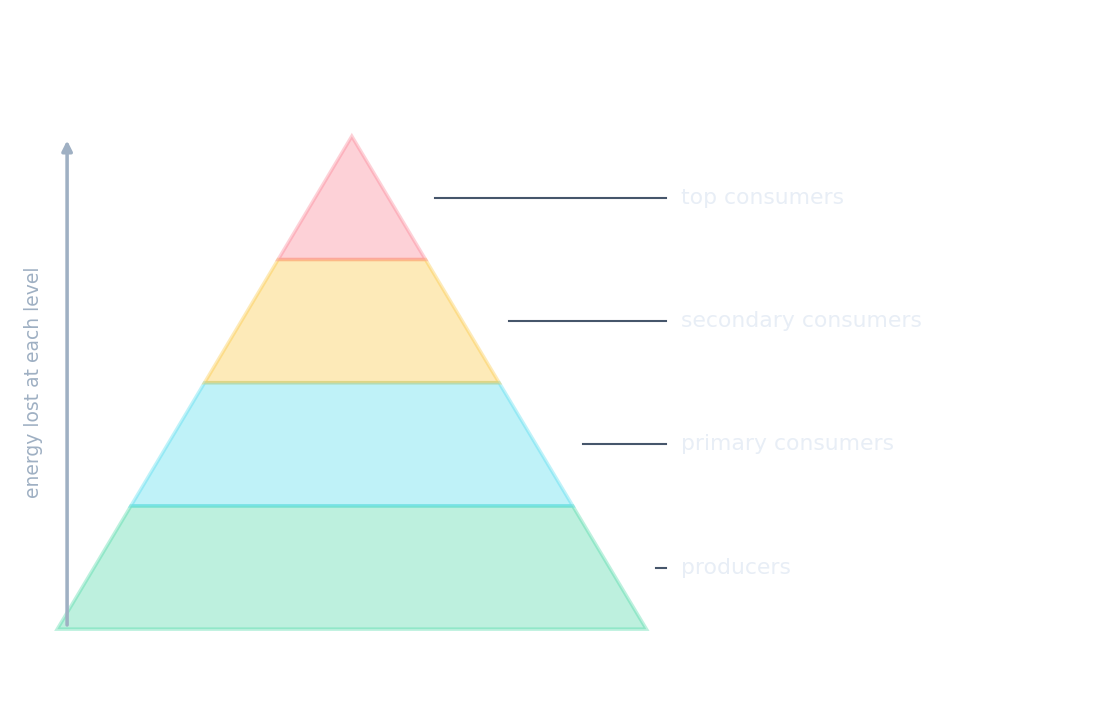
Each level passes on only a fraction of its energy, so the pyramid narrows sharply.
Build the pyramid of energy
Drag the energy the plants capture and watch only a tenth pass up each level — so the top predator is left with almost nothing.
Food chains are short because so much energy is lost at each level.
Difficulty 1/5 · 100 coins + a small bonus on first completion today
There is not enough energy to support many levels.
Why chains are short
- Because so much energy is lost each step, there isn't enough left to support many levels.
- This is why food chains usually have only 4 or 5 links.
Worked example. If producers capture 10,000 units of energy, the primary consumers get about 1,000, the secondary about 100, and the top consumers just 10 — too little to support another level.
You've got it
- a trophic level is a feeding stage; producer → primary → secondary consumer
- only about 10% of energy passes to the next level (rest lost as heat, movement, waste)
- huge energy loss is why food chains are short (4–5 links)