Asexual reproduction
Introduced| English | Meaning |
|---|---|
| asexual reproduction/eɪˈsekʃuːəl rɪprəˈdʌkʃn/ | Reproduction without the fusion of gametes, normally producing genetically identical offspring except for mutations. |
| gametes/ˈɡæmiːts/ | Haploid reproductive cells that fuse during fertilisation to form a zygote. |
| clones/kləʊnz/ | A genetically identical copy of a cell or organism, apart from any new mutations. |
| variation/ˌveərɪˈeɪʃn/ | Differences in characteristics between individuals or values within a set. |
Copies of one parent
- Some organisms reproduce all by themselves, with no partner needed.
- This is asexual reproduction 无性生殖, and the offspring are exact copies.
Asexual reproduction needs how many parents?
Difficulty 1/5 · 100 coins + a small bonus on first completion today
Only one parent is needed.
The offspring of asexual reproduction are:
Difficulty 1/5 · 100 coins + a small bonus on first completion today
They are clones — genetically identical.
Genetically identical offspring are called ______.
Difficulty 1/5 · 100 coins + a small bonus on first completion today
Asexual reproduction produces clones.
What asexual reproduction is
- Asexual reproduction needs only one parent and no gametes 配子.
- The offspring are genetically identical to the parent — they are clones 克隆.
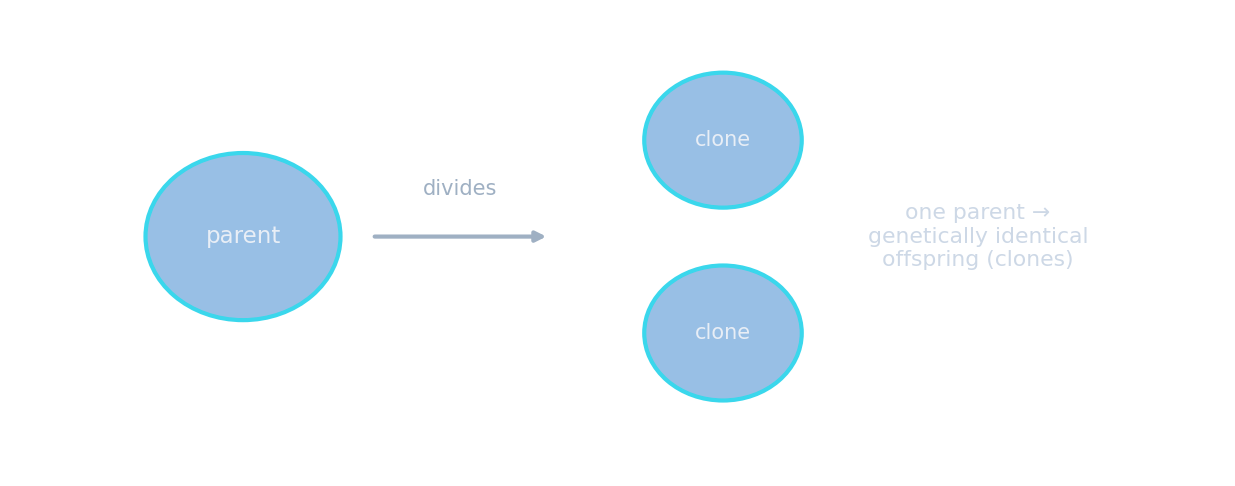
Asexual reproduction: one parent gives genetically identical offspring (clones)
Asexual reproduction
One parent makes genetically identical offspring (clones) by mitosis — no gametes needed.
Which reproduce asexually? (Select all that apply.)
Difficulty 2/5 · 140 coins + a small bonus on first completion today
A baby from two parents is sexual reproduction.
Examples
- Bacteria divide in two; plants grow runners or tubers; some animals bud.
- Many crops are grown asexually (e.g. from cuttings) to keep useful traits.
A disadvantage of asexual reproduction is a lack of variation.
Difficulty 1/5 · 100 coins + a small bonus on first completion today
Identical offspring are all equally vulnerable to the same threat.
Advantages and disadvantages
- Advantages: fast, no partner needed, all good traits passed on.
- Disadvantage: no variation 变异 — so a single disease or change could wipe out the whole population.
No variation is the big weakness. Because clones are identical, if one is vulnerable to a disease, they all are. Asexual reproduction is fast but risky in a changing environment.
You've got it
- asexual reproduction: one parent, no gametes, identical offspring (clones)
- examples: bacteria dividing, plant runners/tubers, cuttings
- it is fast but produces no variation — risky if the environment changes