Gas exchange surfaces
Introduced| English | Meaning |
|---|---|
| gas exchange/ɡæs eksˈtʃeɪndʒ/ | The movement of gases, such as oxygen and carbon dioxide, between an organism and its environment or between internal regions. |
| alveoli/ˈælvɪɒli/ | Tiny air sacs in the lungs where gases are exchanged between air and blood. |
Trading gases with the air
- Every cell needs oxygen and must get rid of carbon dioxide.
- This swap happens at a gas exchange 气体交换 surface — and good ones share key features.
Which are features of a good gas exchange surface? (Select all that apply.)
Difficulty 2/5 · 140 coins + a small bonus on first completion today
A thick, dry surface would slow diffusion.
A large ______ area speeds up the diffusion of gases.
Difficulty 1/5 · 100 coins + a small bonus on first completion today
More surface area means faster gas exchange.
Features of a good surface
- Large surface area, thin (short diffusion distance), moist, and a good blood supply.
- These features make diffusion of gases fast.

Gas exchange happens across the huge surface of the lungs
A good gas-exchange surface
Tap the alveolus to see the four features that make it ideal for exchange: a huge surface area, a thin wall, a moist lining and a good blood supply.
Gas exchange in the lungs happens in the:
Difficulty 1/5 · 100 coins + a small bonus on first completion today
Alveoli are the tiny air sacs where gases exchange.
The alveoli 肺泡
- In the lungs, gas exchange happens in millions of tiny air sacs called alveoli.
- Their huge combined surface area and thin walls make them ideal.

At an alveolus, oxygen diffuses into the blood and carbon dioxide diffuses out
At the alveoli, oxygen diffuses:
Difficulty 1/5 · 100 coins + a small bonus on first completion today
Oxygen moves down its gradient into the blood.
Gas exchange occurs by diffusion, which is different from breathing.
Difficulty 1/5 · 100 coins + a small bonus on first completion today
Breathing ventilates; gas exchange is diffusion across the surface.
How gases move
- Oxygen diffuses from the alveoli into the blood; carbon dioxide diffuses the other way.
- A steep concentration gradient (kept by breathing and blood flow) speeds this up.
Gas exchange is diffusion, not breathing. Breathing moves air in and out; gas exchange is the diffusion of O₂ and CO₂ across the alveolar surface. They work together but are different processes.
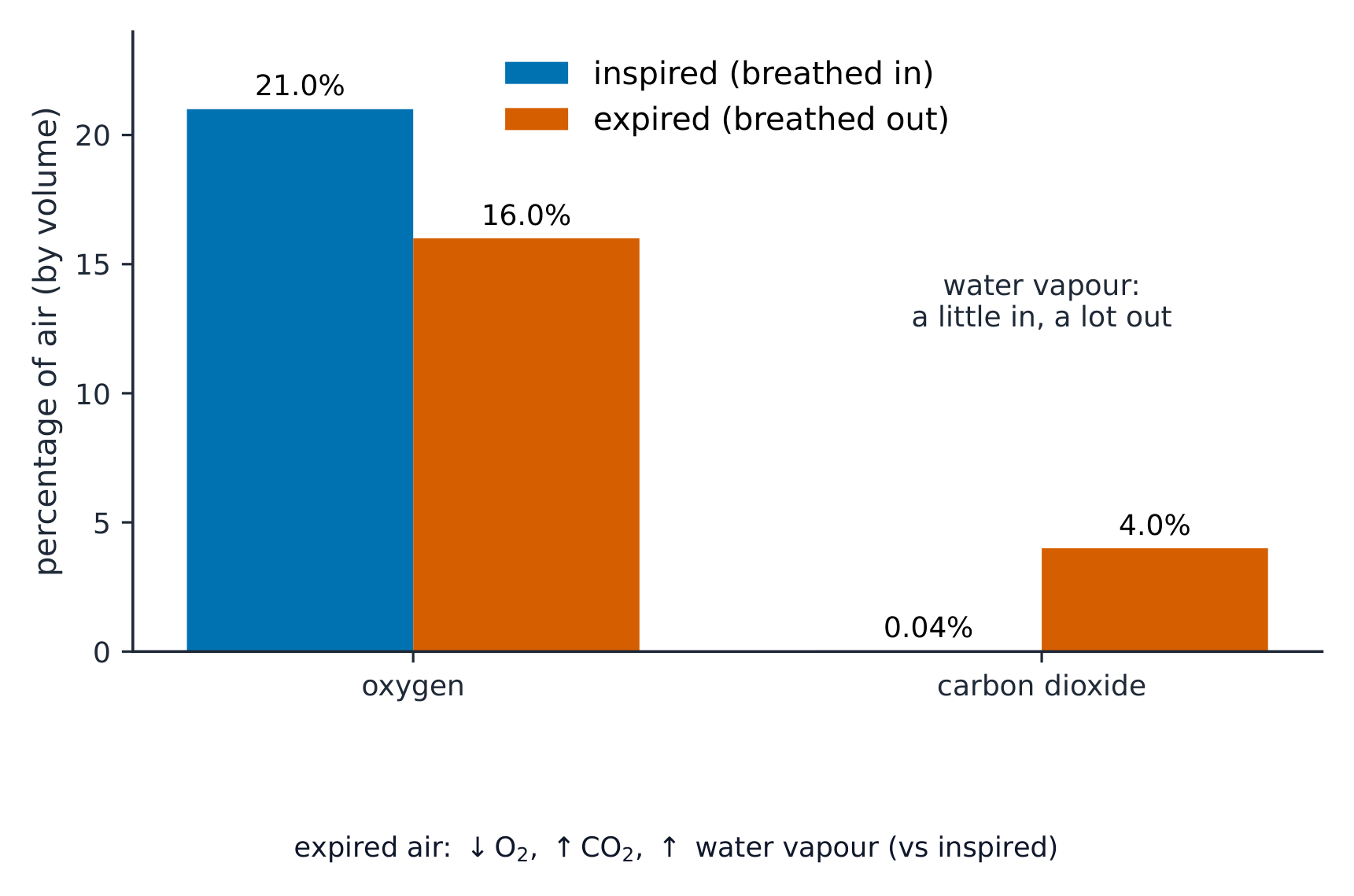
Expired air has less oxygen and much more carbon dioxide than inspired air
You've got it
- a good gas exchange surface is large, thin, moist with a good blood supply
- the alveoli provide a huge surface area and thin walls
- oxygen diffuses in, carbon dioxide diffuses out — driven by a concentration gradient