Your learning plan · Continue · Review →
Part 2 — develop a relevant long turn
IntroducedYour saved position stays in this browser. Resuming does not complete the lesson or answer its questions.
A note can cue an event without writing the whole speech
-
Outcome: choose brief notes, develop a connected response to the actual card and explain its requested aspect. Start with Speaking format; use recordings here to compare and revise before a fresh card. Written decisions support preparation; they cannot demonstrate your spoken performance.
-
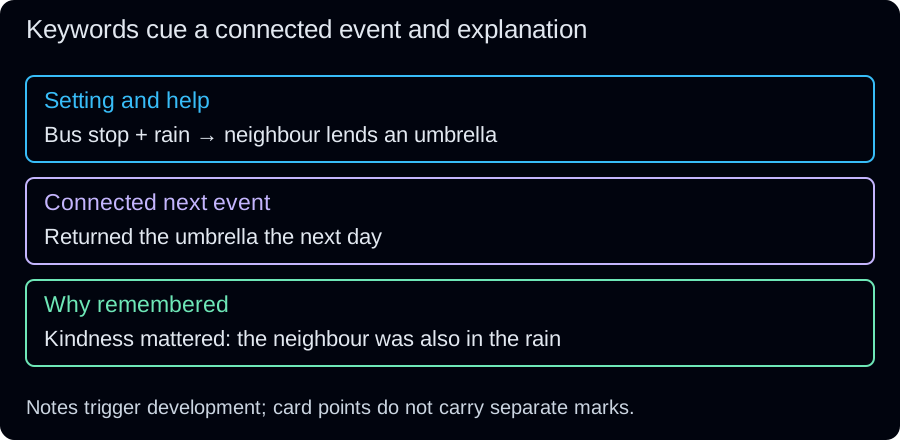
Original card: describe a time someone helped you; say where you were, who helped, what happened, and explain why you remember it. Notes: bus stop / rain / neighbour / borrowed umbrella / returned next day / grateful.
-
A developed explanation is “The neighbour was also waiting in the rain but offered me the umbrella, so I remembered the kindness.” It connects the feeling to what happened. Six adjectives about gratitude would leave the event waiting at the bus stop.

What is the upper time limit, in minutes, for the Part 2 long turn?
Difficulty 2/5 · 140 coins + a small bonus on first completion today
You speak for up to two minutes; the examiner stops you when the time is up. Practise developing a relevant answer with a timer.
Use the preparation minute to choose a route
- You have one minute to prepare, then up to two minutes for the long turn. Write short cues for the supplied points and explanation. There is no compulsory noun-only note format; use whatever brief prompts help you recall accurate details.
- For this card, organise setting → neighbour’s help → what you did afterward → why it mattered. A script can take too long to write and be hard to adapt. Notes support speaking; they are not the submitted answer or a separately scored essay.
What is a useful way to use the one-minute preparation?
Difficulty 1/5 · 100 coins + a small bonus on first completion today
Keywords help you remember a route and speak flexibly; full sentences take longer to write and can tempt you to read.
Develop the explanation rather than adding unrelated detail
- “It was nice” names an evaluation. Explaining that the neighbour offered help while also exposed to the rain makes the reason specific. Returning the umbrella the next day gives a connected next event rather than a different holiday story.
- If a practice attempt ends quickly, add a relevant detail or reason while staying on the card. Do not force unrelated material simply to fill time. The examiner controls the real turn’s end; being stopped at the time limit is normal.
You must give every card point an identical, fixed share of the two minutes.
Difficulty 1/5 · 100 coins + a small bonus on first completion today
Use the points as a route, but adapt your timing to the card and leave room to explain the requested aspect.
Choose grammar from the timeline
- “I was waiting when the neighbour offered the umbrella” places a completed action inside an ongoing past situation. “I had left my coat at home” can describe an earlier past event if that is part of your chosen account.
- A present statement such as “I still remember it” can naturally comment on a past experience. Range means using suitable structures, not banning every present-tense clause from a past-event answer or inserting past perfect without an earlier event.
Which examples use past-time structures suitable for the intended past-event meanings? Choose all that apply.
Difficulty 2/5 · 140 coins + a small bonus on first completion today
The first, second and fourth use suitable past-time structures. Present tense can still be appropriate for a current comment, such as I still remember it; grammar must match the intended timeline.
A past-event answer may appropriately include “I still remember it” as a current comment.
Difficulty 1/5 · 100 coins + a small bonus on first completion today
The memory comment concerns the present while the narrated event concerns the past. Choose tense by the intended time.
In “I had left my coat at home before I reached the bus stop”, which event is earlier?
Difficulty 1/5 · 100 coins + a small bonus on first completion today
The past perfect and before locate leaving the coat earlier than arrival at the stop.
Separate revision from transfer
- Record a first attempt and identify a thin explanation. On the next attempt, develop that reason. This can show what your revision changed on the same card; it does not establish flexible performance across new questions.
- Transfer to an original new card about a useful object: name it, how you use it and why it is useful. Keep the planning method while choosing new relevant details. Replaying the neighbour story unchanged would answer a different task.
Memorising a full answer for a common Part 2 topic is a good use of preparation time.
Difficulty 1/5 · 100 coins + a small bonus on first completion today
A fixed script may not fit the card or the follow-up. Prepare topics and details so you can respond flexibly.
Review the route without assigning marks to card points
- Check that you developed the topic and requested explanation in understandable speech. The card points guide content; they do not receive equal fixed shares of time or separate marks in these exercises. Recording and listener feedback supply evidence that written checks cannot.
- Format checked on 19 October 2026: official IELTS Speaking guide. The cards, account and transfer checks are original practice; no short check predicts a band.

View the original cue map at full size
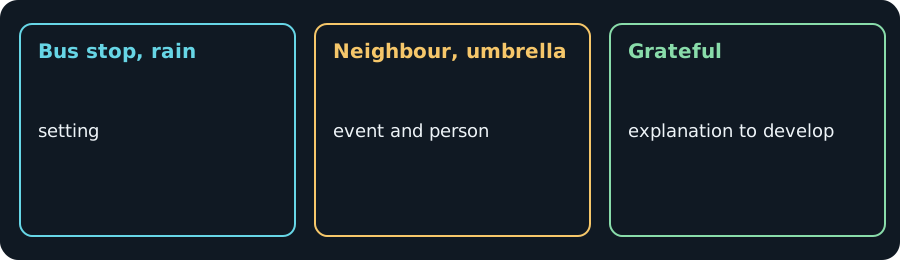
- Use notes to develop a relevant connected turn, choose grammar for the timeline and test the method on a new card.
Match the distinctions in this worked case.
Difficulty 2/5 · 140 coins + a small bonus on first completion today
Develop the explanation: “I remembered the kindness because the neighbour was also waiting in the rain, yet offered me the umbrella.” The feeling is connected to an event rather than added as a list of adjectives.
Which addition develops why the event mattered?
Difficulty 1/5 · 100 coins + a small bonus on first completion today
Original long-turn preparation: “bus stop / rain / borrowed umbrella / neighbour / returned next day / grateful”. These notes can cue where, what happened, who helped and why you remember it. Develop the explanation: “I remembered the kindness because the neighbour was also waiting in the rain, yet offered me the umbrella.” The feeling is connected to an event rather than added as a list of adjectives.
A new card asks about a useful object. Which response transfers the planning method?
Difficulty 1/5 · 100 coins + a small bonus on first completion today
Transfer keeps the method while changing the content to answer the new card.
Turn a cue into a reason the listener can follow
- Learning to cook: “Soup / aunt / salty / dinner” can cue an account, but “It was important because it was important” repeats an evaluation. “My aunt let me taste and adjust the soup, so I learned to check it myself” develops how she helped. “I could then prepare dinner when she worked late” explains a personal benefit.
- Quiet place: “Courtyard / wall / chapter / afternoon” can become “The wall reduces road noise, so I can follow a chapter without losing my place.” “It is beautiful, amazing and fantastic” adds evaluation without the same explanation. These are original possible accounts, not researched claims about cooking or courtyards.

Make a supported planning choice
- Ten guided written checks point to one useful decision: choose a route, develop the requested explanation, keep the timeline consistent or repair meaning. Follow the planning cue, choose, then read why the alternative does or does not serve that card.
- These are language-awareness choices, not official Speaking questions or a measure of your pronunciation. A plan is useful if it helps you speak; collecting elaborate notes is not a separate competitive sport.
Original card: describe a meal you learned to cook; say what it was, how you learned, what was difficult, and explain why learning it mattered. Notes: lentil soup / aunt showed / too much salt / shared family dinner. Planning cue: keep a route to the requested explanation.
Decision: Which notes add the missing explanation? Choose ONE answer.
Difficulty 1/5 · 100 coins + a small bonus on first completion today
The new cue links the skill to a useful change in the speaker’s life. Repeating topic words or widening into a food lecture does not explain why this learning mattered.
Original card: describe a quiet place where you like to read; say where it is, when you go, what you do there, and explain why you like it. Draft: “It is nice. It is very nice.” Planning cue: develop a relevant feature and its effect.
Decision: Which addition develops the reason? Choose ONE answer.
Difficulty 1/5 · 100 coins + a small bonus on first completion today
A place feature is connected to an effect on this speaker’s reading. Adjective repetition adds little explanation; the universal claim exceeds this personal account.
Original card: describe a useful object you own; say what it is, how you got it, how you use it, and explain why it is useful. Object: a small desk lamp. Planning cue: use the card points as prompts, not equal timed boxes.
Decision: What is a useful planning decision? Choose ONE answer.
Difficulty 1/5 · 100 coins + a small bonus on first completion today
Brief cues can support connected development. The points do not carry identical timed allocations or separately fixed marks in this lesson.
Original past-event card: describe a time you repaired something. Intended sequence: noticed loose wheel; had previously borrowed tools; tightened wheel; still use the case. Planning cue: choose grammar for each time.
Decision: Which sentence keeps that meaning? Choose ONE answer.
Difficulty 1/5 · 100 coins + a small bonus on first completion today
Had borrowed locates the borrowing earlier; still use describes the present. No tense earns credit merely by appearing: it must fit the intended timeline.
Original card: describe a person who taught you something; say who, what they taught, how, and explain why you remember them. Draft: “My cousin taught me to mend a pocket.” Planning cue: develop the teaching, not an unrelated biography.
Decision: Which addition connects method and effect? Choose ONE answer.
Difficulty 1/5 · 100 coins + a small bonus on first completion today
A specific action explains how the cousin helped the speaker learn. A biography detour or repeated praise does not develop the teaching.
Original card: describe a journey you remember; include where, who was with you, what happened, and why you remember it. Draft: “We missed the ferry, so we walked along the shore until the next departure.” Planning cue: connect later detail to the same event.
Decision: Which continuation remains relevant? Choose ONE answer.
Difficulty 1/5 · 100 coins + a small bonus on first completion today
The continuation develops what happened and why it was memorable. It does not turn one missed departure into a general claim about transport.
Original card: describe a useful skill you learned. You want to say “I used a ___ to make the wooden edge smooth” but cannot recall “sandpaper”. Planning cue: communicate the missing meaning.
Decision: Which repair keeps the account moving? Choose ONE answer.
Difficulty 1/5 · 100 coins + a small bonus on first completion today
A clear paraphrase preserves the intended tool and action. It is not proof of pronunciation quality, but it supports communication.
Original card: describe a visit that changed your view of a place. The real practice recording sounds rushed when listing details. Planning cue: use actual audio to choose a repair.
Decision: What is the most useful next attempt? Choose ONE answer.
Difficulty 1/5 · 100 coins + a small bonus on first completion today
Grouping can help a listener follow meaning. There is no universal speed or mandatory pause pattern; written notes cannot establish actual delivery or a band.
Original card: describe a useful present. The speaker says the present arrived last winter but later says they have used it for ten years. Planning cue: check a consistent timeline.
Decision: What should the speaker repair? Choose ONE answer.
Difficulty 1/5 · 100 coins + a small bonus on first completion today
The timeline changes the listener’s understanding. Repair that meaning before ornamental vocabulary; length alone does not make an account coherent.
Original card: describe an activity you tried for the first time. You revised the same pottery answer twice. Planning cue: distinguish revision from transfer.
Decision: What checks whether the method carries to a fresh task? Choose ONE answer.
Difficulty 1/5 · 100 coins + a small bonus on first completion today
Same-card revision shows work on that response. A fresh topic requires selecting and developing new content, which offers different evidence of flexible use.
Choose from a fresh card without a cue
- Ten independent written checks use new cards and short draft fragments. Decide what the actual question needs rather than applying a fixed story, tense list or sentence count. No planning hint is supplied.
- Then do the three deeper recorded tasks. The number of written checks is not a count of spoken performances. Recording, replay, a specific revision and a fresh card supply practice that choosing a radio button cannot.
Original card: describe a book you recommended; say what it is, who you recommended it to, what it is about, and explain why you recommended it. Draft: “It is a book about local birds. I told my cousin about it.”
Decision: What relevant development is still missing? Choose ONE answer.
Difficulty 1/5 · 100 coins + a small bonus on first completion today
The draft identifies book and reader, but the requested reason needs development. The cousin’s interests can supply a relevant connection without a universal claim.
Original card: describe a time you changed a plan; say what you planned, why it changed, what you did instead, and explain how you felt. Draft: “We planned a picnic. The path flooded, so we cooked at home.”
Decision: Which continuation answers the remaining requested aspect? Choose ONE answer.
Difficulty 1/5 · 100 coins + a small bonus on first completion today
The feeling and its development answer the final aspect. A broad flood lecture would leave this personal response unfinished.
Original card: describe a shop you like; include where it is, what it sells, when you go, and why you like it. You choose a repair shop rather than a supermarket.
Decision: Which addition develops why you like this repair shop without changing the chosen account? Choose ONE answer.
Difficulty 1/5 · 100 coins + a small bonus on first completion today
A relevant service feature explains the preference. A repair shop fits this practice card; there is no need to replace it with a memorised topic or invent a policy.
Original card: describe a new habit you developed. Intended meaning: you began walking to work in spring and continue now.
Decision: Which wording preserves that timeline? Choose ONE answer.
Difficulty 1/5 · 100 coins + a small bonus on first completion today
Past start plus present routine matches the intended meaning. Grammatical variety should follow meaning rather than a compulsory tense checklist.
Original card: describe a place where you learned something. You have already named a community workshop and its location.
Decision: Which detail develops learning rather than repeating identification? Choose ONE answer.
Difficulty 1/5 · 100 coins + a small bonus on first completion today
The action explains what happened in the workshop and how learning took place. Repeated naming does not develop the account.
Original card: describe someone you enjoy spending time with and explain why. Draft: “My uncle has a bicycle. The bicycle has two wheels.”
Decision: Which revision connects the detail to the question? Choose ONE answer.
Difficulty 1/5 · 100 coins + a small bonus on first completion today
The shared activity and the uncle’s behaviour explain why the speaker values the time. The object detail becomes useful when connected to that relationship.
Original card: describe a celebration you attended. During practice you say “last Friday” and realise you mean Saturday.
Decision: Which repair best protects meaning and continuity? Choose ONE answer.
Difficulty 1/5 · 100 coins + a small bonus on first completion today
A brief correction repairs the date and continues the account. This is no rule about a fixed score cost or a required number of corrections.
Original card: describe an object you would like to own and explain why. Your account is hypothetical.
Decision: Which sentence keeps that status clear? Choose ONE answer.
Difficulty 1/5 · 100 coins + a small bonus on first completion today
Would use fits a desired object and develops its possible benefit. Keep the chosen status consistent rather than forcing a past purchase or fabricated evidence.
Original card: describe a time you solved a problem. You have explained that you labelled identical storage boxes.
Decision: Which addition develops why the solution mattered? Choose ONE answer.
Difficulty 1/5 · 100 coins + a small bonus on first completion today
The consequence connects the solution to the problem. Repetition, a universal claim and an unrelated event do not supply that connection.
Original card: describe a place you would like to revisit and explain why. Your recording names many sights but never develops the reason for returning.
Decision: Which is the most useful revision target? Choose ONE answer.
Difficulty 1/5 · 100 coins + a small bonus on first completion today
The requested explanation is thin. More names do not repair it, and a transcript cannot certify pronunciation. Use actual audio for delivery review.
Record an account of a repair
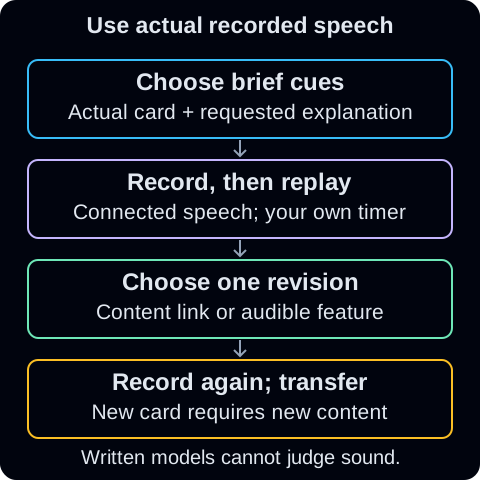
- The first original card asks about a repair: object, problem, actions and why it mattered. Use one minute for brief notes, then record a connected turn of up to two minutes with your own timer. The page does not enforce an exam clock. Stop and replay before opening the written illustrations.
- Recording needs browser microphone access; allow it only if you wish to use this recorder. Audio stays in this page, is not uploaded and disappears on reload. If access is unavailable, practise with your own recorder; the page cannot certify that external attempt. Compare content with the written examples and actual sound with the checklist. No model voice or automatic score is provided.
Original speaking card: Describe a time you repaired something. Say what it was, what the problem was, how you repaired it, and explain why the repair mattered to you.
Use one minute to make brief notes, then record a connected turn of up to two minutes with your own timer. Stop, play My recording, then open written guidance and compare. Use details you can develop; do not read a prepared speech. No automatic timing or speaking evaluation is provided.
Compare actual speech with the card and checklist. Same-card revision and a fresh-card attempt provide different evidence. This is self-review, not an examiner judgement.
Explain learning from another person
- This fresh card asks for the skill, the person, how they helped and why you value it. Choose a skill you can explain. “They are good and it was useful” can introduce a view, but a specific action and consequence develop it.
- Record before reading the models. Replay and identify one thin explanation or unclear connection in your own speech, then record a revision. The example about soup demonstrates decisions; it is not a speech to memorise or a guaranteed two-minute script.
Original speaking card: Describe a skill you learned from another person. Say what the skill was, who taught you, how they helped you learn, and explain why you value the skill.
Use one minute to make brief notes, then record a connected turn of up to two minutes with your own timer. Stop, play My recording, then open written guidance and compare. Use details you can develop; do not read a prepared speech. No automatic timing or speaking evaluation is provided.
Compare actual speech with the card and checklist. Same-card revision and a fresh-card attempt provide different evidence. This is self-review, not an examiner judgement.
Explain why a place suits you
- The third card concerns a place for quiet time: where, when, what you do and why it suits you. Change the content to fit the new card. A previously rehearsed repair account cannot become a place description merely by adding “at the courtyard”.
- Use your recording to notice whether the listener can follow the route and explanation. A written illustration cannot tell you how clearly you pronounced a word or where you actually paused. Use one-feature speech review for a practical repair loop.
Original speaking card: Describe a place where you like to spend quiet time. Say where it is, when you go, what you do there, and explain why the place suits you.
Use one minute to make brief notes, then record a connected turn of up to two minutes with your own timer. Stop, play My recording, then open written guidance and compare. Use details you can develop; do not read a prepared speech. No automatic timing or speaking evaluation is provided.
Compare actual speech with the card and checklist. Same-card revision and a fresh-card attempt provide different evidence. This is self-review, not an examiner judgement.
Transfer from a past account to a desired activity
- Try the new activity-you-would-like-to-try card before reopening the old examples. Choose content and grammar for a possible future activity rather than pretending every card describes a completed past event.
- Record, replay and revise one feature. There is no complete speech model for this transfer: written guidance helps check the planning choices after your attempt. Your own answer may develop a different activity, route and reason.
Original fresh speaking card: Describe an activity you would like to try. Say what it is, how you heard about it, how you would begin, and explain why you would like to try it.
On a fresh attempt, use one minute for notes and record up to two minutes with your own timer. Replay, compare and record one useful revision. These are local practice instructions; the page does not run an exam clock.
Fresh material tests whether you can choose and develop new content. The page records self-review only; no proficiency result is inferred.
Return on another day and use a new decision
- The later review card asks about a decision that helped you use time better. Return on another day before reopening examples. Make brief cues, record a fresh response, replay and revise one specific connection or audible feature. Same-card polish and unfamiliar-card practice answer different learning questions.
- Continue with familiar answers and broader discussion, or clarity review if the difficulty is audible delivery. Self-review completion is not a Speaking band or evidence that an independent listener understood you.
Source checked on 19 October 2026: official IELTS Speaking format. All new cards and written illustrations are originally authored local teaching material. Written illustrations have no calibrated speaking duration; no automatic pronunciation assessment, official task status or examiner rating is claimed.
Original fresh speaking card: Describe a decision that helped you use your time better. Say what you decided, when and why, what changed, and explain how you feel about the decision now.
On a fresh attempt, use one minute for notes and record up to two minutes with your own timer. Replay, compare and record one useful revision. These are local practice instructions; the page does not run an exam clock.
Fresh material tests whether you can choose and develop new content. The page records self-review only; no proficiency result is inferred.