Your learning plan · Continue · Review →
Short answers — find the right fact, then count
IntroducedYour saved position stays in this browser. Resuming does not complete the lesson or answer its questions.
Finding pages faster does not make every word correct
- Outcome: identify the requested person, place, count, action, time or reason, then copy a precise short answer within its instruction. Start with Reading orientation if these tasks are new. The archive’s faster search does not make every transcription correct.
- The archive project below is original practice. Read it once, then answer from its evidence rather than outside knowledge. Its sequence is preparation → index → search trial → result → remaining limitation; the initial questions follow that sequence. An archive keeps records; a short answer has less room for words.
In 2021, staff at Elm Town Library began digitising donated field notebooks. Each notebook was photographed before its pages went through text recognition. The originals stayed in a climate-controlled storeroom; researchers used scans. Volunteers added place names to a searchable index, but they did not correct the notebooks' spelling. To test the index, staff selected 60 notebooks and asked 12 students to find references to river floods. In the first trial, students found relevant pages in an average of nine minutes. After the index was added, the average fell to three minutes. The project team called this an improvement in access, not proof that every transcription was accurate. The search page therefore kept a button for reporting doubtful words.
In which year did the library begin digitising notebooks?
Difficulty 2/5 · 140 coins + a small bonus on first completion today
The first sentence states 2021. A date remembered from another project is irrelevant.
Locate the fact the question asks for
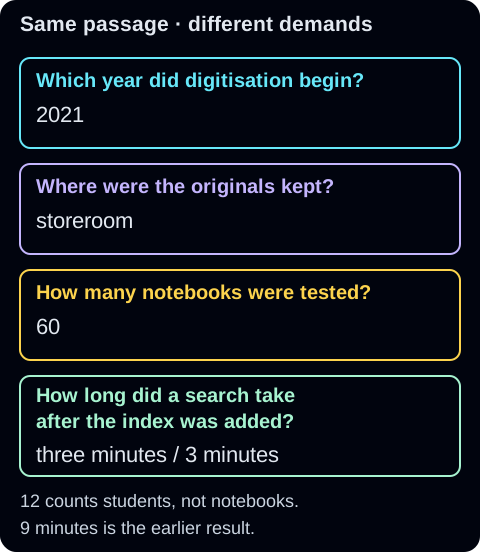
- Under NO MORE THAN TWO WORDS AND/OR A NUMBER FROM THE PASSAGE, “What year did digitisation begin?” takes 2021 from the opening. “Where were the original notebooks kept?” takes storeroom, not the researchers’ scans or a location remembered from another archive.
- Climate-controlled storeroom is also a valid two-word response here: the correctly hyphenated adjective counts as one word. Adding a makes three. Short-answer evidence follows information order in the official format guide; use the next relevant evidence rather than assuming every later noun is an answer.
Where were the original notebooks kept? NO MORE THAN TWO WORDS FROM THE PASSAGE.
Difficulty 1/5 · 100 coins + a small bonus on first completion today
Storeroom identifies the location; climate-controlled storeroom is also copied from the passage and fits two words because climate-controlled is one correctly hyphenated word.
Count words and numbers after finding the fact
- “How many notebooks were selected?” takes 60, not 12, which counts students. “What kind of event did students search for?” takes river floods, two copied words. Flooding near the river is neither the requested copied phrase nor within that two-word limit.
- “How long did finding pages take after the index was added?” takes three minutes or 3 minutes. Nine minutes is the earlier result. A number alone does not supply the unit for this duration question. Match the question’s noun and time before checking response length.
How many NOTEBOOKS were selected for the index test?
Difficulty 1/5 · 100 coins + a small bonus on first completion today
60 notebooks were selected. Twelve counts students; nine measures the earlier search time in minutes.
What kind of event did the students look for? NO MORE THAN TWO WORDS FROM THE PASSAGE.
Difficulty 1/5 · 100 coins + a small bonus on first completion today
The passage says 'references to river floods'. Those two words name the event exactly.
Do not turn a faster search into perfect accuracy
- The team reports quicker access but does not claim that every transcription is accurate. It retains a report button for doubtful words. A question about the unverified outcome needs that limit rather than the attractive time improvement.
- Distinguish selecting the wrong fact from copying the right fact in the wrong form. A count of students does not answer a count of notebooks, even when its spelling and length are perfect. An answer about accuracy is not repaired by substituting a shorter search time.
- Check the question’s noun and time qualifier together: 60 notebooks differs from 12 students; after the index differs from before it.
Because search time fell, the team concluded that every transcription was accurate.
Difficulty 1/5 · 100 coins + a small bonus on first completion today
The passage explicitly separates improved access from transcription accuracy and keeps a way to report doubtful words.
A four-check routine
- First identify the question word and requested noun or relationship; then locate its evidence, using information order where applicable. Who, where, how many, how long and why can require different facts from the same paragraph.
- Next copy a precise answer, keeping any necessary modifier or unit; finally check source wording, spelling and the instruction. The shortest response is useful only when it still identifies the requested fact. Count what you enter, not words already in the question.
- A complete short answer identifies the requested fact, comes from the passage when instructed, and fits the stated limit. A related fact remains the wrong answer.
Source checked on 19 October 2026: official IELTS Reading guide, short-answer questions.
A faster search is a different outcome from accurate text
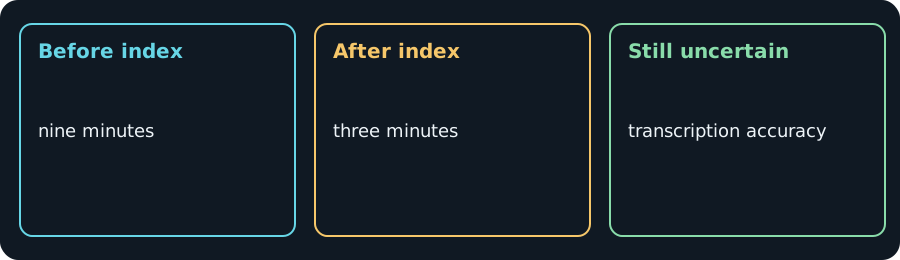
- The archive trial falls from nine minutes to three: a six-minute reduction in finding pages. This does not prove that all transcribed words are correct.
- The report button still invites readers to flag doubtful words. Match the question’s demand to the fact or limit, then check the response instruction.

View the original archive case at full size
- Apply that distinction to the initial checks. The later questions use fresh original contexts; none is an official item or a band prediction.
Match the distinctions in this worked case.
Difficulty 2/5 · 140 coins + a small bonus on first completion today
The report button still invites users to flag doubtful words. A question about accuracy needs that limit, not the attractive time improvement.
What does the faster trial establish in the passage?
Difficulty 1/5 · 100 coins + a small bonus on first completion today
The archive trial falls from nine minutes to three. That is a six-minute reduction in finding pages. It does not prove that the transcribed notebook words are all correct. The report button still invites users to flag doubtful words. A question about accuracy needs that limit, not the attractive time improvement.
Three worked contrasts: person, reason and necessary detail
- Original case: “Mara prepared the proposal. Ali approved it after comparing the estimates.” Who approved it? takes Ali, not the proposal’s author. Original case: “The pool closed because of roof leaks; staff moved the lesson to another building.” Why did the pool close? takes roof leaks, not the later move. Both fit a two-word maximum, but they answer different demands.
- Original case: “Seeds stayed in the north store; tools were placed in the south store.” Where were seeds kept? takes north store under a two-word limit. Store alone cannot distinguish the two. In the archive’s original question, storeroom already identifies the place, so its adjective is optional. Do not turn “short answer” into “remove every modifier”.

Guided short answers: identify the demand before the response
- The next ten original tasks provide a reading cue. Name the person, place, action, count, duration, cause or condition required, then read the exact instruction. The numeric tasks explicitly allow digits or number words; durations need their units where the question does not supply one.
- Feedback distinguishes evidence selection from source/form and limit errors. Some copied phrases have a shorter valid alternative; others need a modifier to avoid ambiguity. The checker uses an authored answer list, not an unrestricted judgement of every possible English response.
Original passage: Lena approved the purchase after checking the quotations. Uma installed the equipment once it arrived.
Question: Who approved the purchase?
Instruction: ONE WORD ONLY FROM THE PASSAGE.
Reading cue: Identify the action attached to each person.
Difficulty 1/5 · 100 coins + a small bonus on first completion today
Lena gives approval; Uma performs the installation. The question asks for the authorising person, not the later installer.
Original passage: The original charts remained in the storeroom. Copies were displayed in the meeting hall.
Question: Where were the original charts kept?
Instruction: ONE WORD ONLY FROM THE PASSAGE.
Reading cue: Keep original and copy separate.
Difficulty 1/5 · 100 coins + a small bonus on first completion today
Storeroom identifies the originals’ location. Meeting hall concerns displayed copies and would also use two words under this direction.
Original passage: Twenty crates were loaded by six carriers. Each carrier made several trips between the rooms.
Question: How many crates were loaded?
Instruction: WRITE A NUMBER. Digits or number words are accepted in this local task.
Reading cue: Attach the number to the requested noun.
Difficulty 1/5 · 100 coins + a small bonus on first completion today
Twenty/20 counts crates. Six counts carriers; several describes trips without giving a count.
Original passage: The first search took ten minutes. After the index was revised, the same search task took six minutes.
Question: How long did the search take after the revision?
Instruction: NO MORE THAN TWO WORDS AND/OR A NUMBER FROM THE PASSAGE.
Reading cue: Use the time qualifier before copying a duration.
Difficulty 1/5 · 100 coins + a small bonus on first completion today
Six minutes/6 minutes is the later duration. Ten minutes is earlier, and six alone omits the unit needed by how long.
Original passage: The lower path closed because flooding covered its entrance. The upper path remained open while staff checked the lower one.
Question: Why was the lower path closed?
Instruction: ONE WORD ONLY FROM THE PASSAGE.
Reading cue: Distinguish a reason from an action taken afterwards.
Difficulty 1/5 · 100 coins + a small bonus on first completion today
Flooding is the stated cause. Checking is the later staff response, not the cause of closure.
Original passage: The temporary collection desk moved into the ticket office. The main office continued handling staff paperwork.
Question: Where was the temporary collection desk placed?
Instruction: NO MORE THAN TWO WORDS FROM THE PASSAGE.
Reading cue: A shorter answer must still distinguish the requested place.
Difficulty 1/5 · 100 coins + a small bonus on first completion today
Ticket office distinguishes the collection location from the main office. Office alone does not identify which of the two is meant; the modifier is needed here.
Original passage: The trial ran in July. The permanent display opened in August after the team reviewed the trial findings.
Question: In which month did the permanent display open?
Instruction: ONE WORD ONLY FROM THE PASSAGE.
Reading cue: Keep trial and permanent opening distinct.
Difficulty 1/5 · 100 coins + a small bonus on first completion today
August is the permanent opening; July is the trial month. A nearby earlier event is not the requested one.
Original passage: Staff sealed the envelopes before moving the boxes. They labelled the boxes once the move was complete.
Question: What was done to the envelopes before the move?
Instruction: ONE WORD ONLY FROM THE PASSAGE.
Reading cue: Check both object and stage.
Difficulty 1/5 · 100 coins + a small bonus on first completion today
Sealed describes the earlier envelope action. Labelled belongs to boxes after the move.
Original passage: Participants had to bring gloves. Aprons were provided for those who wanted them but were not compulsory.
Question: Which protective items were compulsory?
Instruction: ONE WORD ONLY FROM THE PASSAGE.
Reading cue: Separate compulsory from available.
Difficulty 1/5 · 100 coins + a small bonus on first completion today
Gloves are required; aprons are optional. Glove changes the copied plural, and the gloves exceeds the one-word direction.
Original passage: The index made the notebooks easier to locate, but the trial did not check spelling. The report invited readers to flag doubtful words.
Question: What remained unchecked by the trial?
Instruction: ONE WORD ONLY FROM THE PASSAGE.
Reading cue: Answer the unmeasured outcome rather than its neighbouring benefit.
Difficulty 1/5 · 100 coins + a small bonus on first completion today
Spelling is explicitly unchecked. Improved location of notebooks is a measured access benefit, not evidence that the words are correct.
Independent questions: twenty new mini-passages
- Each question has a distinct original mini-passage and no reading cue. Type before checking. Do not substitute the first name, nearest number, earlier month or a stated but unmeasured outcome. A proposed action, an approval and its later implementation may belong to different people.
- These focused tasks do not measure all the navigation and timing demands of a full Reading paper. Spread the lesson across sessions if useful and use its saved-position choice deliberately. Remembering a response from another passage is not evidence for the new question.
Original passage: Eli approved the new display layout. Uma fitted the panels to that layout, while Ben prepared the opening notice.
Question: Who fitted the panels?
Instruction: ONE WORD ONLY FROM THE PASSAGE.
Difficulty 1/5 · 100 coins + a small bonus on first completion today
Uma fits the panels; Eli approves and Ben prepares a notice. Preserve the requested action rather than copying the first name.
Original passage: The original letters stayed in the vault. Scans went to the gallery, where visitors could examine them on screens.
Question: Where were the original letters kept?
Instruction: ONE WORD ONLY FROM THE PASSAGE.
Difficulty 1/5 · 100 coins + a small bonus on first completion today
Vault is the originals’ location. Gallery contains the scans, not the original letters.
Original passage: Twelve notebooks were examined by eight students. The students worked in pairs but each notebook received its own record.
Question: How many notebooks were examined?
Instruction: WRITE A NUMBER. Digits or number words are accepted in this local task.
Difficulty 1/5 · 100 coins + a small bonus on first completion today
Twelve/12 counts notebooks. Eight counts students, and working in pairs does not change the notebook total.
Original passage: Finding a file took eight minutes before the tags were added. Afterwards the average fell to five minutes.
Question: How long did finding a file take before tagging?
Instruction: NO MORE THAN TWO WORDS AND/OR A NUMBER FROM THE PASSAGE.
Difficulty 1/5 · 100 coins + a small bonus on first completion today
Eight minutes/8 minutes is the before duration. Five minutes belongs to afterwards; a number alone would omit the unit.
Original passage: The side path was closed after inspectors found loose stones overhead. The main path stayed open while the stones were secured.
Question: Why was the side path closed?
Instruction: NO MORE THAN TWO WORDS FROM THE PASSAGE.
Difficulty 1/5 · 100 coins + a small bonus on first completion today
Loose stones names the hazardous condition causing closure. Stones alone omits what made them a reason to close, and securing them is the response.
Original passage: School groups entered through the west gate. Suppliers used the east gate to reach the loading area.
Question: Which gate did school groups use?
Instruction: NO MORE THAN TWO WORDS FROM THE PASSAGE.
Difficulty 1/5 · 100 coins + a small bonus on first completion today
West gate distinguishes the pupils’ entrance from the suppliers’ east gate. Gate alone does not settle which one.
Original passage: The public consultation began in October. Work on the new room started in December once the plans were approved.
Question: In which month did consultation begin?
Instruction: ONE WORD ONLY FROM THE PASSAGE.
Difficulty 1/5 · 100 coins + a small bonus on first completion today
October begins consultation; December begins construction. The question names the earlier process, not the building work.
Original passage: The demonstration plug was made from cork. The permanent fitting used metal so visitors could compare the two materials.
Question: What material was used for the demonstration plug?
Instruction: ONE WORD ONLY FROM THE PASSAGE.
Difficulty 1/5 · 100 coins + a small bonus on first completion today
Cork belongs to the demonstration plug. Metal is the permanent fitting’s material, a different version.
Original passage: The coating left fewer marks in a short trial. Long-term durability was not assessed, so the team withheld a claim about years of use.
Question: What property was not assessed?
Instruction: ONE WORD ONLY FROM THE PASSAGE.
Difficulty 1/5 · 100 coins + a small bonus on first completion today
Durability is the unassessed property. Fewer marks is an observed short-term result and does not answer the negative question.
Original passage: The observers began counting at dawn. Calibration had been completed earlier, while the site was still dark.
Question: When did counting begin?
Instruction: ONE WORD ONLY FROM THE PASSAGE.
Difficulty 1/5 · 100 coins + a small bonus on first completion today
Dawn starts counting. The earlier darkness belongs to calibration, not the start of observations.
Original passage: Ana Reed approved the revised schedule. Jon Reed requested another consultation before the next expansion.
Question: What is the full name of the person who approved the schedule?
Instruction: NO MORE THAN TWO WORDS FROM THE PASSAGE.
Difficulty 1/5 · 100 coins + a small bonus on first completion today
Ana Reed is the approving person’s full name. Reed alone cannot distinguish the two people, while Jon Reed performs a different action.
Original passage: Fourteen recordings were checked by three readers. Each recording was heard twice before the notes were compared.
Question: How many recordings were checked?
Instruction: WRITE A NUMBER. Digits or number words are accepted in this local task.
Difficulty 1/5 · 100 coins + a small bonus on first completion today
Fourteen/14 counts recordings. Three counts readers and twice is the number of listens, not recordings.
Original passage: Borrowers must complete training before taking the recorder. A booking alone does not meet that requirement.
Question: What must borrowers complete before the loan?
Instruction: ONE WORD ONLY FROM THE PASSAGE.
Difficulty 1/5 · 100 coins + a small bonus on first completion today
Training is the required preparation. Booking is explicitly insufficient by itself.
Original passage: The samples used for the trial stayed in the cool room. Spare containers were kept in the warm room next door.
Question: Where were the trial samples stored?
Instruction: NO MORE THAN TWO WORDS FROM THE PASSAGE.
Difficulty 1/5 · 100 coins + a small bonus on first completion today
Cool room distinguishes the samples’ location from the warm room holding containers. Room alone is ambiguous.
Original passage: Waterproof jackets were required for the trip. Reflective jackets were available for a separate indoor demonstration but were not required on the trip.
Question: What type of jacket was required for the trip?
Instruction: NO MORE THAN TWO WORDS FROM THE PASSAGE.
Difficulty 1/5 · 100 coins + a small bonus on first completion today
Waterproof and waterproof jackets both identify the required type within the limit. Reflective belongs to a different optional activity; jackets alone does not identify the type.
Original passage: The organisers first considered replacement of the platform. After a carpenter examined it, they chose repair instead and postponed any purchase.
Question: Which option did the organisers select?
Instruction: ONE WORD ONLY FROM THE PASSAGE.
Difficulty 1/5 · 100 coins + a small bonus on first completion today
Repair is the selected option. Replacement is the earlier possibility, not the final choice described.
Original passage: An explanatory caption was added below the photograph. Its frame and position were left unchanged.
Question: What was added to the display?
Instruction: NO MORE THAN TWO WORDS FROM THE PASSAGE.
Difficulty 1/5 · 100 coins + a small bonus on first completion today
Caption and explanatory caption both name the addition. Frame and position are unchanged, and the explanatory caption would exceed two words.
Original passage: The trial measured waiting time at the entrance. Walking time from the car park was discussed but not measured.
Question: What did the trial measure?
Instruction: NO MORE THAN TWO WORDS FROM THE PASSAGE.
Difficulty 1/5 · 100 coins + a small bonus on first completion today
Waiting time is measured. Walking time is unmeasured, and time alone does not distinguish the two outcomes named in this passage.
Original passage: The report covered summer observations. Winter remained unmeasured because no readings from that season survived.
Question: Which season was unmeasured?
Instruction: ONE WORD ONLY FROM THE PASSAGE.
Difficulty 1/5 · 100 coins + a small bonus on first completion today
Winter is the missing season. Summer supplies the report’s observations rather than the requested limitation.
Original passage: Nora proposed moving the workshop. Mina requested an access check before a decision; Eli asked for delivery estimates.
Question: Who requested an access check?
Instruction: ONE WORD ONLY FROM THE PASSAGE.
Difficulty 1/5 · 100 coins + a small bonus on first completion today
Mina requests the access check. Nora proposes relocation and Eli asks about delivery; each person has a separate role.
Transfer: follow authorisation, location and an unassessed outcome
- The letter-exhibition passage has three questions in information order. For each answer, write ONE WORD ONLY FROM THE PASSAGE. Distinguish the person authorising the exhibition, the originals’ location and the outcome that the index trial did not assess.
- The complete passage repeats so each question can be reviewed on its own, but it remains one shared source, not three independent passages. Keep scanning for the requested relation rather than assigning a nearby word simply because it follows your previous answer.
Original passage — a letter exhibition
Asha authorised the exhibition after Noel prepared the proposal. The original letters remained in the vault while scans were shown in the library.
An index helped visitors locate a page more quickly. The trial measured search time but did not assess transcription accuracy.
For each question, write ONE WORD ONLY FROM THE PASSAGE. Questions follow the passage’s information order. The complete passage repeats for later review; it is one shared text, not three independent passages.
Question: Who authorised the exhibition?
Difficulty 1/5 · 100 coins + a small bonus on first completion today
Asha authorises; Noel prepares the proposal. Approval and proposal are distinct actions.
Original passage — a letter exhibition
Asha authorised the exhibition after Noel prepared the proposal. The original letters remained in the vault while scans were shown in the library.
An index helped visitors locate a page more quickly. The trial measured search time but did not assess transcription accuracy.
For each question, write ONE WORD ONLY FROM THE PASSAGE. Questions follow the passage’s information order. The complete passage repeats for later review; it is one shared text, not three independent passages.
Question: Where were the original letters kept?
Difficulty 1/5 · 100 coins + a small bonus on first completion today
Vault holds the originals; library is the location of the exhibited scans.
Original passage — a letter exhibition
Asha authorised the exhibition after Noel prepared the proposal. The original letters remained in the vault while scans were shown in the library.
An index helped visitors locate a page more quickly. The trial measured search time but did not assess transcription accuracy.
For each question, write ONE WORD ONLY FROM THE PASSAGE. Questions follow the passage’s information order. The complete passage repeats for later review; it is one shared text, not three independent passages.
Question: What outcome did the trial leave unassessed?
Difficulty 1/5 · 100 coins + a small bonus on first completion today
Accuracy is unassessed. Search time is measured; transcription accuracy would exceed the one-word direction here.
Repair a count attached to the wrong noun
- The private task asks how many tables were delivered. Separate tables from chairs, carriers and duration; then explain why the nearby count and time value answer other questions. Draft before comparing the model, and revise one noun or response-form mismatch.
- Digits and the stated number word can both fit the local direction. Explanatory wording can vary while preserving the source quantities. Your draft stays in this page; copy it before leaving. Recorded self-review is reflection, not automatic correctness, proficiency or an IELTS score.
Original passage: Thirty chairs and twelve tables were delivered to the hall. Six carriers completed the work in three hours.
Question: How many tables were delivered?
Instruction: WRITE A NUMBER. Digits or number words are accepted in this local task.
A reader answers “30”. Write the supported short response and explain in two sentences why 30 and three hours answer different questions. Draft before comparing the model, then revise one noun or response-form mismatch. Your draft stays in this page; copy it before leaving.
Digits and the stated number word are both valid here. Compare noun, count and response form rather than identical explanatory wording. Recording self-review is not automatic correctness or an IELTS score.
Later review: a preparation stage and a regular opening
- After a break, try the two new passages without reopening the examples. Name the question word and the evidence that excludes the nearest alternative. A trial month does not become the regular opening, and a later comparison does not become an earlier preparation stage.
- Continue with sentence completion to check a copied word inside a supplied sentence, or matching information to locate a requested relationship by paragraph. Source checked on 19 October 2026: official IELTS Reading guidance. These original tasks still require independent specialist review and learner trials.
New original passage: Calibration was completed before the field readings began. Staff compared the readings only after every station had submitted its record.
Question: Which preparation stage preceded the field readings?
Instruction: ONE WORD ONLY FROM THE PASSAGE.
Difficulty 1/5 · 100 coins + a small bonus on first completion today
Calibration precedes readings. Comparison occurs after the station records arrive, a later stage.
New original passage: The workshop trial took place in March. The regular public sessions began in June after staff reviewed the trial.
Question: In which month did regular public sessions begin?
Instruction: ONE WORD ONLY FROM THE PASSAGE.
Difficulty 1/5 · 100 coins + a small bonus on first completion today
June is the regular opening; March belongs to the trial. Preserve the event as well as the month.