Newton's First Law
Introduced| English |
|---|
| inertia/ɪˈnɜːʃə/ |
| mass/mæs/ |
| equilibrium/ˌiːkwɪˈlɪbrɪəm/ |
Yank the tablecloth — the dishes stay put
- Whip a tablecloth out fast and the plates barely move.
- They "want" to stay where they are — that reluctance to change motion is inertia 惯性.
- Newton's first law: an object keeps its velocity unless a net force acts on it.
- At rest it stays at rest; moving, it keeps moving in a straight line at constant speed.
Inertia and mass
- Inertia is an object's resistance to any change in its motion.
- Mass 质量 is the measure of inertia — more mass, harder to speed up, slow down, or turn.
- A loaded truck is far harder to stop than a bicycle at the same speed.
- Inertia is why you lurch forward when a car brakes: your body keeps its velocity.
An object's resistance to a change in its motion is called ____.
Inertia is that resistance, and mass is its measure.
At the same speed, which is harder to stop — and therefore has more inertia?
More mass means more inertia. The heavy truck resists stopping far more than the bicycle.
Balanced forces mean constant velocity
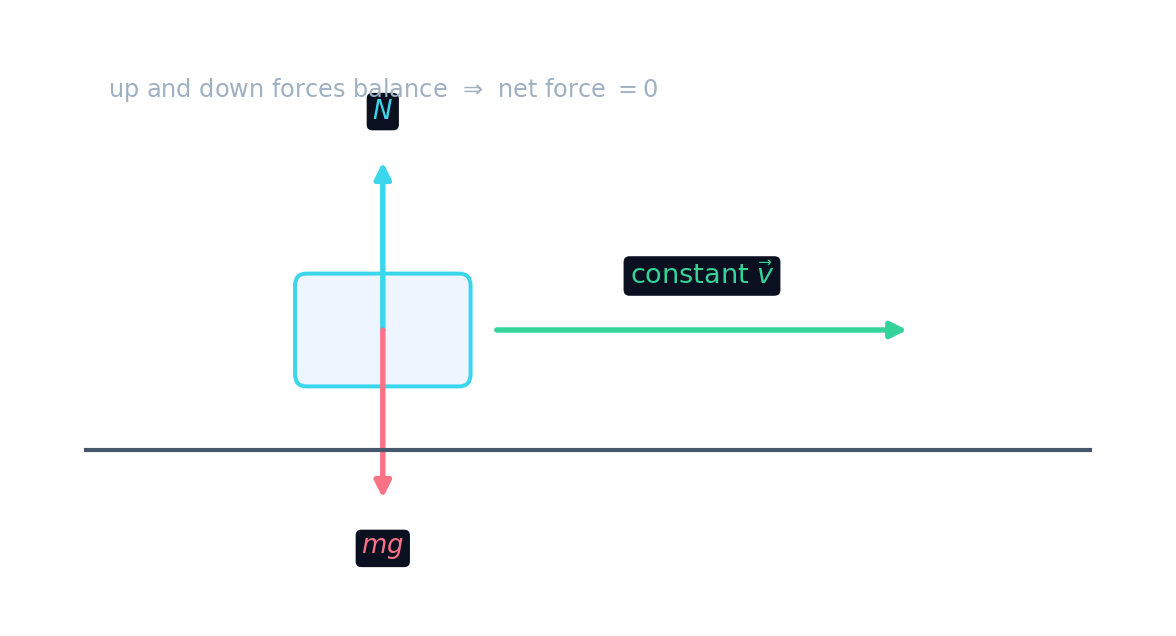
- If the forces on an object balance, the net force is zero.
- Zero net force ⇒ zero acceleration ⇒ constant velocity (an equilibrium 平衡).
- "At rest" is just the special case of constant velocity equal to zero.
- So no force is needed to keep moving — only to change the motion.
Balance the forces
Reduce the applied force and friction to zero and see the net force vanish — constant velocity.
An object has zero net force acting on it. What must be true of its motion?
Zero net force ⇒ zero acceleration ⇒ constant velocity. Rest is the special case where that velocity is zero.
A box feels $8\ \text{N}$ up, $8\ \text{N}$ down, $5\ \text{N}$ right and $5\ \text{N}$ left. What is the net force, in $\text{N}$?
Each pair cancels ($8-8=0$, $5-5=0$), so the net force is $0\ \text{N}$ — the box is in equilibrium.
Select all objects that are in equilibrium (zero net force).
Rest and constant-velocity motion both mean zero net force. The falling ball is accelerating, so it is not in equilibrium.
Coasting forever
- A spacecraft far from any star cuts its engines and drifts on, unchanged, for years.
- With no friction and no net force, nothing slows it — the first law in its purest form.
- On Earth, friction and air resistance are the "hidden" forces that eventually stop things.
- Remove them (ice, space) and motion simply continues.
A moving object does not need a continuous force to keep moving. The old intuition "things stop unless you keep pushing" is really about friction quietly opposing the motion. Take friction away and no push is needed at all.
A moving object needs a continuous forward force just to keep moving at constant velocity.
No net force is needed to keep constant velocity. It only feels that way on Earth because friction opposes the motion.
A puck slides on frictionless ice with the only vertical forces being weight down and the normal force up.
- Those two balance, so the net force is zero.
- The puck therefore glides at constant velocity forever — no push required.
Newton's first law: with zero net force, an object keeps a constant velocity (rest is the zero case). Inertia is resistance to that change, measured by mass. Motion continues on its own; a net force is needed only to change it.