Newton's Second Law
Introduced| English |
|---|
| mass/mæs/ |
The same shove — a feather flies, a fridge barely budges
- Give a feather a gentle push and it shoots off; give a fridge the same push and it hardly moves.
- Same force, wildly different results — the difference is mass 质量.
- Newton's second law ties them together: force, mass and acceleration in one equation.
- It is the engine of mechanics: give me the forces and the mass, and I'll give you the motion.
The equation
- The net force equals mass times acceleration: $\vec F_{\text{net}} = m\,\vec a$.
- Rearranged: $\vec a = \dfrac{\vec F_{\text{net}}}{m}$ — acceleration is what the net force produces.
- The acceleration points in the same direction as the net force.
- It is the net force that counts, never one force in isolation.
What net force gives a $2\ \text{kg}$ object an acceleration of $5\ \tfrac{\text{m}}{\text{s}^2}$? Answer in $\text{N}$.
$F = ma = 2 \times 5 = 10\ \text{N}$.
Two proportions inside one law
- More force, more acceleration: $a \propto F$ (double the force, double the acceleration).
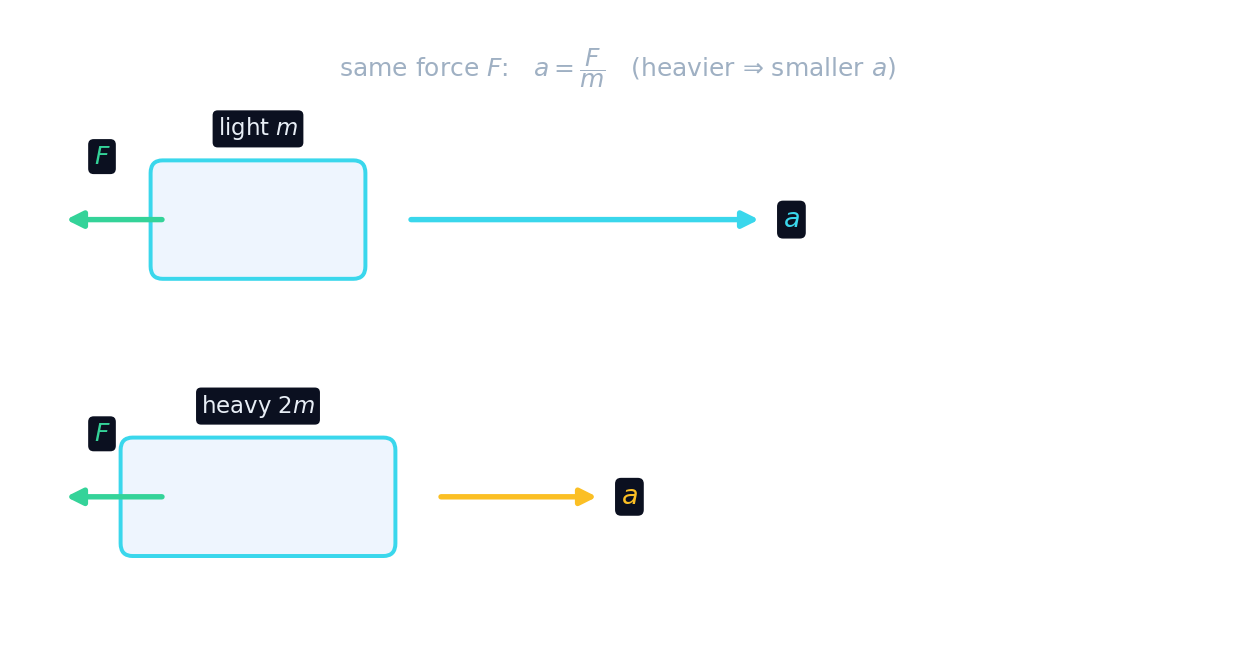
- More mass, less acceleration: $a \propto \dfrac{1}{m}$ (double the mass, halve the acceleration).
- So a light cart leaps ahead while a heavy one crawls under the same push.
- Heavy objects are "sluggish" precisely because $a = F/m$ shrinks as $m$ grows.
Net force sets the acceleration
Raise the applied force or the mass and watch how the net force and the acceleration change.
A net force of $12\ \text{N}$ acts on a $3\ \text{kg}$ trolley. What is its acceleration, in $\tfrac{\text{m}}{\text{s}^2}$?
$a = F_{\text{net}}/m = 12/3 = 4\ \tfrac{\text{m}}{\text{s}^2}$.
If you double the net force on an object but keep its mass the same, its acceleration:
Since $a = F/m$ and $m$ is fixed, $a \propto F$: doubling the force doubles the acceleration.
Doubling the mass while keeping the same net force halves the acceleration.
$a = F/m$, so $a \propto 1/m$: double the mass, half the acceleration.
Units and weight
- $1\ \text{N} = 1\ \text{kg} \cdot \tfrac{\text{m}}{\text{s}^2}$ — the newton is defined by this law.
- Weight is just the second law applied to gravity: $W = mg$.
- Mass ($\text{kg}$) measures inertia; weight ($\text{N}$) is a force — do not confuse them.
- On the Moon your mass is unchanged, but your weight is about one-sixth.
Complete the definition: $1\ \text{N} = 1\ \text{kg} \cdot$ ____ (write the units).
From $F = ma$, $1\ \text{N} = 1\ \text{kg} \cdot 1\ \tfrac{\text{m}}{\text{s}^2}$.
You travel from Earth to the Moon. Which of these changes?
Mass (inertia) is unchanged; weight $W = mg$ drops because the Moon's $g$ is about one-sixth of Earth's.
Use the net force in $F = ma$, not a single force. If several forces act, add them as vectors first. And remember mass is not weight: mass is in kilograms, weight is a force in newtons ($W = mg$).
A net force of $12\ \text{N}$ acts on a $3\ \text{kg}$ trolley.
- $a = \dfrac{F_{\text{net}}}{m} = \dfrac{12}{3} = 4\ \tfrac{\text{m}}{\text{s}^2}$.
Keep the same force but double the mass to $6\ \text{kg}$, and the acceleration halves to $2\ \tfrac{\text{m}}{\text{s}^2}$.
Newton's second law: $\vec F_{\text{net}} = m\vec a$, so $\vec a = \vec F_{\text{net}}/m$ in the direction of the net force. Acceleration grows with force ($a\propto F$) and shrinks with mass ($a\propto 1/m$). $1\ \text{N} = 1\ \text{kg}\cdot\text{m/s}^2$; weight is $W = mg$.