Price Elasticity of Supply
Introduced| English |
|---|
| price elasticity of supply/praɪs ɪlæˈstɪsɪti ɒv səˈplaɪ/ |
| midpoint (arc) method/ˈmɪdpɔɪnt ˈmeθəd/ |
| elastic/ɪˈlæstɪk/ |
| perfectly inelastic/ˈpɜːfektlɪ ɪnɪˈlæstɪk/ |
| inelastic/ɪnɪˈlæstɪk/ |
| perfectly elastic/ˈpɜːfektlɪ ɪˈlæstɪk/ |
| time horizon/taɪm həˈraɪzn/ |
| spare capacity/speə kəˈpæsɪti/ |
Can sellers react in time?
- A price jump is an invitation to sell more — but can sellers actually do it?
- A baker can bake extra loaves by tonight; an oil field takes years to expand.
- How quickly quantity supplied responds to price is its own kind of elasticity.
- It is called price elasticity of supply 供给价格弹性 (PES).
Measuring PES
- PES answers: "if price changes by 1%, by what % does quantity supplied change?"
- Formula: $\text{PES} = \dfrac{\%\,\Delta\,\text{quantity supplied}}{\%\,\Delta\,\text{price}}$.
- Because price and quantity supplied move together, PES is normally positive.
- Use the same midpoint (arc) method 中点法 as PED: divide each change by the average of the two values.
Price elasticity of supply is normally:
Supply obeys a direct relationship, so PES is positive.
Price rises causing a 30% rise in quantity supplied and a 10% rise in price. What is PES?
$\text{PES} = 30\% \div 10\% = 3$ — elastic supply.
From elastic to perfectly inelastic
- Elastic 富有弹性: $\text{PES} > 1$ — output changes a lot. Inelastic 缺乏弹性: $\text{PES} < 1$ — output barely moves.
- Perfectly elastic 完全弹性: $\text{PES} = \infty$, a horizontal line — any amount at one price.
- Perfectly inelastic 完全无弹性: $\text{PES} = 0$, a vertical line — a fixed quantity no matter the price.
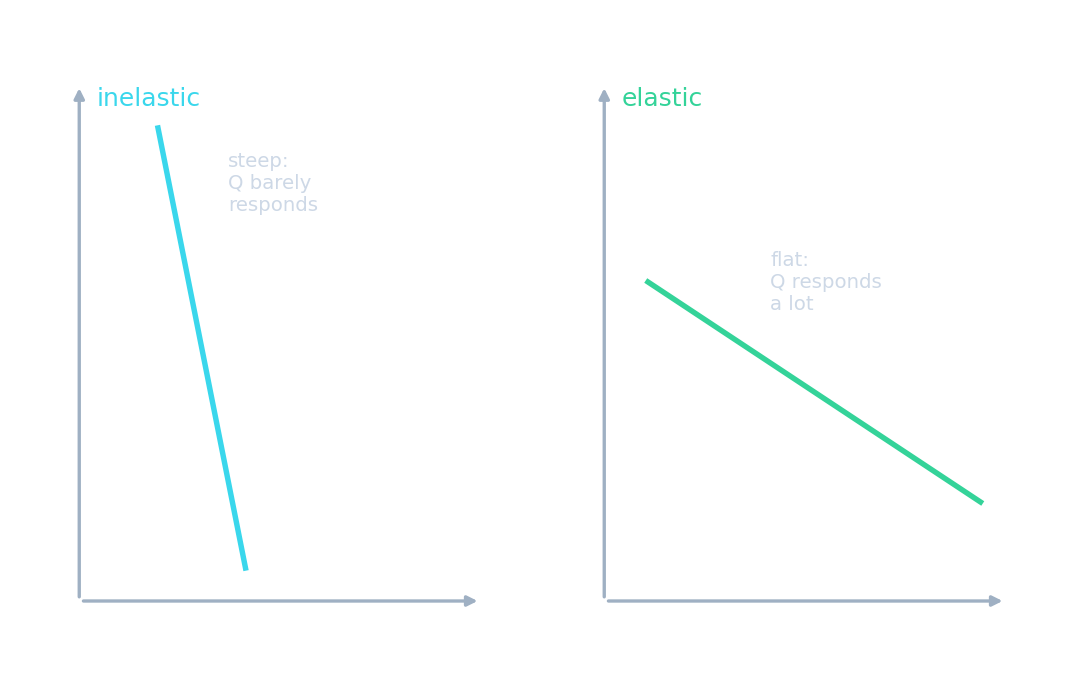
Elastic or inelastic supply?
Supply is more elastic when firms can change output quickly — with spare capacity or plenty of time. It is inelastic when quantity is fixed.
A supply curve drawn as a vertical line has a PES of:
A vertical supply means quantity is fixed no matter the price — PES = 0.
What makes supply elastic
- Time horizon 时间跨度: given more time, firms build, hire, and adjust — so supply is far more elastic in the long run.
- Spare capacity 闲置产能: idle machines and spare workers let a firm raise output quickly.
- With no spare capacity and no time, supply is stuck — inelastic.
Supply is usually more elastic in the long run than in the short run.
Given more time, firms can build capacity and hire, so output responds more.
Idle machines and unused workers give a firm ______ capacity, which makes supply more elastic.
Spare capacity lets output rise quickly when price rises.
Select all that make supply more elastic.
Time, spare capacity and easy storage all let quantity respond; a fixed quantity is inelastic.
PES = %ΔQ supplied ÷ %ΔP (normally positive, via the midpoint method). $\text{PES}>1$ is elastic, $<1$ inelastic; a horizontal curve is perfectly elastic, a vertical one perfectly inelastic. Supply is more elastic with more time and spare capacity.